
Follow Us
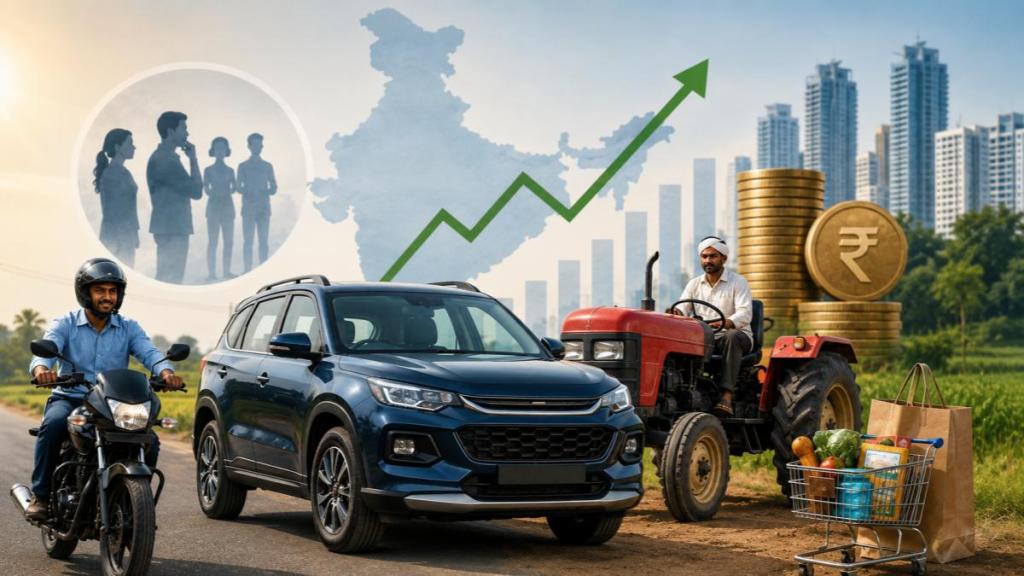
India’s demand story is throwing up an unusual split. Consumers are still buying cars, two-wheelers and tractors at a brisk pace but the labour market that normally underpins household spending looked softer through the first quarter of 2026-27.
Retail passenger vehicle sales rose 19.1% year-on-year in July, tractor sales jumped 28.1% and two-wheeler sales climbed 28.3%, according to data compiled in the Reserve Bank of India’s August Bulletin. Overall retail automobile sales grew 25.9%. The RBI assessment said domestic demand remained strong during July, supported by rural consumption, while urban demand also stayed firm.
Yet the labour-market numbers for the preceding quarter were softer. The labour force participation rate (LFPR), which measures the share of the working-age population either employed or looking for work, fell to 54.6% in April-June 2026 from 55.5% in January-March. The worker population ratio (WPR) declined to 51.7% from 52.8%, while unemployment increased to 5.4% from 5%.
The RBI’s bulletin described labour-market conditions as having “softened” in the quarter, with the deterioration driven largely by rural areas.
ALSO READIndia shows 6 signs of growth momentum, but there are 2 big risks
When we see those numbers next to the surge in purchases of cars, two-wheelers and tractors, an obvious question emerges: what is sustaining consumption when employment conditions are not improving uniformly?
The answer is more nuanced than the headline numbers suggest. The labour market weakened sequentially but looked considerably more stable when compared with a year earlier. The quality and sectoral composition of employment improved in some respects, other official surveys point to employment expansion and the latest July data suggest the labour-market soft patch may already be easing.
Consumption signal is strong, but not universal
Vehicles provide the most striking evidence of demand. Rural-facing categories have been particularly strong: tractor and two-wheeler sales rose more than 28% each in July. Passenger vehicles, usually associated more closely with urban discretionary demand, also recorded double-digit growth (19.1%).
RBI data further showed petrol consumption rising 9.2% year-on-year in July and diesel consumption increasing 10%. GST collections were 15.4% higher and the value of digital payments rose 18.2%.
But “consumption boom” should not be read as every demand indicator firing simultaneously. Domestic air passenger traffic fell 4.8% in July and toll-collection volumes declined 6.3%, while overall petroleum-product consumption grew a much more modest 2.9%.
Even so, the broader assessment from the RBI has been that private consumption remains resilient. In its August monetary policy assessment, the central bank said private consumption had remained robust and that sustained services activity and broadly stable employment conditions should support urban demand.
The question is therefore less whether demand exists and more whether the jobs and income base beneath that demand is broad and durable enough to sustain it.
Jobs market over a longer lens
The first important qualification comes from comparing the latest quarter not just with the quarter immediately before it but with the same period last year.
According to the National Statistical Office’s Periodic Labour Force Survey, overall LFPR in April-June 2026 was only 0.4 percentage point lower than the 55% recorded in April-June 2025. WPR was down 0.3 percentage point from 52% a year earlier. Most strikingly, the unemployment rate of 5.4% was exactly the same as in April-June 2025.
That makes the interpretation important: India did see a sequential weakening in participation and employment during the first quarter but the data do not point to a comparable year-on-year deterioration.
The absolute numbers underline the point. The Ministry of Statistics and Programme Implementation (MoSPI) estimated that an average 56.6 crore people aged 15 and above were employed in April-June 2026, compared with 56.4 crore in the corresponding quarter a year earlier. In other words, the employment ratio slipped slightly because the underlying population expanded faster, even as the estimated number of people working increased.
Nor was the weakness evenly distributed.
Urban LFPR was unchanged sequentially at 50.2%, while urban WPR was almost flat at 46.8% compared with 46.9% in January-March. Urban unemployment edged up only marginally to 6.7% from 6.6%. Much of the quarterly decline came from rural participation, where LFPR fell to 56.9% from 58.2%.
That distinction matters because strong passenger-vehicle demand has been occurring against a relatively stable urban employment backdrop.
ALSO READUsed clothes to Thai pet food: What fine print of India’s import bill tells about its economy
There were also signs of improvement in the composition of employment. MoSPI said regular wage or salaried employment increased from 15.5% to 16.1% of rural workers and from 48.9% to 49.3% in urban areas between January-March and April-June. Rural employment shifted away from agriculture towards secondary and tertiary activities, while the secondary-sector share also increased in urban India.
What kind of jobs India is creating
That is where a separate NITI Aayog report released in August adds useful structural context.
Its ‘Reimagining Skilling for Viksit Bharat@2047‘ report, drawing on PLFS 2023-24 and other earlier datasets, described a labour market still dominated by forms of work outside regular salaried employment. Its workforce snapshot puts self-employment at 58.4%, regular wage or salaried work at 21.7% and casual labour at 19.8%.
The NITI report should not be treated as a real-time reading of the 2026 labour market, as much of its baseline comes from older datasets, but it highlights the structural issue behind the latest numbers: the number of jobs alone does not necessarily capture their stability, productivity or income-generating capacity.
NITI identified persistent gaps between education, skills and employment, arguing that outdated curricula, limited practical exposure and insufficient alignment with industry demand continue to constrain the transition into productive work.
Participation itself can also be affected by factors other than whether employers are hiring. The report pointed particularly to women’s caregiving responsibilities, mobility and safety constraints, lack of childcare and scarcity of nearby flexible employment as barriers to sustained economic participation.
That is relevant because an LFPR decline can mean fewer people are offering themselves for work, not simply that employers have stopped creating jobs.
Another official survey further complicates the weakening-jobs narrative.
MoSPI’s newly released Quarterly Bulletin of Unincorporated Sector Enterprises estimated employment in unincorporated non-agricultural businesses at 13.70 crore in April-June 2026, up 6.55% from a year earlier. Employment in other services increased by more than 21%, while urban employment in the sector grew more than 12%.
That survey is not directly comparable with PLFS: it measures establishments and their workers and excludes agriculture, while PLFS measures individuals’ labour-force status. Still, it shows that employment-generating activity was expanding in a large part of the economy during the same quarter.
It comes with its own quality caveat. Working owners accounted for 62.38% of workers in the unincorporated sector, up from 60.18% a year earlier, while hired workers’ share declined to 22.77% from 24.38%.
Again, the distinction is between more work and more stable wage employment.
Credit may be helping bridge the gap
Household spending also does not move mechanically with the employment ratio.
Consumption can be supported by wage growth among those already employed, transfers, savings and access to finance. On that last count, credit has been expanding quickly.
RBI data showed personal loans growing 15.8% year-on-year in June. Vehicle loans increased 17.3%, housing credit 11% and other personal loans 14.2%.
The RBI also said NBFC retail lending remained robust, supported by vehicle loans, housing and loans against gold jewellery.
That does not establish that the current consumption expansion is debt-fuelled. The data are insufficient to make that claim. But expanding credit availability provides one channel through which big-ticket purchases such as vehicles can remain strong even when labour-market indicators temporarily soften.
July may already be closing the gap
The strongest reason not to overstate the consumption-jobs divergence is that labour-market conditions subsequently improved.
MoSPI’s July PLFS showed overall LFPR rebounding to 55.4% from 54.4% in June, while WPR increased to 52.5% from 51.4%. Unemployment fell to 5.1% from 5.5%.
The improvement was particularly strong in rural India: rural LFPR rose 1.4 percentage points to 58%, rural WPR increased 1.6 percentage points to 55.4%, and rural unemployment declined to 4.5% from 5%. Female LFPR also rose sharply to 34.4% from 32.7%.
The improvement was not merely sequential as the overall WPR in July was 0.5 percentage point above its year-earlier level, while rural WPR was one percentage point higher. MoSPI said the overall unemployment rate was also below its July 2025 level.
So India’s consumption-jobs puzzle is real, but narrower than the first-quarter numbers alone suggest.
ALSO READ8.7 crore young Indians are outside work and education. The number hides a bigger problem
The economy is not experiencing a straightforward combination of booming spending and collapsing employment. Rather, consumption has remained unusually resilient through a period in which labour-force participation weakened, employment failed to keep pace fully with population growth and the quality of jobs remained uneven.
At the same time, absolute employment has risen from a year earlier, regular salaried work has gained some share, non-agricultural unincorporated employment has expanded and July’s labour indicators have turned decisively better.
That shifts the longer-term question. For consumption to remain durable, India will need not merely more workers, but more people able to participate in the labour market and move into productive, regular and income-enhancing employment.
For now, the consumption engine is running faster than some of the headline jobs gauges suggested in the first quarter. July provides an early indication that the labour market may be beginning to catch up.
TOPICSeconomy newsEmploymentIndian Economyjobs in IndiaRBI + 0 MoreThis article was first uploaded on August twenty-seven, twenty twenty-six, at forty-three minutes past six in the evening. © IE Online Media Services (P) Ltd