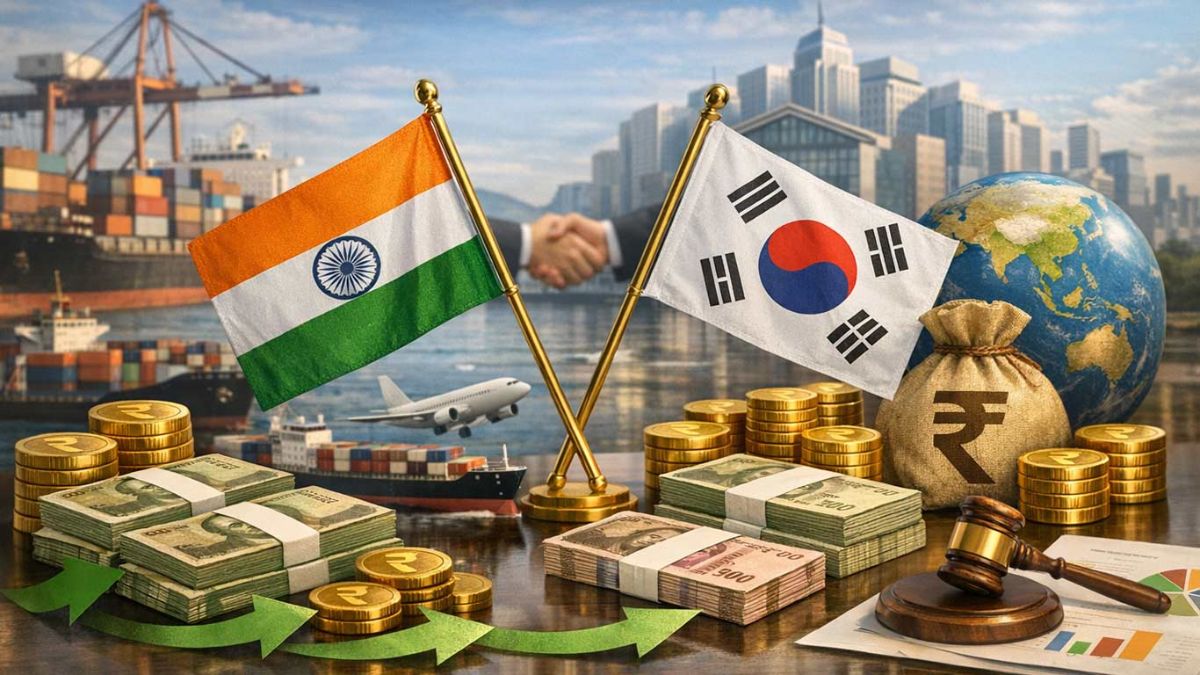
India and Korea have agreed to address New Delhi’s concerns over the widening bilateral trade deficit within the framework of the existing Comprehensive Economic Partnership Agreement (CEPA), instead of negotiating a fresh trade pact.
“Both sides acknowledged India’s bilateral trade deficit, which has risen significantly since the India-Korea CEPA came into force in 2010, and agreed to address the issue within the overall India-Korea CEPA framework,” the commerce ministry said in a statement.
The idea of exploring a fresh agreement had earlier been floated by Commerce and Industry Minister Piyush Goyal amid delays in concluding the review of the CEPA.
ALSO READOdisha, Maharashtra roll out coal gasification incentives
Another reason behind the proposal for a new pact was the changing global trade environment, including tariff wars and the series of free trade agreements signed by India over the past three to four years.
The two countries had agreed to review the CEPA in 2016 after concerns emerged that the agreement, operational since 2010, was benefiting Korea more than India. Since then, the two sides have held 11 rounds of negotiations without reaching a conclusion.
Decade-Long Deadlock
During Korean President Lee Jae Myung’s visit to India from April 19-21, both sides decided to conclude the review process by the end of this year. Officially, the negotiations are being described as “upgrade negotiations”. The 12th round of talks was held in New Delhi from May 25-27.
The negotiations were co-chaired by Kapil Chaudhary, Joint Secretary in the Department of Commerce, and Park Geun-oh, Director General for Trade Agreement Policy at South Korea’s Ministry of Trade, Industry and Energy (MOTIE).
During the 12th round, discussions were held on Trade in Goods (TiG), Trade in Services (TiS), Rules of Origin (RoO) and Origin Procedures (OP), investment, and Sanitary and Phytosanitary (SPS) standards.
The two sides also decided to constitute sub-groups to discuss cooperation in digital trade, supply chain resilience, and strategic industrial cooperation, the statement added.
ALSO READChina tightens hold over India’s key imports for new-age production
Evaluating Trade Asymmetry
Since the CEPA came into force, India’s exports to Korea have increased from $3.7 billion in 2010-11 to $5.8 billion in 2024-25. During the same period, imports from Korea rose from $10.4 billion to $21.3 billion.
Apart from tariffs, non-tariff barriers (NTBs) and the reluctance of local Korean industry to source from foreign suppliers have been flagged as key reasons why India has not been able to fully benefit from the CEPA.
TOPICSSouth KoreaTradeThis article was first uploaded on May twenty-eight, twenty twenty-six, at fifty-four minutes past ten in the night.