
Follow Us
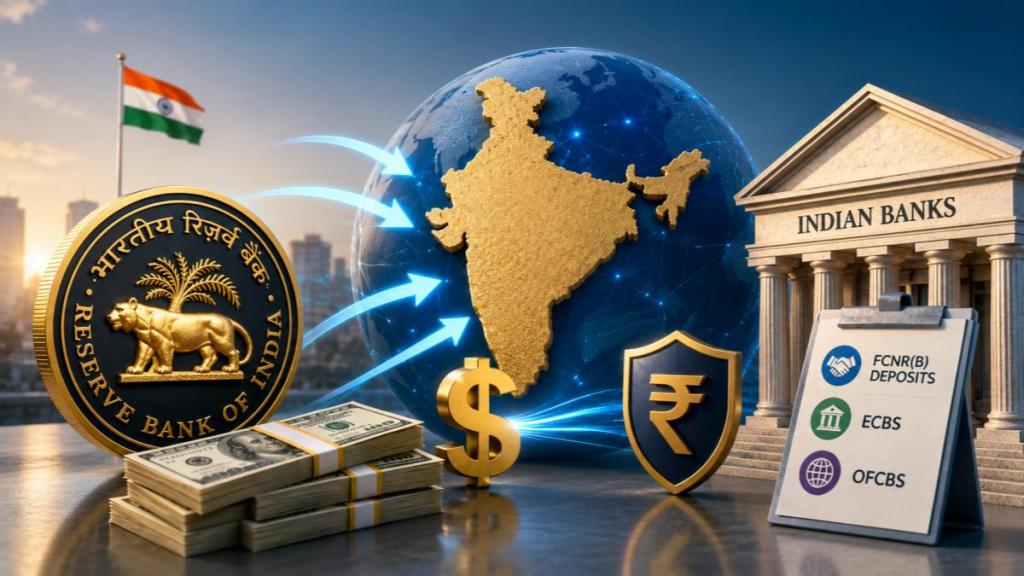
India’s balance-of-payments outlook is being transformed by a funding channel that barely figured in forecasts at the start of the financial year. It is a set of temporary foreign-exchange swap windows opened by the Reserve Bank of India in June.
Banks had reported $72.85 billion of foreign-currency inflows under the facilities by August 21, RBI data showed. Nearly 90% of this ($65.40 billion) came through Foreign Currency Non-Resident (Bank) deposits. Overseas foreign-currency borrowings by banks contributed $4.86 billion, while external commercial borrowings brought in another $2.59 billion.
The speed and scale of the mobilisation have prompted IDFC FIRST Bank Economics Research to raise its estimate of India’s balance-of-payments surplus for 2026-27 to $60 billion from $40 billion. According to their report, gross inflows across the three windows are estimated to reach $116 billion by December, including $85-90 billion from FCNR(B) deposits alone.
That would mark a sharp turn from 2025-26, when India recorded a current-account deficit of $25.2 billion and foreign-exchange reserves declined by $23.6 billion on a BoP basis. It would also reverse the weak start to the current year where preliminary RBI data showed an overall BoP deficit of $8.1 billion in April-June.
However, it is important to note that the improvement does not mean India has suddenly begun earning far more dollars from exports than it spends. It is primarily a financing story — one in which the RBI has made it easier and cheaper for banks, non-resident depositors and eligible public-sector borrowers to bring medium-term dollars into the country.
ALSO READFrom ACs to smartphones, wagons to defence: Inside 2 stocks building their next act
How the windows work
The RBI opened the facilities on June 8. Under the FCNR(B) window, banks mobilise fresh or renewed foreign-currency deposits from non-resident Indians for three to five years. They sell the dollars to the RBI at the prevailing reference rate and simultaneously agree to buy back the same amount when the swap matures. The RBI offered this swap at par, removing much of the exchange-rate risk that banks would otherwise price into the deposits.
For eligible external commercial borrowings and overseas foreign-currency borrowings, the RBI offered swaps of up to five years at a fixed annual cost of 1.5%, compounded half-yearly. The ECB leg is restricted to eligible public-sector entities, while the OFCB facility is available for foreign-currency borrowing by authorised dealer banks. These inflows can be raised until December 31, with swaps available until January 15, 2027.
The response to FCNR(B) deposits was so strong that the central bank brought forward the last date for mobilising eligible deposits to August 31 from September 30. When it announced that decision on August 14, inflows stood at $56.85 billion. They increased by another $16 billion in just over a week. Banks can complete the FCNR(B) swaps until September 11.
The attraction is straightforward. Non-resident depositors receive a foreign-currency product and avoid direct rupee risk. Banks gain stable, multi-year funding and a known route to hedge it. The central bank, meanwhile, receives dollars up front and releases rupees into the domestic system, with the transaction reversing at maturity.
Why this changes the BoP arithmetic
The balance of payments records both India’s transactions with the rest of the world and how those transactions are financed. A merchandise trade deficit pulls down the current account; services exports and remittances offset part of it. Foreign investment, deposits and overseas borrowing sit on the financing side.
In April-June, India ran a current-account deficit of only $3.1 billion. A merchandise deficit of $85.7 billion was substantially offset by a $52.2 billion services surplus and net transfers of $41.4 billion. The larger drag came from financial flows: foreign portfolio investment recorded a net outflow of $9.6 billion, while net FDI brought in $7.8 billion. The capital-account balance was a deficit of $5 billion, leaving the overall BoP $8.1 billion in the red.
The swap windows attack that financing weakness directly. FCNR(B) deposits add to banking capital and non-resident deposits, while ECBs and OFCBs add external borrowing. If these inflows exceed the current-account gap and other financial outflows, the overall BoP moves into surplus and the RBI can accumulate reserve assets.
The mobilisation is particularly notable against last year’s flows. In all of 2025-26, NRI deposits recorded net inflows of $14.4 billion and ECBs to India brought in $14.2 billion on a net basis, RBI data showed. The $72.85 billion raised in less than three months is a gross number, so it is not directly comparable but it illustrates why forecasts have changed.
The reserve build-up is already visible as India’s foreign-exchange reserves stood at $729.33 billion on August 21, up $38.22 billion from end-March. Changes in headline reserves also reflect valuation movements, market intervention and other transactions, so the increase cannot be attributed entirely to the swaps.
ALSO READUPI is booming. So why is cash in India still growing at 12.5%?
The trade deficit has not disappeared
The extra financing arrives when India’s underlying external gap remains under pressure. Commerce Ministry data show merchandise imports at $76.22 billion in July against exports of $44.24 billion, implying a goods deficit of nearly $32 billion. During April-July, the merchandise deficit widened to $118.60 billion from $96.66 billion a year earlier.
Services provide an important cushion. The ministry estimated a surplus of $69.17 billion for April-July, up from $64.35 billion a year earlier. Even so, a larger goods deficit, especially if crude-oil prices remain high, could reduce the benefit of the new funding.
This is why, the IDFC FIRST Bank forecast added only $20 billion to its BoP-surplus estimate even though projected gross mobilisation has risen much more sharply. Some FCNR(B) money may be a rebooking of deposits that would have entered or remained in India anyway. Some new borrowing may replace other funding rather than represent a fully additional flow. The RBI may also sell dollars in the spot or derivatives markets to limit disorderly rupee depreciation, while older buy-sell swaps mature, the report stated.
There is a further accounting and risk distinction. These dollars are borrowed, not permanent capital. Banks and borrowers will need dollars to repay depositors and lenders after three to five years. The research report noted that the RBI already had a net short forward-dollar position of about $103 billion in June, of which roughly $64 billion had a residual maturity beyond one year. The new longer-tenor swaps improve near-term availability but add to obligations that must eventually be managed.
Forex success with a liquidity cost
When the RBI buys dollars under the swaps, it releases rupees to banks. IDFC FIRST Bank estimates that FX operations injected about Rs 3.6 lakh crore between June 5 and August 14, lifting core liquidity surplus to Rs 8.1 lakh crore from Rs 4.7 lakh crore. It expects the surplus to peak at Rs 9.9 lakh crore in September before easing as currency in circulation rises and the external balance moves closer to neutral in the second half.
The RBI has been absorbing the excess through variable-rate reverse repos and the standing deposit facility. Its August 28 statistical release showed net daily absorption of Rs 2.51 lakh crore to Rs 3.72 lakh crore during August 17-21. Too much cash can pull overnight rates below the policy rate and complicate monetary transmission.
ALSO READIs India’s consumption boom sustainable without stronger job growth? What latest data reveal
The swap windows have therefore achieved more than a conventional reserve-raising exercise. They have given India a large near-term external buffer, improved the probability of a sizeable FY27 BoP surplus and reduced the immediate strain caused by portfolio outflows and a widening trade deficit.
But the $60 billion estimate should be read as a forecast, not a settled outcome. Its durability will depend on how much of the gross mobilisation is genuinely additional, the path of oil and imports, portfolio flows, RBI intervention and the eventual unwind of the swaps. The windows have rewritten this year’s BoP arithmetic. They have not eliminated India’s need for stronger, recurring foreign-exchange earnings.
TOPICSforexForex ReserveIndian EconomyRBIReserve Bank of India + 0 MoreThis article was first uploaded on August twenty-nine, twenty twenty-six, at nine minutes past four in the afternoon. © IE Online Media Services (P) Ltd