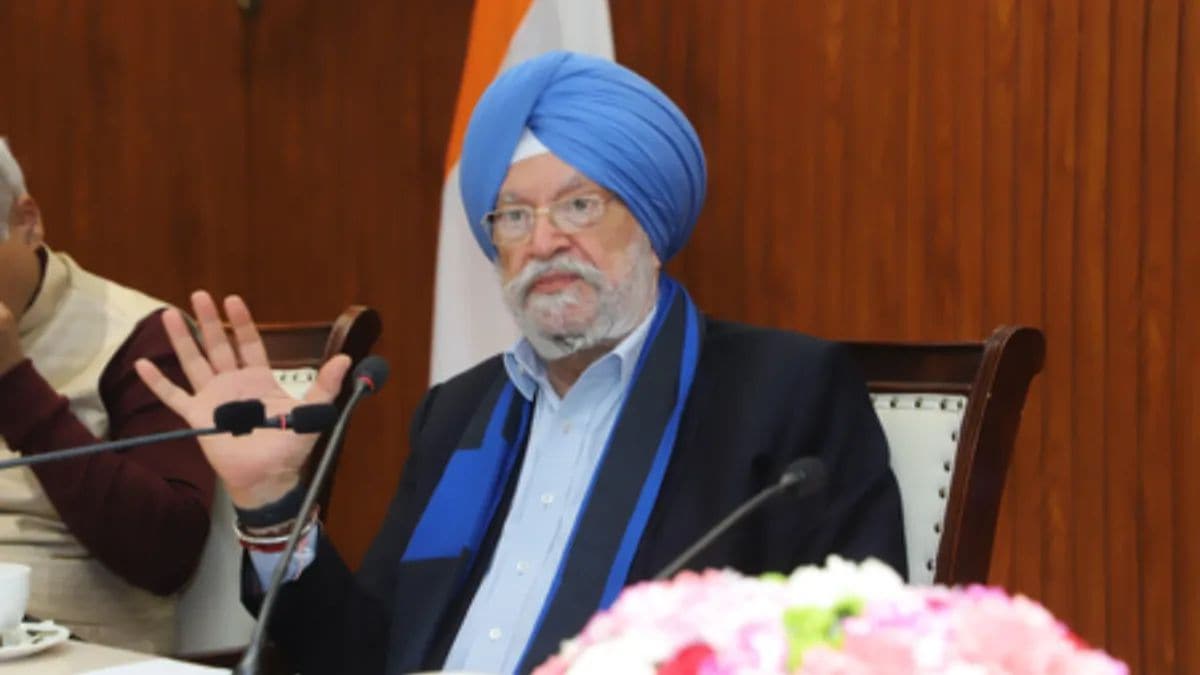
Union Petroleum and Natural Gas Minister Hardeep Singh Puri is on a two-day visit to Qatar amid concerns over energy supplies triggered by the Iran war. The visit follows Tuesday’s news of a ceasefire between the United States and Iran, but Israel continues to pound Lebanon with its heaviest strikes.
Puri’s visit comes at a precarious time for India as India reels from disruptions to LPG supply caused by the month-long war. As per oil economist Kirit Parikh, India imports 50% of its LNG stocks from the international market, out of which an estimated 40% stocks are sourced from Qatar.
The mission comes at a volatile moment for global energy markets, as India attempts to insulate its domestic supply chains from the catastrophic fallout of the Iran-Qatar conflict.
Amid wider disruptions to international trade, caused by the West Asia war India moved to protect itself from global supply chain disruptions by beginning large-scale imports of natural gas from new markets and routes – reportedly mainly from the US, Australia, and Russia for LNG.
ALSO READUS to exit NATO? Trump meets alliance chief after White House confirms talks on possible withdrawal
Though the ceasefire has eased oil price volatility, reports of fresh attacks from Iran’s refineries, Saudi pipelines, Lebanon and UAE have been surfacing for the last 24 hours. Set against this backdrop Puri’s visit to Qatar is being viewed as a high stakes diplomacy to secure India’s energy needs.
Why the urgent visit ?
20 billion dollar dent for Qatar
The primary catalyst for Puri’s visit is the severe degradation of Qatar’s export capacity. Iranian strikes on the Ras Laffan Industrial City in late February have left the one of the world’s most reliable LNG exporter reeling.
According to QatarEnergy CEO Saad al-Kaabi, the precision strikes crippled two of the nation’s 14 LNG trains (Train 4 and Train 6) and a crucial gas-to-liquids (GTL) facility that produces an estimated 12.8 million tonnes of LNG output annually.
The math of this Infrastructure strike on Qatar is sobering:
Capacity Loss: 12.8 million tonnes per annum (MTPA) of LNG output is offline.
Export Impact: This accounts for roughly 17% of Qatar’s total LNG export capacity.
The Recovery Horizon: Repairs are projected to take between three to five years, a timeline that threatens to turn a temporary supply shock into a structural deficit.
Revenue Loss: The disruption is bleeding Qatar an estimated $20 billion in annual revenue losses and has raised concerns over global energy security
Given these developments, Puri is likely to discuss liquefied natural gas (LNG) supplies during his visit, as per IANS.
LPG concerns
There have been concerns over the LPG supply shortage in India after Iran blocked the Strait of Hormuz passage, a critical maritime route that used to carry a fifth of the world’s oil supply. Given the wider disruptions, India’s ministry of Petroleum has maintained that the LPG cylinder supply in the country is “operating normally”.
ALSO READWhat are the 3 versions of Iran’s 10-point ceasefire proposal? Vance says ‘one likely written by ChatGPT’
Despite the maritime blockade, the Ministry of Petroleum has moved aggressively to prevent panic. On April 7 alone, 5.35 million domestic LPG cylinders were delivered, signaling that the “last mile” remains robust.
The government is leaning heavily on digital authentication to prevent black-marketing:
Online Bookings: Have surged by 95% across the industry.
DAC-Based Deliveries: The Delivery Authentication Code (DAC) system now covers 91% of deliveries, a critical move to stop the diversion of subsidized fuel during the crisis.
Jaishankar’s parallel track: The UAE-Mauritius link
While Puri evaluates trade options with Qatar, External Affairs Minister S. Jaishankar is reportedly set to visit Mauritius (April 9-10) for the Indian Ocean Conference before heading to the UAE (April 11-12).
As per a report published by NDTV, this marks the first ministerial visit to the Emirates since the war began. The agenda is clear: Energy and Maritime Security. With the UAE being a critical alternative for both crude and LPG, Jaishankar’s discussions with the Emirati leadership will likely focus on securing a “blue-water corridor” for Indian energy tankers, independent of the volatility currently plaguing the Qatari ports.
As the two-week ceasefire clock ticks down, India’s dual-track diplomacy in Doha and Abu Dhabi represents a frantic yet focused attempt to ensure that the “lights stay on” even if the regional peace remains dim.
TOPICSbusinessECONOMYHardeep Singh PuriOil ministryThis article was first uploaded on April nine, twenty twenty-six, at forty-five minutes past four in the afternoon.