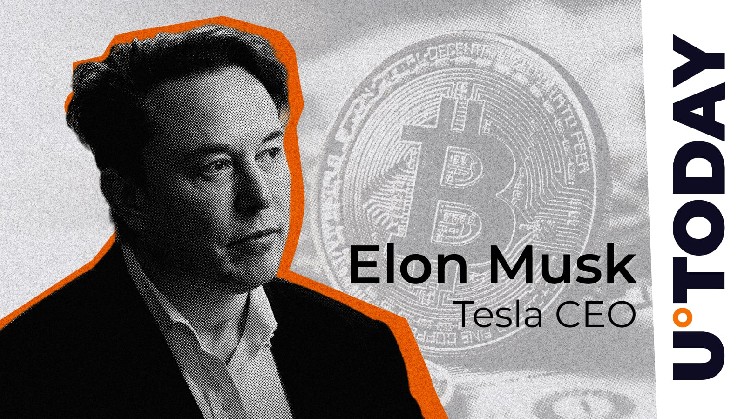
Recently, Elon Musk shared his thoughts on social media, suggesting that energy should be considered the ultimate form of currency.
This perspective has been embraced by Bitcoin enthusiasts as it aligns with the fundamental principles of proof-of-work cryptocurrencies.
Many believe Musk’s comments serve as a tacit acknowledgment that Bitcoin stands out as a more effective monetary system since its value is intrinsically linked to energy usage, in contrast to traditional fiat currencies.
Musk’s Clear Support for Bitcoin
According to U.Today, about three weeks ago during a podcast discussion, the billionaire elaborated on this viewpoint.
Musk made a direct connection between his idea of “energy as currency” and Bitcoin. He commended Bitcoin for its relationship with energy resources and pointed out that unlike energy, one cannot simply create or legislate more money at will.
He suggested that humanity’s advancement should be gauged by how well it harnesses energy (referencing the Kardashev scale).
Moreover, Musk forecasted that traditional forms of money may eventually fade away. He envisions a future where artificial intelligence and robotics lead us into an era devoid of scarcity.
A Complex Perspective
In 2021, Tesla invested $1.5 billion in Bitcoin and initially accepted it for transactions.
However, shortly thereafter, the company had to retract its acceptance of BTC payments due to concerns over sustainability.
Musk found it challenging to align Tesla’s commitment to sustainable practices with the environmental impact associated with Bitcoin mining at that time which heavily relied on coal power sources.
A significant portion of global Bitcoin mining was situated in China’s Xinjiang region where coal was predominantly used for power generation.
The landscape shifted between 2021 and 2025 allowing Musk to adjust his stance without appearing inconsistent or hypocritical regarding his views on sustainability in relation to cryptocurrency mining practices.
The Chinese government imposed a ban on crypto mining mid-2021 which prompted miners to relocate operations primarily towards regions like Texas (utilizing wind/solar) and Iceland (leveraging geothermal resources).
A report from Cambridge Centre for Alternative Finance indicated by 2025 that over half of all bitcoin mining operations were powered by sustainable energy sources.