Vitalik Buterin, the co-founder of Ethereum, has provided additional insights into a recently unveiled roadmap that aims to significantly accelerate the creation of new blocks and transaction confirmations on the Ethereum network.
On Thursday, Buterin elaborated on a publicly shared visual roadmap named “Strawmap,” which was introduced by the Protocol team at the Ethereum Foundation.
He noted that “Fast slots” are positioned separately at the top of this roadmap and appear somewhat disconnected from other elements. According to him, most parts of the plan operate independently from slot time considerations.
The term “slot time” refers to how long it takes for Ethereum to generate new blocks—currently about 12 seconds. The objective outlined in this roadmap is to reduce this duration dramatically, potentially down to just 2 seconds. This would transform Ethereum into a more immediate and interactive system rather than one users must wait on.
Buterin anticipates an incremental reduction in slot times following approximately a square-root-of-two progression: moving sequentially from 12 seconds down through 8, then 6, followed by 4 seconds, ultimately reaching as low as 2 seconds.
He also highlighted improvements in peer-to-peer (P2P) networking — enhancements that optimize how nodes exchange information such as new blocks without redundant data downloads. These upgrades could substantially decrease block propagation delays and enable shorter slot durations without compromising security.
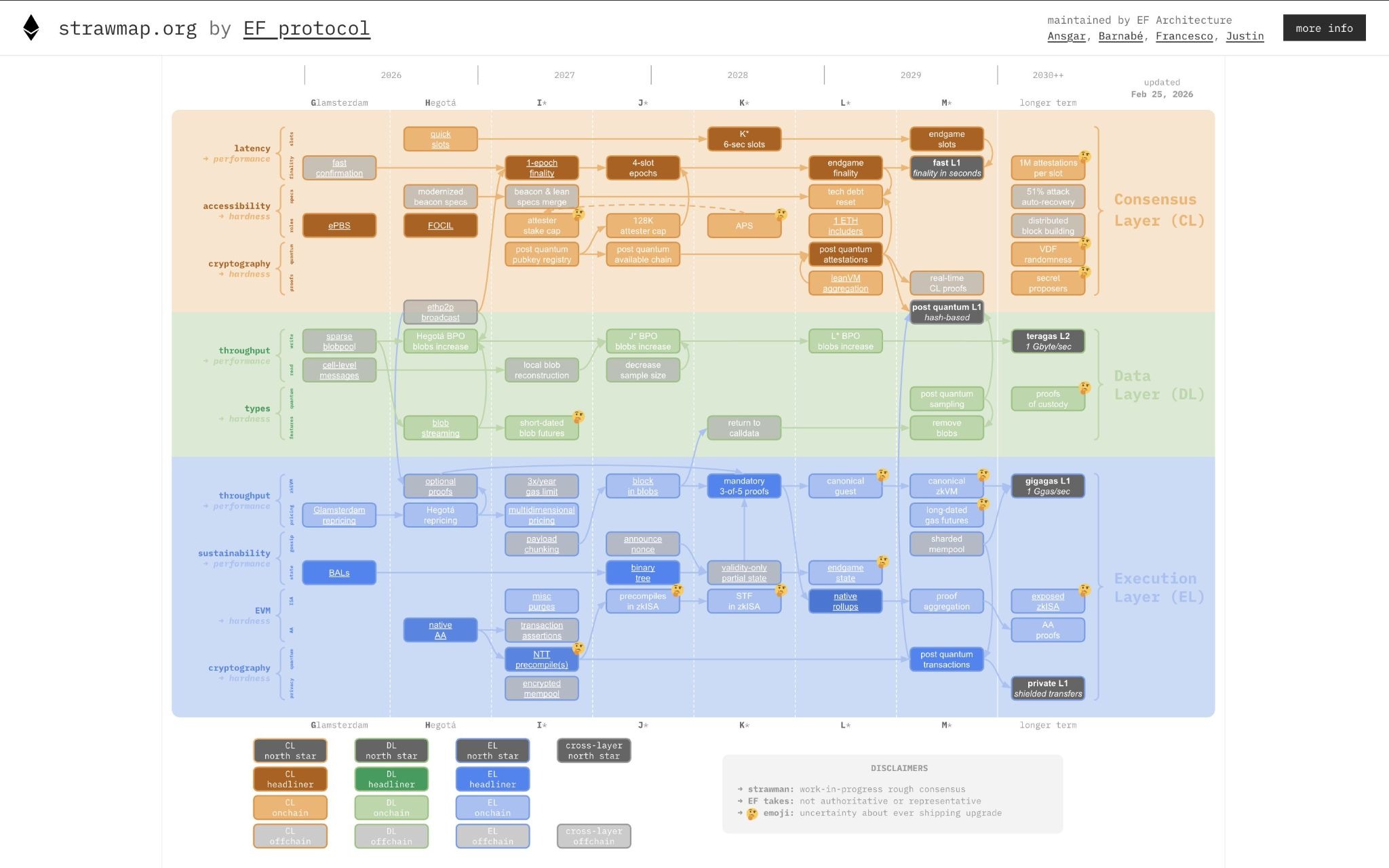
The Strawmap outlines a four-year strategic plan for Ethereum’s development. Source: Ethereum Foundation
Reducing Finality Time From Minutes To Seconds
A second critical upgrade focuses on finality—the moment when transactions become mathematically irreversible—which currently takes around sixteen minutes on average.
The vision is to shorten finality times drastically to between six and sixteen seconds by replacing today’s complex confirmation mechanism with a simpler system designed also for quantum resistance.
“The aim is to separate slot timing from finality so they can be addressed independently,” Buterin explained further.
This overhaul involves extensive changes considered highly invasive technically. Therefore, major updates will be bundled together with cryptographic switches—specifically transitioning toward post-quantum hash-based signature schemes—to enhance security against future quantum threats.
Achieving Quantum Resistance Ahead Of Finality
An intriguing result of this phased approach is achieving quantum resistance in slots before it becomes possible for finality guarantees themselves:
“One fascinating aspect of taking incremental steps is that we can make slots resistant to quantum attacks well before we secure finality against them,”
If powerful quantum computers emerge suddenly, there might be scenarios where although finality assurances weaken temporarily, blockchain operations continue uninterrupted according to Buterin’s explanation.
“Users should expect gradual improvements both in reducing slot durations and shortening finalization periods,” he summarized succinctly.
This stepwise replacement strategy targeting each component involved in consensus mechanisms will yield an overall cleaner architecture—one that’s simpler yet robustly secure with formal verification support throughout its design process.
These transformations are planned over roughly four years via seven scheduled network upgrades occurring approximately every six months. Two upcoming forks named Glamsterdam and Hegotá have already been confirmed for later this year.