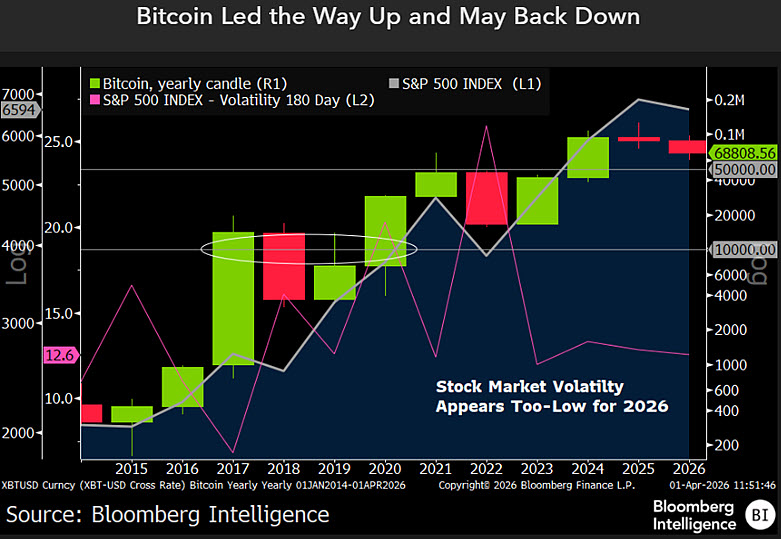
As the cryptocurrency market strives to find its footing in a new cycle, Mike McGlone, a Senior Strategist at Bloomberg Intelligence, has released an updated forecast for Bitcoin’s price. His central premise remains consistent: there is still a risk that Bitcoin could drop back to the $10,000 mark — which he refers to as a “fundamental anchor.”
McGlone’s perspective is grounded in mathematical regression analysis. The $10,000 threshold is not merely psychological; it represents the most actively traded price range since Bitcoin futures were introduced in 2017.
The Rationale Behind McGlone’s $10,000 Target for Bitcoin ($BTC)
The strategist points out that the extraordinary surge witnessed during 2020-2021 was fueled by what he describes as “the greatest monetary expansion in history.” With excess liquidity now exiting the markets, $BTC may trend towards its natural average — reflecting where it was positioned before the onset of this decade.
McGlone draws a distinct line between Bitcoin and other cryptocurrencies. As of April 2026, while millions of crypto assets exist today, he underscores that most tokens lack genuine backing. He asserts that only stablecoins are currently showcasing real utility within this sector.
This backdrop of economic uncertainty in 2026 has led investors to increasingly favor gold over cryptocurrencies like Bitcoin — categorizing them as “high-risk assets with elevated beta coefficients.”
Even though Bitcoin’s current trading value significantly exceeds this projected low point, Bloomberg’s report serves as an important reminder about potential risks associated with a “bubble burst.”
McGlone cautions that if stock markets—especially the S&P 500—experience an extended downturn, speculative assets such as cryptocurrencies will likely be hit hardest first. In such circumstances, revisiting the $10,000 level would simply signify a necessary market correction from excessive speculation.