
The much-discussed four-year cycle of Bitcoin continues to unfold, but the dynamics influencing it have transitioned from halving events to political factors and liquidity issues, as stated by Markus Thielen, the research lead at 10x Research.
During his appearance on The Wolf Of All Streets Podcast, Thielen emphasized that declaring the four-year cycle as “broken” overlooks its underlying structure. He believes that while this cycle persists, it is increasingly influenced by U.S. election schedules and central bank policies rather than solely by Bitcoin’s programmed supply reductions.
Thielen highlighted historical peaks in the market during 2013, 2017, and 2021—all occurring in Q4—as more closely tied to presidential election cycles and broader political uncertainties than to Bitcoin halving events which have varied over time.
“There’s a prevailing uncertainty regarding whether the current president’s party will lose significant seats. I think there’s a good chance Trump or Republicans could face substantial losses in the House; consequently, he may struggle to advance his agenda,” he remarked.
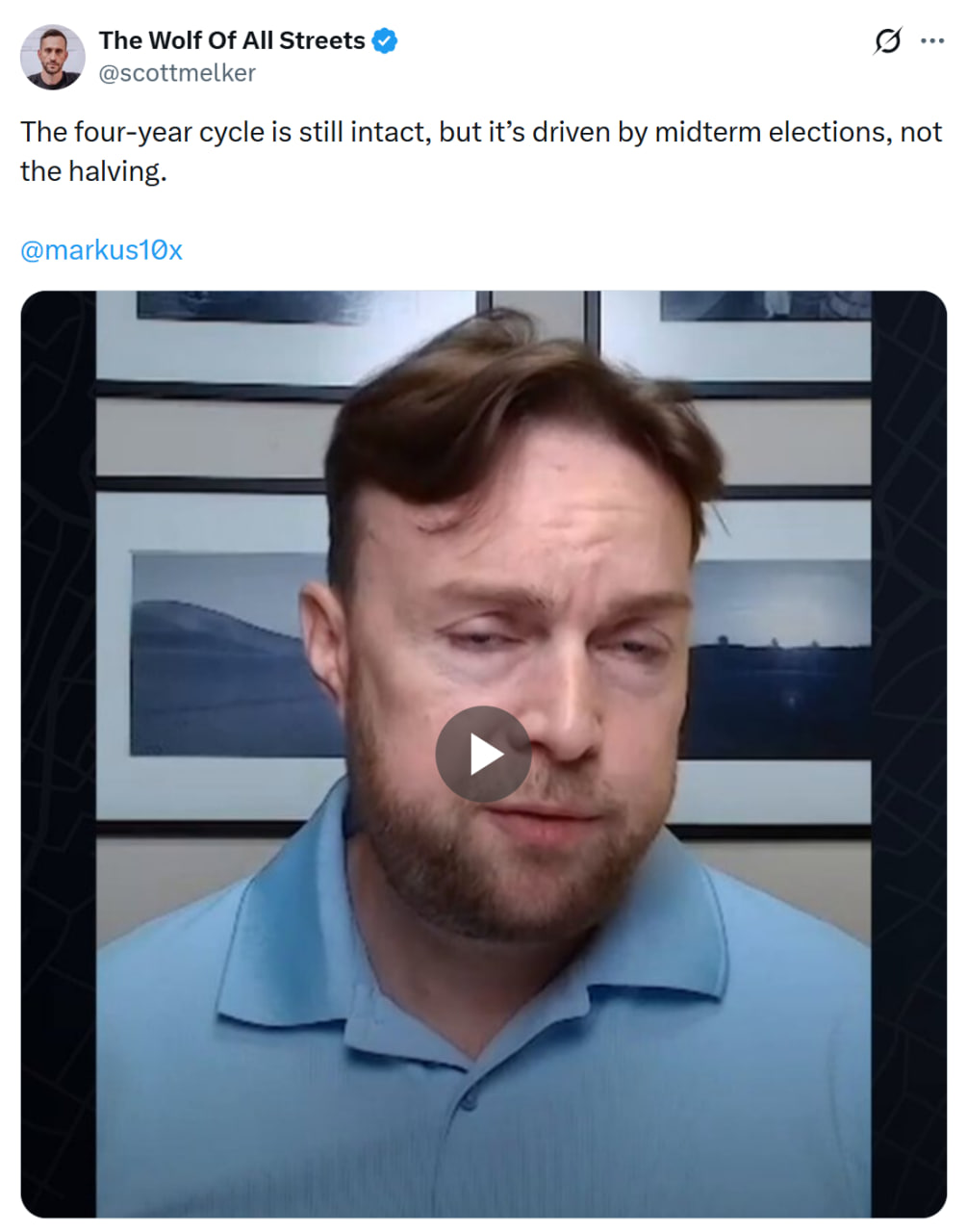
Markus Thielen asserts that the four-year cycle remains relevant. Source: The Wolf Of All Streets
Related: The prediction for Bitcoin’s ‘up year’ is set for 2026; some claim the four-year cycle has ended
No Boost from Fed Rate Cuts for Bitcoin
This commentary comes at a time when Bitcoin is finding it challenging to regain its momentum following recent rate cuts by the Federal Reserve. Historically, such cuts have provided support for risk assets; however, Thielen pointed out that today’s landscape differs significantly. Institutional investors—now leading players in crypto markets—are exhibiting greater caution due to mixed signals from Fed policies and tightening liquidity conditions.
Additonally, capital inflows into Bitcoin are not matching last year’s levels which diminishes any upward pressure necessary for a robust breakout. Without an evident increase in liquidity levels soon enough, Thielen anticipates that Bitcoin will likely remain within a consolidation phase instead of embarking on another explosive rally.
This change also affects how investors should approach timing their strategies. Instead of relying heavily on halving dates as indicators of market movement like before, Thielen suggested focusing on political catalysts such as U.S elections and fiscal policy discussions alongside shifts in monetary conditions.
Related: A fresh perspective suggests that perhaps Bitcoin’s four-year cycle isn’t finished yet according to Glassnode
A Contrasting View from Arthur Hayes
<pIn October last year BitMEX co-founder Arthur Hayes expressed his belief that traditional four-year crypto cycles are no longer applicable—not due to waning institutional interest or changes related specifically to halving schedules but because traders who depend on historical timing models may be misled about current market trends since those patterns no longer accurately depict market behavior today.
Hayes argued convincingly that past cycles were always dictated primarily by global liquidity rather than arbitrary timelines spanning every four years. Previous bull markets typically concluded when monetary conditions tightened up especially with reduced liquidity flowing through both US dollar and Chinese yuan channels respectively; thus he contended halvings had been exaggerated concerning their role causatively versus merely being coincidental markers within these broader economic contexts overall.”
Magazine: The year 2026 marks pragmatic privacy advancements within cryptocurrency — featuring Canton , Zcash , among others