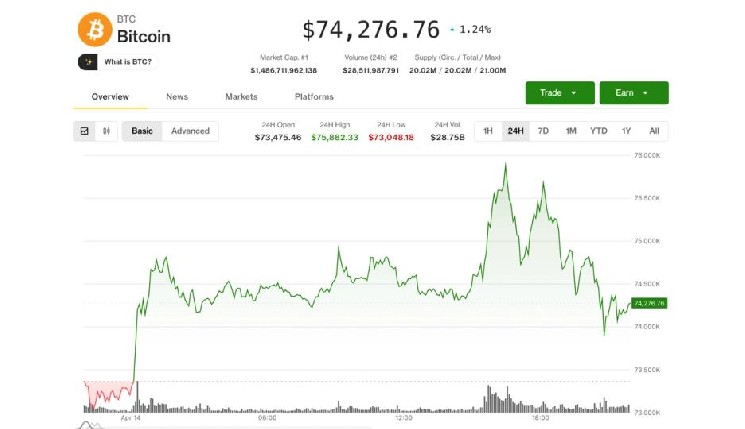
Bitcoin began the day with a strong potential for a breakout, but the momentum quickly dissipated at a well-known resistance level that has restrained prices for over two months.
After momentarily exceeding $76,000—a significant barrier—the leading cryptocurrency reversed its trajectory, falling below $74,000 later in the trading session. Nevertheless, it managed to maintain a 1.3% increase over the previous 24 hours and was recently trading around $74,300.
Ether (ETH) mirrored this trend by retreating from above $2,400; however, it still outperformed Bitcoin with a daily gain of 2.5%. In contrast to cryptocurrencies, traditional markets did not experience such pullbacks; the Nasdaq closed at its highest point of the session with an increase of 2%.
The environment remains conducive for an upward squeeze despite Tuesday’s breakout failing to sustain itself.
Vetle Lunde, head of research at K33 Research, noted that funding rates on Binance’s bitcoin perpetual contracts have remained negative for eleven consecutive periods despite recent price increases. This indicates that traders are still adopting bearish positions even as prices rise. Additionally, open interest has been increasing—implying that new short positions are being established rather than liquidated.
This combination has historically paved the way for significant upward movements in price dynamics.
Lunde further mentioned that the average funding rate over thirty days has now been negative for forty-six straight days—matching patterns seen during previous market stress phases like after FTX’s collapse in late 2022 and during China’s ban on bitcoin mining in mid-2021 when bearish sentiment prevailed.
“Similar risk-off environments have historically provided favorable entry points for BTC,” Lunde stated as crowded short positions were compelled to unwind under pressure.