Financial markets are increasingly factoring in the prospect of “peace” as a significant macroeconomic influence in the current economic cycle.
This trend seems to be bolstered by recent developments. The Kobeissi Letter reports that new negotiations may soon be initiated between the U.S. and Iran.
These discussions could commence as early as Thursday, April 16th, following previous unsuccessful attempts to finalize an agreement.
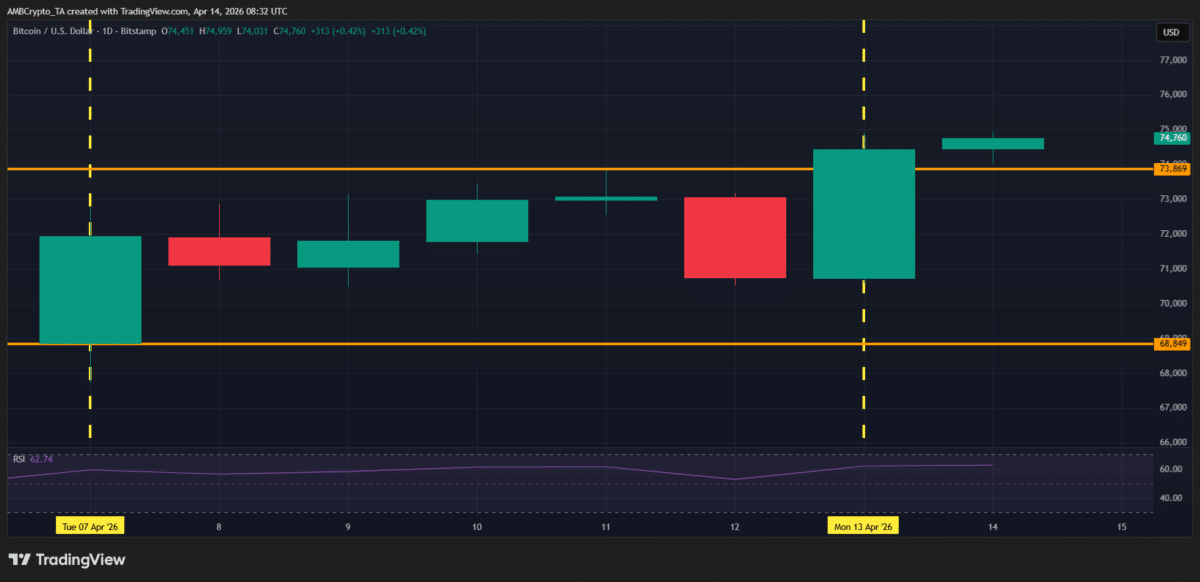
The market’s response has been noteworthy. In reaction to this news, Bitcoin [$BTC] experienced a daily increase of 5.23%, reaching a peak of $74,911 during trading.
This movement underscores how closely investors are monitoring geopolitical events, with macroeconomic headlines continuing to serve as crucial drivers for price fluctuations.
The repercussions did not end there.
As reported by CoinGlass, total liquidations have surpassed $530 million, with nearly 82% attributed to short positions.
Bitcoin exhibited a similar liquidity-driven pattern; it saw $219 million worth of short positions liquidated—the largest squeeze recorded within a week. However, when looking at the broader picture, this is not an isolated incident.
On April 7th, $BTC demonstrated comparable behavior by surging 4.48% up to $73k while triggering over $200 million in short liquidations. Nevertheless, momentum faltered near resistance levels around $75k.
This shift ultimately reversed positioning and resulted in long liquidations amounting to $75 million on April 12th as market dynamics changed direction.
The pressing question now is whether Bitcoin will replicate this strategy or if this cycle will deviate from prior liquidity trends. AMBCrypto suggests that one significant divergence may involve changes in structural patterns during this cycle.
A Shift in Sentiment Indicates Potential Breakthrough for Bitcoin’s Resistance
The more aligned the market becomes with its environment, the more “sentiment” emerges as an essential indicator of future movements.
This has been vividly illustrated over recent days; investor sentiment has closely mirrored daily fluctuations related to geopolitical news—especially concerning U.S.-Iran relations—with risk appetite adjusting almost instantaneously alongside each development.
Consequently, Bitcoin finds itself right at the center of these shifts.
The Crypto Fear and Greed Index clearly reflects these dynamics.
Since tensions arose between Iran and the U.S., it has encountered resistance twice coinciding with $BTC‘s rejection zone around $75k.
| The first occurrence was on March 16th when there was an eight-point drop within just one week. |
| A similar scenario unfolded on April 7th when it reached a score of 47 before experiencing another five-point decline shortly thereafter. |
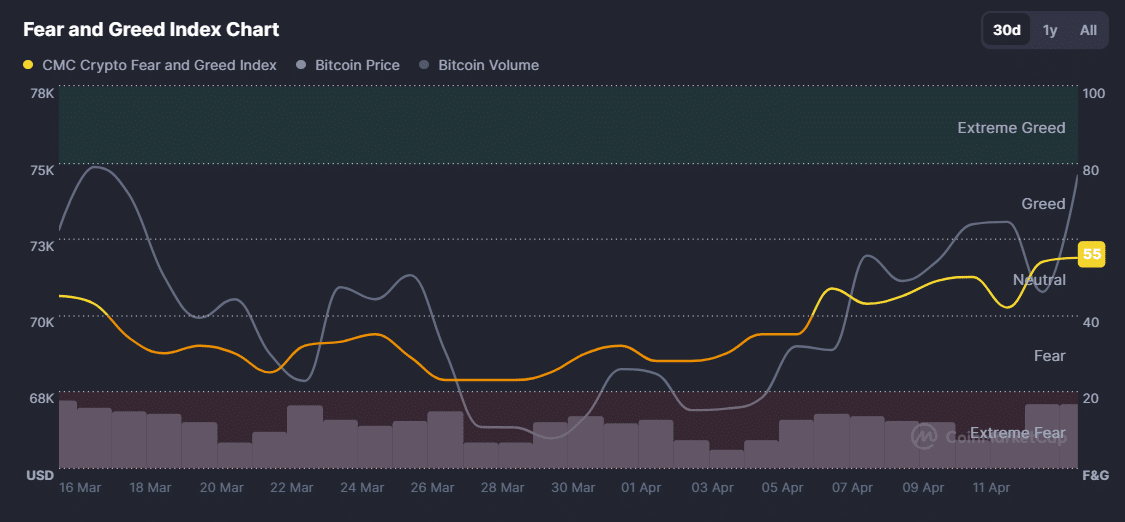
As depicted on the chart below, the index currently sits just five points shy from entering into “greed,” which historically corresponds with stronger accumulation phases.
From a technical perspective, $BTC$’s setup appears robust around$ $75k level.
If positive sentiment persists following any potential deal between Iran and America,$ $ BTC’s upward trajectory might break free from previous rejection patterns at that resistance level—making it critical metric moving forward.
A Concise Overview
$ BTC’s latest highlight revolves around liquidity-driven movements consistent with recurring “short squeezes into resistance” structures near$&nbs p;$75k zone.
The Crypto Fear & Greed Index approaches “greed,” indicating enhanced risk sentiment linked directly back toward developments surrounding Iranian-American relations!