
According to Ark Invest, a prominent asset management firm, quantum computing poses a long-term consideration for the security of Bitcoin but is not an immediate concern.
In a report released on Wednesday in collaboration with Unchained, the investment firm noted that current quantum computers do not possess the necessary capabilities to compromise Bitcoin’s cryptographic security, which utilizes elliptic curve encryption for wallet protection.
The authors of the report—Dhruv Bansal (co-founder and CSO at Unchained), Tom Honzik (director of custody research at Unchained), and David Puell (research trading analyst and associate portfolio manager for digital assets at Ark Invest)—stated, “Current quantum systems are insufficient to threaten Bitcoin.”
Even if advancements in quantum technology occur that could pose risks, these threats would likely emerge gradually and entail significant costs for potential attackers.
A key reason why Bitcoin is not facing an imminent threat is that any major advancement in quantum computing would first disrupt broader internet security. This would trigger coordinated responses from governments, tech companies, and financial institutions before it could impact Bitcoin directly.
This report arrives as long-term investors consider the possibility that future developments in quantum computing might undermine the cryptography supporting bitcoin. Such concerns have sparked speculation about a potential crisis regarding its security.
Earlier this year, Christopher Wood—a notable portfolio strategist at Jefferies—advised investors to reduce their bitcoin holdings by 10% while reallocating those funds into gold due to perceived risks from quantum threats. This recommendation unsettled many investors and caused turbulence within the digital asset market.
35% of Supply Under Threat
While experts generally agree that such advanced capabilities are still far off on the horizon, there are growing worries among investors about long-term vulnerabilities posed by powerful future quantum machines potentially capable of breaking private keys or older wallet formats within both bitcoin and its wider ecosystem.
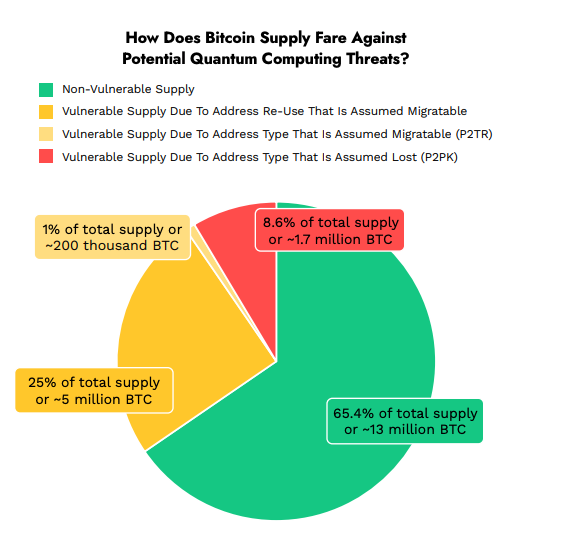 Quantum threat for bitcoin wallets (Ark Invest)
The analysis from Ark estimates approximately 35% of bitcoin’s total supply resides in address types theoretically susceptible to future attacks from quantum technology. This includes around 1.7 million $BTC, which are presumed lost forever; additionally about 5.2 million $BTC, which may be transitioned into more secure wallets over time.
A portion of these vulnerable assets—around 1 million $BTC—is associated with Satoshi Nakamoto himself—the pseudonymous creator behind Bitcoin’s inception.
However, rather than anticipating an abrupt “Q-day,” Ark Invest envisions these developments unfolding through various stages over several years. Some analysts worry that initial attacks could materialize before 2030; others believe such events may be “decades away,” according to their findings.
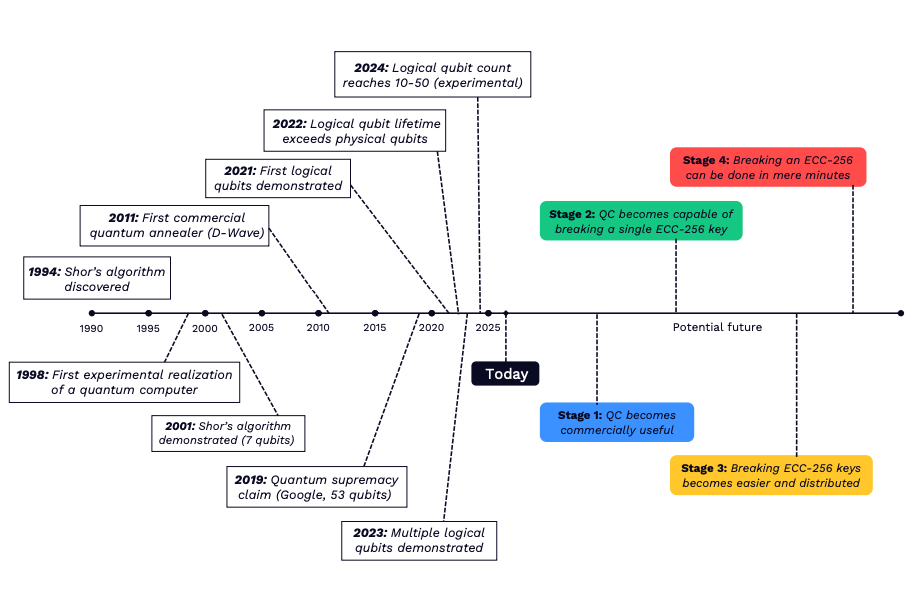 Quantum threat evolving through stages (Ark Invest)
The report contends that regardless of how scenarios play out over timeframes discussed above, there will likely be ample opportunity for members within the Bitcoin community to enhance network defenses using cryptography resistant against potential quantum incursions while also motivating users towards migrating coins into safer address formats as needed.
“The positive aspect is we already understand how best practices can safeguard against possible threats posed by quanta,” stated one section within their findings.
“Most bitcoins currently exist under addresses designed with resistance against such technologies; however some remain under vulnerable categories but should remain safe until Stage Three emerges when CRQC becomes capable enough to breach a standard ECC key sized at256 bits.” The leading cryptocurrency was trading near $70k during publication time frame.<Read more: Grayscale sees regulation shaping crypto markets instead amid fears related specifically towards quanta projected out till2026