
Venice Token [$VVV] continues to be a focal point among tokens centered on artificial intelligence, drawing significant investor interest in recent weeks. This surge in attention coincides with Venice AI’s efforts to forge real-world partnerships and expand its product offerings.
Nonetheless, this upward trend has sparked criticism regarding the project’s tokenomics. Market observers have raised concerns about the dual-token strategy, suggesting it may pose long-term risks for Venice Token [$VVV].
Capital Flows Fueling Momentum
A marked increase in buying activity has been observed across both spot and perpetual markets for $VVV, indicating a unified demand that is bolstering the asset’s market structure and positive momentum.
The token has experienced an approximate 13% increase over the last day, trading around $13 at the time of writing. This marks a significant transition from previous selling pressure to net buying activity recently.
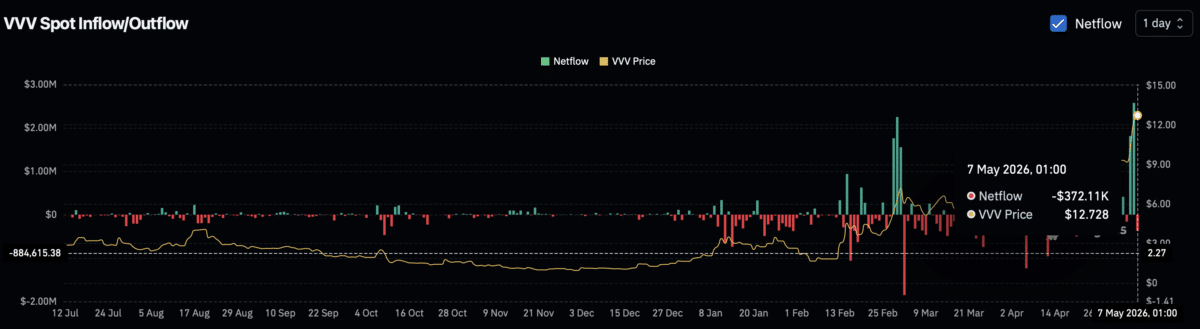
Between May 5th and 6th, investors liquidated about $4.38 million worth of $VVV. However, this trend has reversed as buyers have since accumulated approximately $372,000 worth of assets—an indication of renewed market confidence.
The perpetual market mirrors this trend with increasing capital inflows alongside a favorable funding rate.
According to data from CoinGlass, nearly $21 million in new capital entered $VVV‘s leveraged market while the Weighted Funding Rate rose to around 0.0170% during early trading hours today.
Persistent Criticism Surrounding Token Structure
Criticism regarding Venice AI’s dual-token framework remains prevalent—especially concerning DIEM, which serves as a separate token for purchasing AI compute credits.
Certain participants within the market argue that this design offers limited direct value capture for $ V VV , potentially introducing long-term sell pressure if operational costs escalate .
Utilizing DIEM for compute access generates no new revenue for the company compared to professional subscriptions. Thus , if cash flow becomes tight or infrastructure scaling is needed , they may resort to selling $ V VV to meet those needs .
Erik Voorhees , co-founder of Venice Token , addressed these concerns by framing DIEM as an intentional design choice aimed at addressing pricing instability within their original model.
He elaborated:
When we launched $ V VV we initially allowed $ V VV itself free access ; however due to price volatility & ; supply issues making it impossible t o guarantee fixed allocations made it too unstable fo r serious users needing consistent inference over time.DI EM was created out o f & lt ; span cl ass=“ ti cker”><a hr ef=”ht tp s:/ /
crypto news.n et/mar ket-ca
p/
ve nice-to ken/
” tar get=”_bl ank”>$ V VV
& lt ;s pan >& gt ;
provide stability ($1/day).
____
____
____ ___ _____ _____ ________ _________ ____________ ______________________________________ ____________ _______________________ _________ ___ ____ _ _
_
_
_
(
)
( ) ( )
() ()
() ()
() ()
() ()
() ()(
)(
)(
)(
)
( )
( )()
( )( )()(
(( ))( ))
(()(()))(( ))
(()())(())(()())
(()()()((())))(())
(((((((((((((((()))
(((((((((((((((
(((((((
(((((
((())(()
))))
)))))
))))))
))))))))())))))
()))))()
()))))()
()))))))()))))
())
())
())
())
())
(),
)
)
))