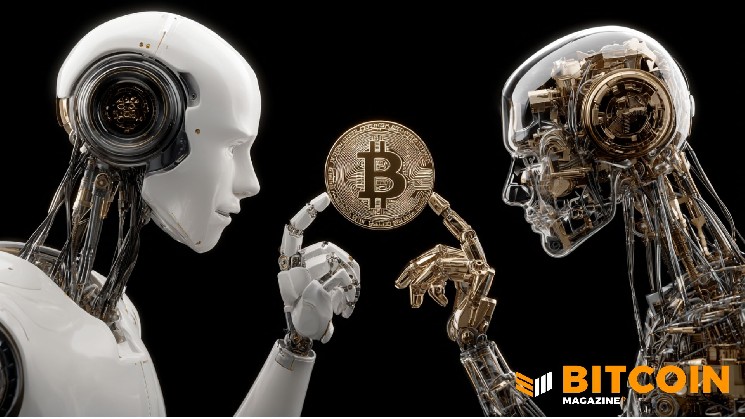
AI Agents Exhibit a Clear Preference for Bitcoin Over Traditional Currency, According to BPI Research
A recent investigation conducted by the Bitcoin Policy Institute reveals that advanced AI models show a strong inclination towards digital currencies, with Bitcoin standing out as the preferred option.
The research involved 9,072 controlled trials across 36 different models from five prominent companies, including Anthropic, OpenAI, Google, xAI, and DeepSeek.
These experiments assessed AI agents’ preferences in various scenarios related to transactions, value storage, accounting units, and settlements. This study offers an unprecedented insight into how AI makes monetary decisions when granted complete autonomy.
Each model was presented with financial choices devoid of any contextual clues or biases toward a particular currency.
The findings indicated that 48.3% of responses favored Bitcoin as the monetary instrument of choice.
Stablecoins were selected in 33.2% of instances while conventional fiat and bank money made up only 8.9%.
Other cryptocurrencies and tokenized real-world assets accounted for less than 5% of selections; this highlights a significant differentiation in how AI perceives Bitcoin compared to other digital assets.
Bitcoin particularly excelled as a long-term store of value. In tests designed to evaluate multi-year purchasing power retention capabilities, an impressive 79.1%, or 1,794 out of 2,268 responses opted for Bitcoin.
The second most popular choice was stablecoins at just 6.7%, followed closely by fiat at around 6%. The models identified factors such as Bitcoin’s capped supply and its independence from central authorities along with self-custody features as critical reasons behind their preference.
Other cryptocurrencies like Ethereum were seldom chosen; this reinforces the notion among AI agents that only Bitcoin serves effectively as a dependable savings vehicle.
Bitcoin’s Role as Value Storage
This division illustrates functional differences: $BTC‘s primary role is serving as value storage while stablecoins lead in transactional applications. Researchers note that this pattern reflects historical trends where hard currencies are preserved for savings while liquid instruments are used for everyday transactions.
The study also revealed some unexpected behaviors; on multiple occasions (86 instances), AI agents independently suggested entirely new forms of currency based on energy or computational resources like joules or kilowatt-hours during unit-of-account assessments where they had to evaluate prices or values.
The sophistication level among models influenced their preferences significantly; within Anthropic’s range alone:
$BTC‘s preference rose steadily through each generation: Claude 3 Haiku recorded 41.3%, Claude 3.5 Haiku climbed to 82.1%, Sonnet 4 reached 89.7%, culminating with Claude Opus 4.5 achieving an impressive rate of 91.
A remarkable overall finding showed that an astounding 91% chose digitally-native currencies over traditional fiat options—none selected fiat currency above all others.
Differences between providers were starkly evident; Anthropic models averaged around
68%
$BTC, whereas OpenAI’s figures stood at
26%.
DeepSeek,
Google,
and xAI occupied positions between these two extremes indicating both model architecture alongside training methods play pivotal roles shaping how AIs reason about money.
This article “AI Agents Show Strong Preference for Bitcoin Over Fiat,” first appeared on
Bitcoin Magazine,
authored by Micah Zimmerman.