Margin loans at Hong Kong securities brokers rose 28% in six months to HK$276.3 billion (about $35.5 billion), the Securities and Futures Commission (SFC) said today (Tuesday). The balance stood at HK$216.4 billion at the end of December.
The regulator’s half-yearly review of the industry also showed pre-tax profit at securities dealers and margin financiers rising 21% from the previous half to HK$51.7 billion, on a record HK$149.0 trillion in transactions.
London’s trading industry is coming home!

Know when your
coins move
Alerts, real-time prices, and market news — all in one app

4.8 based on 40K reviews in the App Store and Google Play


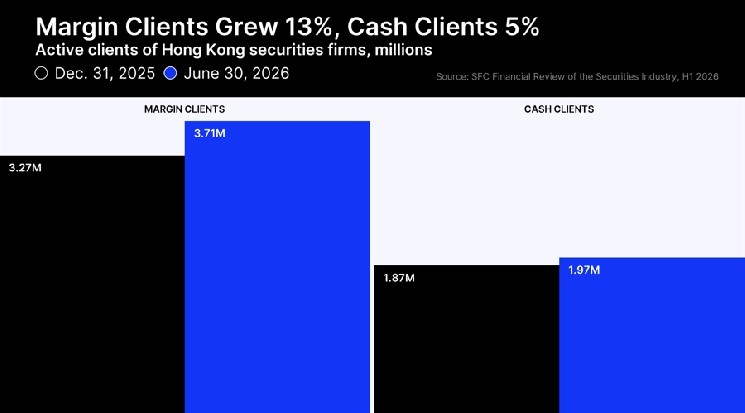
Borrowing grew faster than the client base. The number of active margin clients rose 13% to about 3.71 million, against a 5% rise in cash clients to 1.97 million.
Accounts that allow borrowing now make up about two thirds of the 5.7 million active clients. Brokers’ gross interest income reached HK$22.3 billion, more than the HK$20.2 billion they earned from securities commissions.
Average daily turnover on the Stock Exchange of Hong Kong (SEHK) reached a record HK$283.0 billion, up 9.3% on the previous half, according to exchange data cited by the SFC. That followed a year in which equity turnover in Hong Kong nearly doubled.
Lending Grows as the Index Falls
The Hang Seng Index closed June at 22,881, down 11% from the end of 2025. Clients’ pledged securities still covered their loans 4.7 times on average, up from 4.5 times in December, the SFC said.
Lending is concentrated. The 20 largest margin financiers held 87% of all margin loans, and brokers’ own borrowings from financial institutions rose 51% in six months to HK$58.6 billion.
The SFC does not break the figures out by firm. Nasdaq-listed Futu reported a margin financing and securities lending balance of HK$95.1 billion at the end of June, up 85.1% from a year earlier.
That number, from Futu’s August 20 results, covers the whole group and is not directly comparable with the regulator’s data.
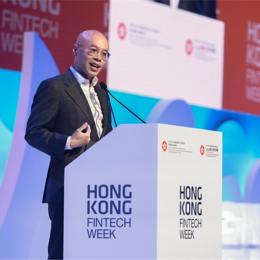
Eric Yip, the SFC’s executive director of intermediaries, said sustaining growth would need continued work with the industry.
“We remain committed to strengthening risk management, operational resilience and conduct standards,” he said.
Top Brokers Handle More Business for Less Commission
The SFC splits exchange Exchange An exchange is known as a marketplace that supports the trading of derivatives, commodities, securities, and other financial instruments.Generally, an exchange is accessible through a digital platform or sometimes at a tangible address where investors organize to perform trading. Among the chief responsibilities of an exchange would be to uphold honest and fair-trading practices. These are instrumental in making sure that the distribution of supported security rates on that exchange are effectiv An exchange is known as a marketplace that supports the trading of derivatives, commodities, securities, and other financial instruments.Generally, an exchange is accessible through a digital platform or sometimes at a tangible address where investors organize to perform trading. Among the chief responsibilities of an exchange would be to uphold honest and fair-trading practices. These are instrumental in making sure that the distribution of supported security rates on that exchange are effectiv Read this Term participants into three groups by monthly turnover. Category A, the 14 largest, handled 21% more business than in the previous half, at HK$77.1 trillion, but its net securities commission income fell 9% to HK$3.2 billion.
Category A’s pre-tax profit slipped 5% to HK$6.5 billion, and its proprietary trading swung to a HK$114 million loss from a HK$27 million gain.
By FinanceMagnates.com’s calculation, Category A commissions equaled about 0.4 basis points of transaction value, against about 2.2 basis points for Category B and 3.5 for Category C.
Pricing pressure has also come from outside the broker ranks. ZA Bank, the city’s largest digital bank, added Hong Kong stock trading last October with trading fees waived as a launch promotion.
Category B, firms ranked 15th to 65th, lifted profit 37% to HK$12.8 billion, helped by HK$3.1 billion in proprietary trading gains, up from HK$1.8 billion.
Category C profit rose 24% to HK$4.5 billion even as its transaction value fell 18%. The five largest dealers served about half of all active clients.
Crypto Dealing Commissions Drop 13.5%
Commission income from virtual asset dealing fell to HK$99.3 million from HK$114.8 million, about 0.4% of brokers’ total commission income. The SFC published guidance in February allowing licensed intermediaries to finance crypto trading against collateral including bitcoin Bitcoin While some may still be wondering what is Bitcoin, who created Bitcoin, or how does Bitcoin work, one thing is certain: Bitcoin has changed the world.No one can remain indifferent to this revolutionary, decentralized, digital asset nor to its blockchain technology.In fact, we’ve gone a long way ever since a Florida resident Laszlo Hanyecz made $BTC’s first official commercial transaction with a real company by trading 10,000 Bitcoins for 2 pizzas at his local Papa John’s.One could now argue that While some may still be wondering what is Bitcoin, who created Bitcoin, or how does Bitcoin work, one thing is certain: Bitcoin has changed the world.No one can remain indifferent to this revolutionary, decentralized, digital asset nor to its blockchain technology.In fact, we’ve gone a long way ever since a Florida resident Laszlo Hanyecz made $BTC’s first official commercial transaction with a real company by trading 10,000 Bitcoins for 2 pizzas at his local Papa John’s.One could now argue that Read this Term and ether.
Mainland-backed firms have taken the licensed route. Guotai Junan International was the first Chinese state-backed brokerage cleared by the SFC to deal in virtual assets, and its parent has offered to take it private.
Asset management fees across licensed firms fell 21% to HK$24.4 billion, which the SFC attributed to performance fees booked in December and not repeated in the first half.
Assets under management rose to HK$16.5 trillion from HK$14.9 trillion over the six months, and the number of licensed securities dealers and margin financiers edged up to 1,484 from 1,475.