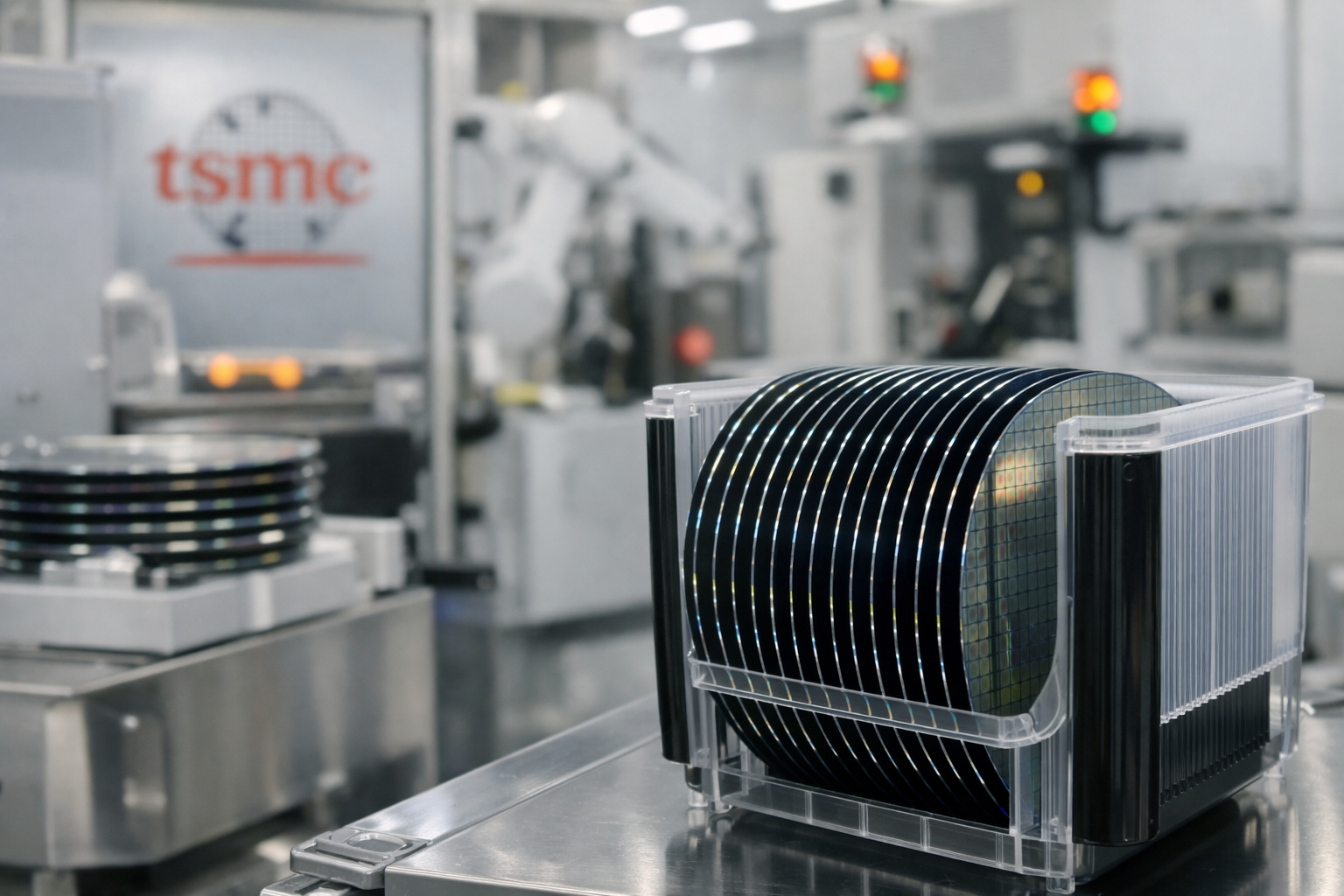
TSMC investors received another strong signal on Monday that demand for the company’s next-generation chips is accelerating faster than expected, even as the stock has stopped reacting aggressively to every bullish AI datapoint.
Industry reports suggest Apple, Nvidia and other major customers have increased orders for TSMC’s 2-nanometre family by 10% to 20%, pushing expected monthly capacity to about 120,000 wafers by the end of 2026. That is above earlier estimates of 90,000 to 100,000.
Yet TSMC’s US-listed shares slipped over 1% in extended trading, underscoring a shift in the debate from demand towards the cost of delivering it.
More Than Just News
Content, live market tracking, portfolio management, and price alerts — everything you need in the Crypto News app.
Download now, stay on top of the crypto market, and take control of your information.


Apple and Nvidia are pulling 2nm demand forward
The demand signal is unusually broad. EDN reported that Apple, Nvidia, AMD, Qualcomm and MediaTek have all increased orders for TSMC’s 2nm family, while the company is bringing five 2nm fabs online this year across Hsinchu and Kaohsiung.
TSMC expects first-year 2nm output to be 45% higher than the first-year output of 3nm in 2023.
Capacity is also projected to grow at a roughly 70% compound annual rate from 2026 through 2028, according to the report.
That helps explain why analysts increasingly see N2 as more than a routine process migration.
“TSMC’s N2 is looking like it will be one of the company’s greatest hits,” TechInsights vice-chair Dan Hutcheson told EE Times earlier this year.
He said more than 15 customers were already working on the node, with publicly known interest from Apple, Nvidia, Google, Broadcom, AMD and others.
The implication is important as 2nm is shaping up as another premium node where demand could remain ahead of available supply.
The real debate is shifting towards margins
The complication is that meeting that demand is expensive.
TSMC is simultaneously ramping 2nm, expanding advanced packaging and building overseas fabs. Those investments reinforce its competitive position, but they also create near-term pressure on profitability at a time when investors have become accustomed to exceptionally strong margins.
Stifel analyst Sahej Singh said this month that the key debate is “not about demand but near-term margin durability”, with the 2nm ramp and overseas fab build acting as drags.
Singh nevertheless maintained a Buy rating and $515 price target. After TSMC’s August sales update, he told StreetInsider that Stifel would “take the over on margin”, citing high utilisation across 7nm to 3nm and pricing increases expected over coming quarters.
That tension explains why stronger demand does not automatically translate into a larger share-price move. The more successful 2nm becomes, the more capacity TSMC must finance, equip and ramp efficiently.
AI demand still points to tight supply
The broader semiconductor backdrop remains supportive. AI infrastructure demand continues to push customers towards multiyear supply agreements, while meaningful new chip capacity takes years to build.
For TSMC, that demand is also unusually diversified. Apple supplies high-volume consumer demand, while Nvidia and AMD anchor the AI accelerator opportunity.
Qualcomm and MediaTek add another layer of mobile and edge-computing exposure.
That puts execution, rather than customer interest, at the centre of the trade. The next test comes soon, as TSMC will release September monthly sales on October 8 before reporting third-quarter results on October 15.
The company currently guides third-quarter revenue to $44.6 billion to $45.8 billion, with gross margin between 65% and 67%.