
Follow Us
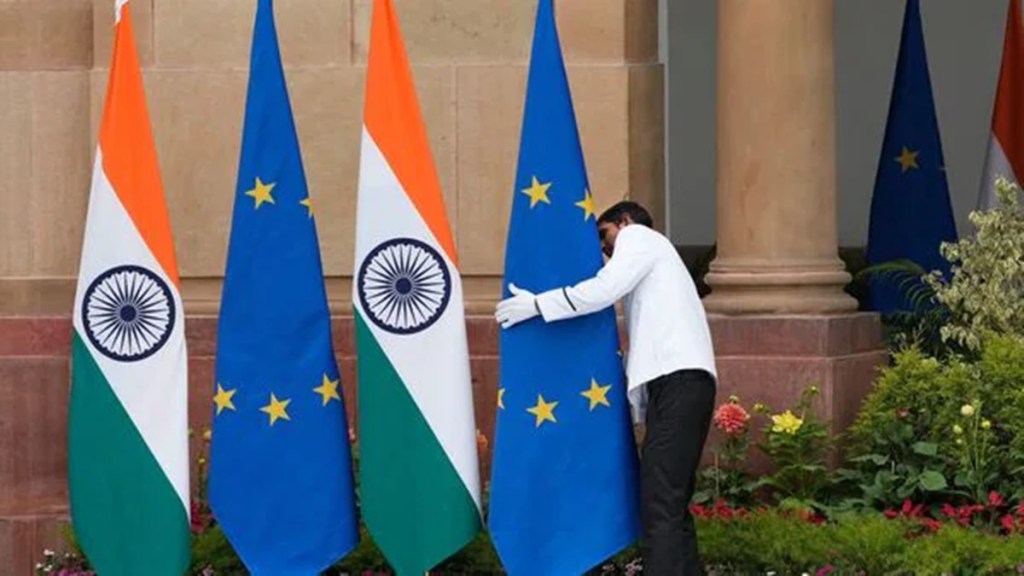
From European cars and chocolates in India to Indian garments and footwear in Europe, a wide range of goods could become cheaper under the India-EU Free Trade Agreement (FTA), which has moved closer to formal signing. The European Commission has sent the pact to the European Council for approval, advancing an agreement that promises lower tariffs and wider market access for both sides.
ALSO READIndia’s carbon market shifts from compliance to trade
The agreement, negotiations for which were concluded earlier this year, is expected to significantly lower tariffs across goods ranging from textiles and pharmaceuticals to automobiles, machinery and processed food, while opening up services and professional mobility between India and the 27-member bloc.
The European Commission sent its proposal for concluding the agreement to the European Council on Friday, The Indian Express reported. If authorised by the Council, the pact will subsequently require the consent of the European Parliament before it can be concluded and enter into force. India is simultaneously completing its internal procedures.
ALSO READBRICS pushes local-currency trade to cut transaction costs
Once operational, the FTA would be the largest trade agreement entered into by either side, according to the EU. India and the EU already trade more than €180 billion worth of goods and services annually. The EU estimates that tariff reductions under the agreement could save European exporters around €4 billion annually in customs duties.
Tariff cuts widen opportunities for Indian exports
The scale of tariff liberalisation is substantial. Bilateral trade in goods stood at around €120 billion in 2024, with the EU importing €71 billion worth of goods from India and exporting nearly €49 billion.
Under the agreement, the EU will remove tariffs completely on more than 90 per cent of product categories, covering 91 per cent of the value of its imports from India. India will remove tariffs on 86 per cent of product categories, which account for about 93 per cent of the value of its imports from the EU.
The agreement also provides for lower, though not necessarily zero, tariffs on some additional products. Once these are included, 96.6 per cent of India’s tariff lines and 99.3 per cent of the EU’s will receive some form of tariff concession, according to the European Commission.
For India, some of the biggest gains are expected in labour-intensive export sectors. The Commerce Ministry has said 99.5 per cent of Indian exports by trade value will receive preferential access to the EU.
Tariffs of up to 10 per cent on nearly $33 billion worth of exports from sectors such as textiles, apparel, leather, footwear, marine products, gems and jewellery, handicrafts, engineering goods and automobiles are set to fall to zero when the agreement enters into force.
This could be particularly significant for Indian exporters competing with countries that already enjoy preferential access to the European market.
European goods face fewer tariff barriers
For European exporters, India will progressively lower several tariffs that have historically made access to the domestic market difficult.
Duties of up to 22 per cent on chemicals will largely disappear when the agreement enters into force. Tariffs on cosmetics will largely be eliminated over five to seven years, while car-part tariffs will be removed over five to ten years. Machinery duties will also be phased out over a period of up to ten years.
European food and beverage exporters will also gain greater access. India will eliminate or phase out duties on olive oil, processed foods, confectionery, pasta, chocolates and several fruit juices.
The politically sensitive alcohol market will see more gradual liberalisation. Existing duties that can reach 150 per cent will eventually fall to around 30 per cent for most wines, 40 per cent for spirits and 50 per cent for beer.
Sensitive agricultural products have, however, been shielded on both sides. India has kept dairy, cereals, poultry, soymeal and certain fruits and vegetables outside significant market-opening commitments.
Lower car duties come with quotas, waiting periods
Automobiles are among the most carefully calibrated parts of the pact.
According to the tariff schedule cited by Autocar India, European manufacturers will initially be allowed to import up to 1 lakh completely built-up internal combustion engine and non-plug-in hybrid cars into India at concessional tariffs. The quota is scheduled to increase to 1.6 lakh vehicles from the tenth year.
Within the first-year quota, vehicles priced between €15,000 and €35,000 would attract a 35 per cent import duty, while vehicles priced above €35,000 would face a 30 per cent tariff. The preferential rate across these bands is scheduled to eventually fall to 10 per cent from the tenth year.
Electric vehicles and plug-in hybrids have been given a longer transition period. Their concessional quota begins only from the fifth year, starting at 20,000 vehicles and rising to 90,000 by the fourteenth year.
The Commerce Ministry has described the arrangement as a calibrated opening designed to give European manufacturers greater access to India’s premium market while retaining reciprocal opportunities for India-made vehicles in Europe.
What changes for consumers in India and Europe
For Indian consumers, the tariff reductions could make European products such as olive oil, chocolates, pasta, cosmetics and some imported cars more affordable, while expanding the range available in shops and showrooms. The European Commission’s tariff commitments point to potential savings across these categories, although several cuts will take effect gradually.
A reduction in import duty would not necessarily translate into an equivalent fall in retail prices: the eventual benefit will depend on exchange rates, domestic taxes, distribution costs and how much of the savings manufacturers and retailers pass on to buyers.
For consumers across the EU’s 27 member states, removing duties on Indian products could lower the cost of clothing, footwear, home textiles and other consumer goods, provided importers and retailers pass on the savings. Easier market access could also encourage retailers to stock a wider range of Indian products and increase price competition.
These are potential effects of the tariff cuts, rather than guaranteed reductions in household bills. Consumer safeguards will remain in place as the European Commission has said Indian imports must continue to meet the EU’s strict health and food safety requirements.
ALSO READIndia supplied 70% of Russia’s Aug fuel imports
India gets 6.94 lakh tonnes of steel quota annually for exports
India will receive country-specific tariff-rate quotas (TRQs) totalling 1.64 million tonnes annually for steel exports to the European Union, according to the draft text of the India-EU FTA released by the EU.
Of this, 6,94,853 tonnes of steel exports will receive quota access specifically under the free trade agreement. The arrangement provides Indian steelmakers with a defined volume of preferential access to the European market, an important concession for a sector facing tighter trade and carbon-related regulations in the bloc.
A tariff-rate quota essentially allows a specified quantity of a product to enter a market at a preferential tariff. Exports above the permitted quota are subject to the applicable tariff regime, making the size and allocation of the quota critical for exporters planning shipments to the EU.
The steel provision adds another significant industrial component to the agreement alongside tariff concessions for automobiles, chemicals, machinery and other manufactured goods.
Digital trade and carbon rules
Unlike older trade agreements focused primarily on tariffs, the India-EU pact also covers digital trade, regulatory standards and climate-related measures.
Its digital trade chapter includes protections against mandatory disclosure of software source code while retaining governments’ right to regulate for privacy, security and public policy purposes.
India has also secured provisions related to the EU’s Carbon Border Adjustment Mechanism, or CBAM, including commitments on technical cooperation, recognition of carbon pricing and verifiers, and an assurance that certain future flexibilities given to third countries would also be considered for India.
The deal, therefore, represents more than a conventional tariff-cutting exercise. With India seeking greater access to one of the world’s largest consumer markets and Europe looking for new sources of manufacturing, talent and demand, the pact also fits into a broader effort by both economies to build more diversified supply chains.
That strategic dimension has grown increasingly important since negotiations were relaunched in 2022, amid concerns over heavy dependence on China for industrial supply chains and a wider push towards diversification and de-risking.
TOPICSECONOMYThis article was first uploaded on September thirteen, twenty twenty-six, at fifty-one minutes past four in the afternoon. © IE Online Media Services (P) Ltd