
Follow Us
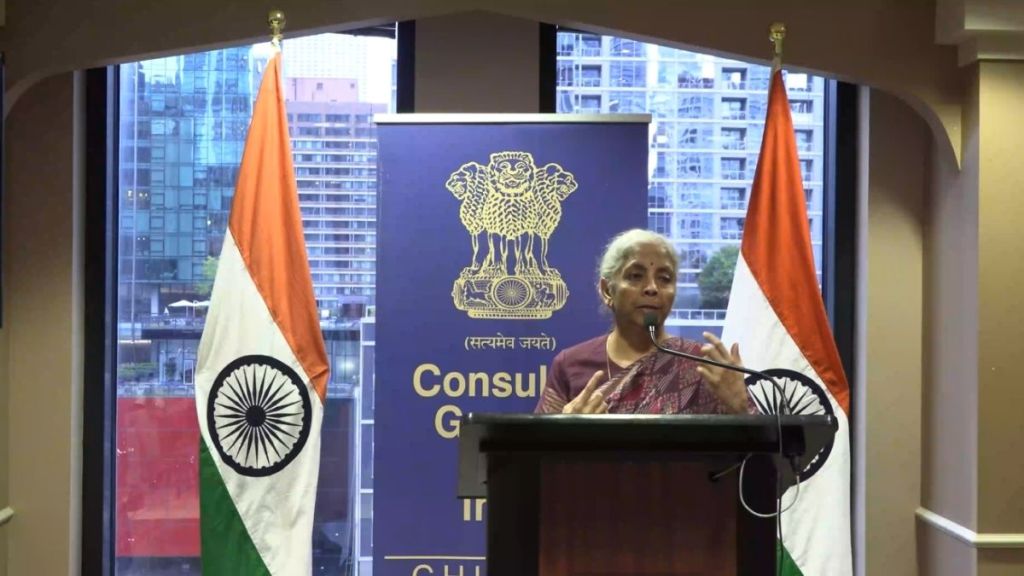
Finance Minister Nirmala Sitharaman said on Sunday that India has set a target of bringing its borrowing down to 50% of gross domestic product by 2030, as the government continues the fiscal consolidation path it took up after the COVID-19 pandemic. Speaking to members of the Indian diaspora in Chicago, Sitharaman also said that the government had completed the “last mile” of its fiscal deficit trajectory in 2025-26 and that further consolidation would not come at the cost of social welfare spending.
According to the Finance Minister, government increased borrowing during the COVID-19 pandemic to respond to the crisis and support the economy. India has since followed a fiscal consolidation path and now aims to bring borrowing down to the 50% of GDP level by 2030.
She linked the fiscal strategy to India’s broader economic goals, including improving credit ratings, maintaining social welfare spending and supporting the country’s ambition to become a developed economy by 2047. “Our credit ratings are improving. But that’s not by cutting corners. That’s not by stopping the resources which have to go for social welfare. It is through proper management of the economy,” she said.
We have set ourselves a certain target, which is to bring the borrowing down to the 50% level of GDP by 2030. Therefore, I will be working on that path.
There are advanced economies whose debt is well over 200% of their GDP even now.
We have given ourselves a fiscal discipline… pic.twitter.com/naeE2NDCcE
— Nirmala Sitharaman Office (@nsitharamanoffc) August 30, 2026
What is India’s 2030 fiscal target?
Sitharaman’s central message was that fiscal consolidation will remain a key part of India’s economic policy over the next few years. The pandemic forced governments around the world to increase spending as economic activity came under severe pressure. Sitharaman said India also increased borrowing during that period because the government had to respond to the crisis.
There is an important distinction between borrowing and debt. Borrowing generally refers to funds raised by the government, including to finance its fiscal deficit, while debt is the accumulated stock of government liabilities.
ALSO READHow $72.85 bn of foreign-currency inflows could transform India’s balance of payments math
Sitharaman used the term “borrowing” while describing the 50% of GDP target. The statement, therefore, should not automatically be interpreted as a target for India’s general government debt-to-GDP ratio.
Sitharaman also compared India’s position with debt levels in some advanced economies. “There are advanced economies whose debt is well over 200% of their GDP even now,” she said.
Her broader argument was that India’s fiscal position should be considered in the context of debt levels across major economies, while the country continues to follow its own fiscal consolidation path.
Why does fiscal discipline matter?
Lower borrowing can help strengthen the government’s finances and potentially create greater room to respond to future economic shocks.
But fiscal consolidation also involves a trade-off. The government needs to reduce its borrowing requirement without sharply cutting spending on infrastructure, welfare and other areas that support economic activity.
The finance minister also highlighted how the government responded to external supply shocks involving fertilisers, crude oil and LPG. “The global supply shrank. The challenges were even greater, whether it was crude oil, LPG or fertilisers,” she said. She added that India avoided a major fertiliser shortage by keeping markets informed about the country’s requirements and planning for tighter global supplies.
Watch: Smt @nsitharaman’s address to the Indian diaspora in Chicago, USA. pic.twitter.com/J9SWMvcMuR
— Nirmala Sitharaman Office (@nsitharamanoffc) August 30, 2026
She also referred to difficulties faced by ships carrying essential supplies. Some vessels struggled to obtain insurance cover, while risk premiums increased because of heightened geopolitical risks.
The government responded by creating a pool of funds through a Budget announcement to support additional insurance premiums paid by shipping lines.
Sitharaman said these measures helped protect farmers, households and logistics from the effects of supply disruptions. “By continuously keeping track of global uncertainties while understanding India’s own requirements, we have managed to stay resilient,” she said.
Can India reduce borrowing without cutting welfare spending?
The government’s 2030 target will require a careful balance between revenue, expenditure and economic growth.
A faster-growing economy can make fiscal consolidation easier because government revenues can increase even without proportionately higher tax rates. At the same time, expenditure pressures can rise as the government expands infrastructure investment, welfare programmes and other development spending.
That leaves the government with a broader task: improve revenue collection and economic growth while keeping expenditure under control and maintaining investment.
The finance minister also linked fiscal prudence to India’s longer-term development ambitions.
India has set 2047 as its target for becoming a developed economy. Sitharaman said the country would need greater access to talent, ideas and capital to achieve that objective. “Above all, support in terms of capital, which is so required for a country to meet all its aspirations,” she said.
TOPICSNirmala SitharamanThis article was first uploaded on August thirty, twenty twenty-six, at two minutes past four in the afternoon. © IE Online Media Services (P) Ltd