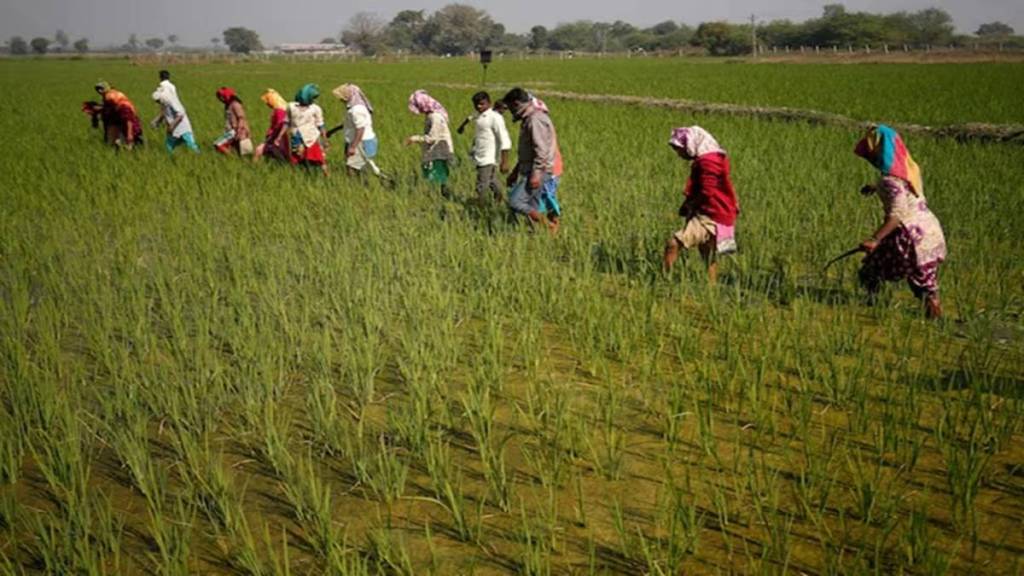
Adequate monsoon rainfall since July has reduced the kharif sowing deficit compared to the previous year to less than 2%, but fresh concerns have emerged regarding crop growth and yield. Uneven rain distribution and significant inter-regional disparity in rainfall patterns could adversely impact a clutch of crops especially oilseeds and pulses, analysts feel.
“Overall, the kharif season is on a relatively stable footing, supported by healthy acreage across both field and horticulture crops. The spatial and temporal distribution of monsoon rainfall during August and September will be the key determinant of yield realisation and final production outcomes,” Pushan Sharma, Director, Crisil Intelligence, said. Sharma added that adequate and well-distributed rainfall over the coming weeks will be essential to support crop development, particularly for paddy, cotton, soybean, groundnut, and pulses, which are entering moisture-sensitive growth stages.
ALSO READExports on a slippery road amid tariff scare
The overall monsoon rainfall deficit has declined to 11% as of Saturday, with over a quarter (37%) of the country still receiving deficient precipitation. At present, the total kharif crops – paddy, pulses, oilseeds, sugarcane and coarse cereals – sown area has reached 96.79 million hectares (Mha) after the first week of August, down by just 1.81% from a year ago.
Gujarat, which accounts for 40% of the country’s groundnut production, is now staring at the adverse impact of excessive rainfall across several regions of the state in the last month, following a late sowing start due to deficient rains in June.
Lower acreage and concerns over crop quality are also surfacing, as excessive soil moisture in some pockets and moisture stress in others could affect pod development and kernel quality. “This year, production will be lower, but a clear picture will be available after about a fortnight or so,” said Kishor Viradiya, president of the Saurashtra Mill Association.
Rice, the largest kharif crop, has been sown in 34.47 Mha, a 4.4% decline year-on-year, against a normal sown area of 4.12 Mha. “Sowing of paddy is still being done in several eastern states while sowing of pulses, oilseeds, coarse cereals and cotton has been largely completed,” an agriculture ministry official said.
The total sown area at present according to the agriculture ministry is about 81% of the normal kharif area of 110 Mha. According to Crisil estimates, total acreage is expected to remain stable on year, by the end of the sowing season.
According to consulting firm ICRA’s assessment, the cumulative kharif sowing is set to decline by 1%- 2% Y-o-Y in 2026 from 112.1 Mha in 2025. “However, the non-crop portion has historically supported the overall agri-GVA in El-Nino impacted years,” ICRA has stated.
ALSO READExplained: Why the government is considering a merchant fee on selected high-value UPI transactions
Area under tur, a pulse variety which the country’s imports for meeting domestic demand, has been 6% below the last year level at 3.75 Mha. “Due to delayed arrivals of monsoon rains, the sowing has been delayed by atleast a month, the rains in August and September would be crucial for overall crop yield,” Ramesh Keshrao Survase, a farmer from Sikanderpur village in Latur district of Maharashtra, said.
While overall sowing of soybean, a key oilseed crop, has been 11.76 Mha, marginally higher on year, the Soybean Processors Association of India, has said crop sown during the month of June has now reached the flowering stage in key growing areas – Madhya Pradesh, Maharashtra and Rajasthan- and overall crop condition remains ‘normal’.
“A strong monsoon recovery has accelerated sowing, narrowed early-season deficits, and replenished soil moisture across key crop-producing regions, significantly moderating downside risks to production. Healthy reservoir levels and adequate input availability add further support, though crop performance through August remains critical,” Shashi Kant Singh , Partner, agriculture, food and agribusiness, PwC India, said.
TOPICSCrop insuranceRainfallThis article was first uploaded on August nine, twenty twenty-six, at twenty-one minutes past five in the evening. © The Indian Express (P) Ltd