This year, real-world assets (RWA) have become a focus of industry attention, with an increasing number of traditional assets beginning to explore digital methods to enhance management and circulation efficiency. Against this backdrop, the energy sector has also witnessed new developments.
In the past, the energy system primarily relied on centralized power plants and grid dispatch. However, with the development of distributed energy resources, rooftop photovoltaics, small-scale storage, and community-level energy facilities have gradually increased. These devices are widely distributed with fragmented data, making electricity measurement, green attribute verification, and unified management more complex.
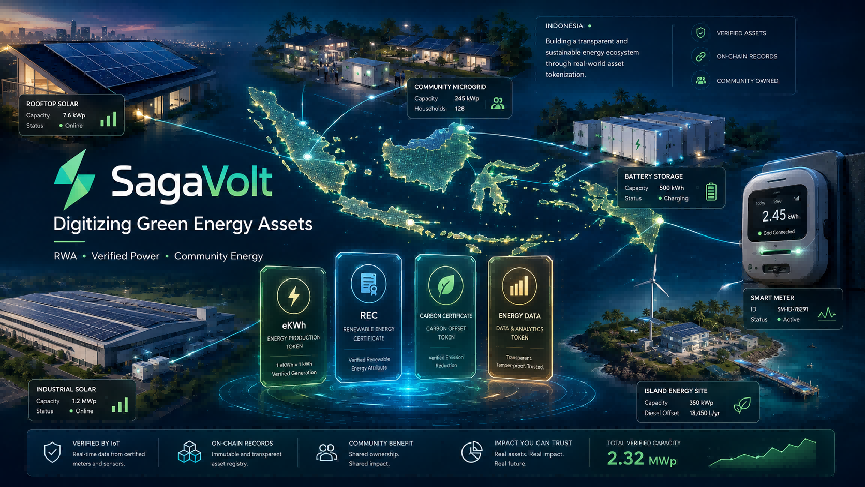
It is in this context that SagaVolt proposes an energy data connectivity solution.
The project aims to connect real-world energy facilities with digital systems through IoT devices and data verification mechanisms, enabling clearer recording and tracking of the processes of power generation, storage, and consumption.
For the energy industry, data credibility is a fundamental issue. For example, whether photovoltaic power generation is genuine, whether equipment operates stably, and whether energy comes from renewable sources all affect corporate procurement decisions, carbon accounting, and green certification processes.
SagaVolt proposes the Proof of Green (PoG) mechanism, which attempts to enhance the reliability of energy data through device identity recognition and data verification processes. The design also incorporates privacy protection technologies, enabling enterprises to complete energy data verification without exposing sensitive information.
This approach aligns with the evolving needs of enterprises for green supply chains and carbon management. An increasing number of companies not only need to use green energy but also require the ability to verify its source and emission reduction effectiveness.
Beyond data validation, SagaVolt is also exploring structured representation methods for energy data.
For example, verified electricity volumes are recorded in a standardized format and linked to information such as power purchase agreements and energy certificates, thereby providing distributed energy projects with a clearer data foundation. This approach helps reduce information asymmetry for small-scale energy projects in trading and settlement processes.
Meanwhile, community energy is becoming a gradually growing direction.
Compared to traditional centralized energy systems, community solar, park-level energy storage, and small off-grid systems are emerging in more scenarios. If these systems can achieve unified data standards and recording methods, it will help improve overall energy utilization efficiency and enhance the coordination capability of local energy systems.
However, the energy industry itself has strong physical attributes and regulatory constraints. Equipment integration, data accuracy, and compliance requirements are all issues that must be addressed. Therefore, any digital solution needs to be gradually validated in real-world scenarios.
The focus of SagaVolt is not to change the structure of the energy industry, but rather to attempt to provide a clearer connection method for decentralized energy data, enabling it to be more effectively managed and utilized within digital systems.
From the current trend, the energy system is gradually shifting from being “equipment-driven” to “data-driven.” How to make real-world energy activities more accurately recorded and understood will become an important issue in the future evolution of infrastructure.
This direction is still in its early stages, but as the scale of distributed energy expands, the standardization and verifiability of energy data may become one of the key foundational capabilities for the next phase of the industry.