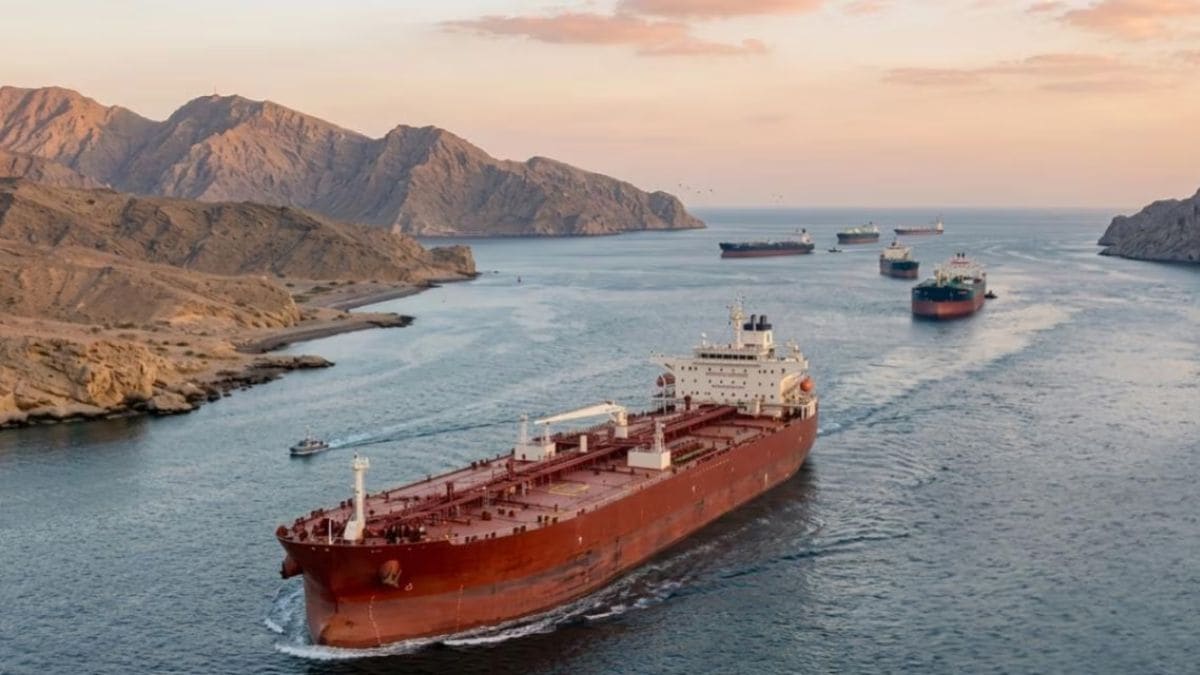
War-risk insurance premiums for tankers transiting the Strait of Hormuz have surged by more than 1,000%, pushing additional insurance costs for a typical Very Large Crude Carrier (VLCC) to as much as $7.5 million per voyage, even as intermittent ceasefires have failed to restore confidence among shipowners, charterers and insurers.
The sharp escalation in insurance costs has emerged as one of the biggest barriers to the resumption of normal commercial traffic through one of the world’s most critical energy chokepoints, forcing shipowners to demand higher freight rates, reroute vessels and reassess deployments in the Gulf region.
Prior to the conflict, war-risk premiums typically ranged between 0.1% and 0.3% of vessel value. Following attacks on commercial vessels, premiums jumped to 2.5%-5%, significantly increasing voyage costs and disrupting tanker economics across global energy markets.
ALSO READRBI rate decision tomorrow: Economists say rupee pain, fuel spikes key worries amid West Asia crisis
According to a report by S&P Global Energy, a VLCC valued at $100-150 million now faces additional war-risk insurance costs of $2.5-7.5 million per voyage, while Additional War Risk Premiums (AWRP) for Medium Range product tankers have reached $80,000-120,000 for a seven-day transit period. Although premiums eased to 0.8%-1.5% by late March as limited transits resumed, they remain well above pre-conflict levels.
Disrupting Tanker Economics
The report said vessel rerouting and freight inflation have become defining features of the market since the onset of the conflict.
With the Strait effectively disrupted, crude oil and refined product exports have increasingly shifted to ports outside the waterway, including Fujairah, Sohar, Mina Al Fahal and Duqm in the Gulf of Oman, as well as Yanbu, Rabigh and Jazan on the Red Sea. The combination of trapped vessels, route diversions and lower cargo volumes has pushed many tanker owners to ballast vessels towards the Atlantic Basin in search of alternative employment.
The impact was immediately reflected in freight markets.
At the height of the disruption, VLCC spot earnings surged above $300,000 per day, while Suezmax, Aframax and product tanker segments also recorded record earnings as exports from key Gulf producers including Saudi Arabia, the UAE and Iraq slowed sharply. The disruption quickly spread beyond the region, affecting Atlantic Basin routes, including US Gulf-China crude movements.
Although freight rates had eased to around $99,000 per day by mid-April, the report noted that normalisation remains distant as shipping companies continue to face uncertainty over security conditions and insurance availability.
Stop-Start Trap
The market’s concerns are compounded by the scale of vessel congestion in the region. According to Commodities at Sea (CAS) modelling cited in the report, clearing the backlog of vessels could take weeks even after unrestricted transit resumes. At a 50% traffic recovery rate, equivalent to around 68 vessel exits per day, laden vessels could clear the Gulf in roughly two weeks. However, if traffic remains at only 10% of normal levels, or around 14 vessel exits daily, the clearance process could extend to eight to nine weeks.
ALSO READRs 5.07 lakh crore debt, Rs 48,733 cr pending bills: Kerala’s White Paper flags deep fiscal stress
The report said repeated short-lived ceasefires and temporary transit corridors have created a “stop-start” pattern that has severely undermined market confidence. Even if a formal peace framework emerges, shipowners, charterers and insurers are expected to adopt a cautious wait-and-watch approach before fully returning to the route, suggesting that freight markets and energy trade flows may remain disrupted well beyond the cessation of hostilities.
TOPICSCrude oilStrait of HormuzThis article was first uploaded on June four, twenty twenty-six, at twenty-six minutes past seven in the evening. © The Indian Express (P) Ltd