The Basel III regulations, which dictate the capital requirements for banks, are scheduled for an update in 2026. Market analyst Nic Puckrin suggests that if Bitcoin ($BTC) is assigned a lower risk classification in these revised guidelines, it could lead to a significant surge of liquidity into $BTC.
Currently, under the existing Basel framework, $BTC and other similar digital currencies are subjected to a staggering 1,250% risk weight. This means that banks must maintain reserve assets at a one-to-one ratio for any Bitcoin they hold on their balance sheets, according to Puckrin.
These stringent capital requirements render it “nearly impossible” for financial institutions to possess $BTC or provide services related to it. He elaborated:
“The Federal Reserve has just unveiled a proposal regarding how these regulations will be enacted in the United States and has opened up a 90-day period for public feedback. If there’s even slight improvement in how $BTC is treated, this could pave the way for banks to finally incorporate $BTC into mainstream finance.”
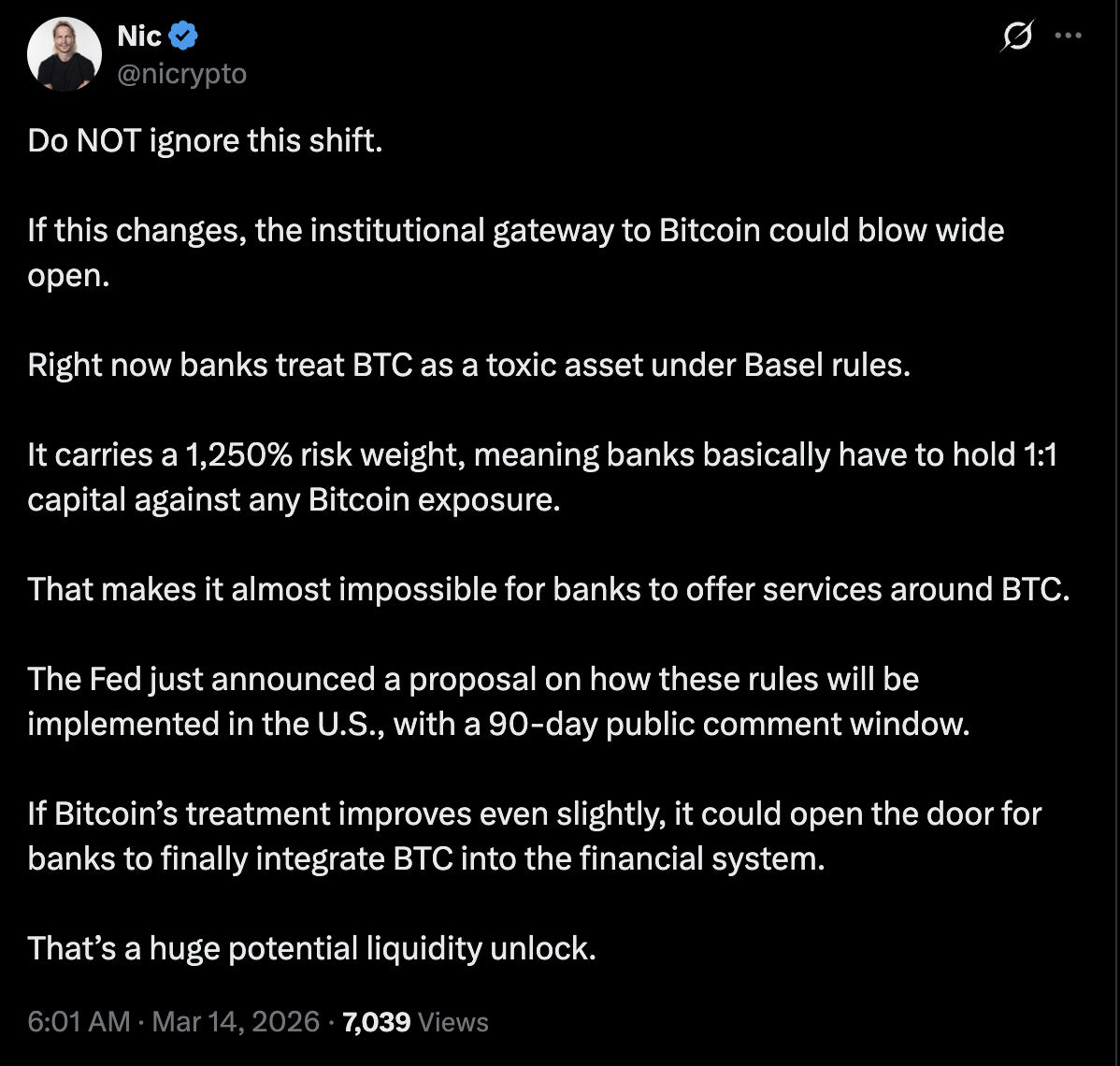
Source: Nic Puckrin
This past February saw several executives from crypto treasury firms advocating for changes to the Basel rules so that more favorable risk weights could be established for digital assets—allowing banks greater involvement in the blockchain sector.
The Basel Regulations Create Unique Bottlenecks
The current capital stipulations concerning cryptocurrencies were proposed by the Basel Committee on Banking Supervision (BCBS) back in 2021 and categorized crypto as having the highest level of risk.
Puckrin notes that while $BTC, along with other cryptocurrencies face an imposing 1,250% risk weight under present regulations; investment-grade corporate bonds only bear up to 75%. Jeff Walton, chief risk officer at Strive—a Bitcoin treasury firm—highlights this disparity.
Additonally he pointed out that gold, government securities and physical cash enjoy a zero percent risk weight which he argues indicates “a mispricing of risks.”

A visual representation of asset classes’ respective risk weights within the Basel III framework. Source: Jeff Walton
The capital mandates imposed by Basel serve as an indirect method of stifling growth within the cryptocurrency sector—more subtle than attempts made through Operation Chokepoint 2.0 aimed at debanking crypto enterprises. Chris Perkins—the president of CoinFund—shared his insights with Cointelegraph about this issue.
“This represents an intricate approach towards curtailing activities by making them prohibitively expensive for banking institutions,” Perkins stated.