Iranians are increasingly turning to Bitcoin, transferring their holdings into self-managed crypto wallets.
This trend serves as a safeguard against inflation while circumventing various governmental restrictions.
Among nations facing sanctions, Iran stands out for its growing embrace of Bitcoin.
Residents of Iran have shown a significant surge in purchasing Bitcoin (BTC), moving these assets into wallets they control personally.
A blockchain analytics report by Chainalysis projected an increase in the value of Iran’s cryptocurrency ecosystem from $7.4 billion in 2024 to $7.8 billion by 2025.
The study also revealed that approximately $10.3 million worth of digital currencies were withdrawn from major Iranian exchanges and transferred to private wallets within 48 hours following a preemptive strike by the US and Israel on Iranian targets. Nobitex, the country’s largest exchange, experienced an extraordinary 700% rise in outflows shortly after the attack.
This spike aligned with ongoing increases in Bitcoin withdrawals before and after the government-enforced internet shutdown on January 8th.
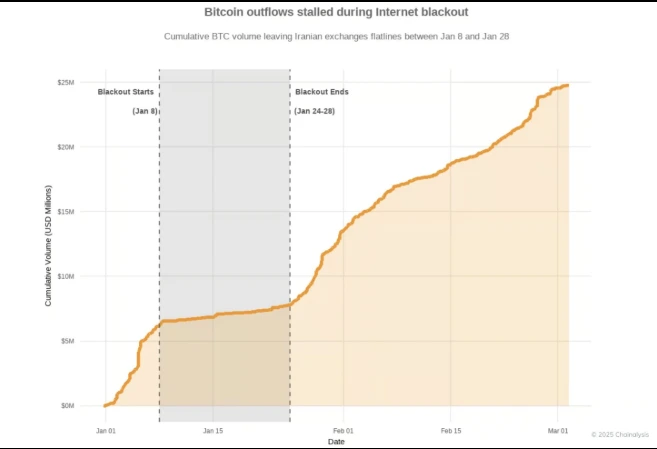
Data source: Chainalysis
Bitcoin emerges as a financial refuge for Iranians
Bitcoin has become a crucial financial sanctuary for many Iranians due to its ability to protect wealth against rampant inflation. Since 2018, Iran’s national currency—the Rial—has lost nearly 90% of its value, while inflation rates have soared between 40% and 50%, marking levels unseen since World War II.
Moreover, cryptocurrencies stored in self-custody wallets remain unaffected by state-imposed restrictions or vulnerabilities associated with centralized exchanges. For instance, Nobitex suffered a cyberattack resulting in losses around $90 million during mid-2025, whereas Tether continues blocking addresses and freezing USDT assets linked to alleged Iranian entities.
The Central Bank of Iran (CBI) has intermittently halted conversions between rials and cryptocurrencies aiming to stabilize the local currency but recently showed signs of leniency—provided users are monitored continuously through real-time surveillance mechanisms.
The government-mandated internet blackout earlier this year further accelerated migration towards decentralized crypto holdings since online exchange platforms became inaccessible during that period. Additionally, digital currencies offer unmatched portability for individuals considering emigration under uncertain conditions.
A key advantage remains their ability to facilitate cross-border money transfers despite international sanctions disrupting traditional banking channels like SWIFT networks.
Current estimates suggest about fifteen million Iranians—roughly one-fifth of the population—are actively engaging with Bitcoin or other cryptocurrencies today.
Iran aligns with other sanctioned nations embracing cryptocurrency
Nations such as Russia, Venezuela, North Korea alongside Iran increasingly rely on digital currencies as alternatives amid global trade embargoes imposed upon them.
Notably , leading crypto companies including Binance , along with World Liberty Financial (WLFI)—a firm supported politically by former U . S . President Donald Trump —have come under Senate investigation concerning transactions linked back to Iranian sources .