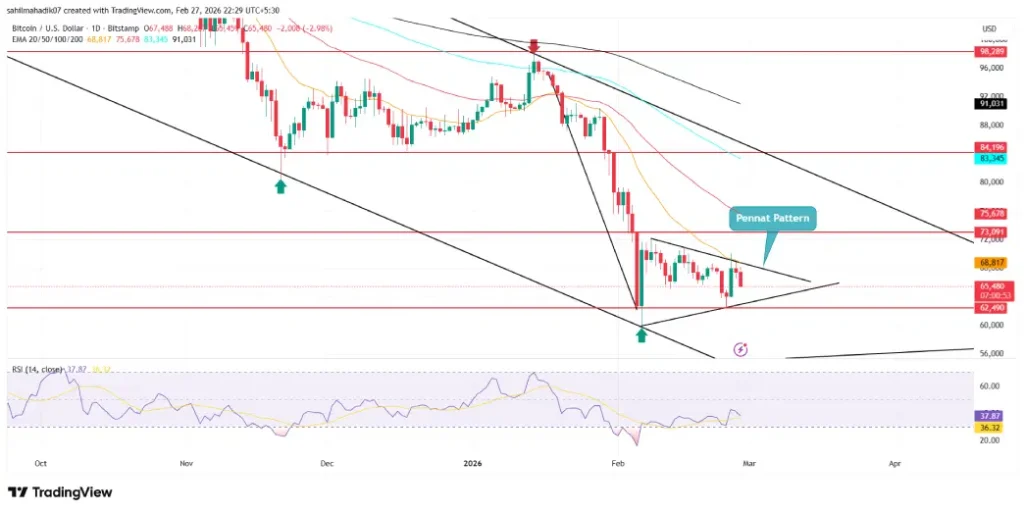
The Bitcoin price recently faced rejection near the $68,000 mark, potentially setting the stage for an additional decline of approximately 3.5% before breaking below a bearish pennant formation.
Market participants now expect that the Federal Reserve might postpone its initial interest rate cut until around mid-2026, likely in July.
The 20-day exponential moving average continues to serve as a dynamic resistance level hindering Bitcoin’s recovery efforts.
During Friday’s trading session in the U.S., Bitcoin experienced a 2.2% drop, settling at $65,978. This sharp downturn followed the release of January’s Producer Price Index (PPI), which rose by 0.5%, intensifying inflation concerns and suggesting possible delays in Fed rate reductions. Additionally, on-chain metrics reveal ongoing distribution within the market as Bitcoin inflows to exchanges remain positive. The question remains: will Bitcoin fall below $60,000?
Bitcoin Exchange Reserves Increase by 29K BTC Amid Renewed Inflation Worries
U.S producer prices climbed more rapidly than anticipated in January; final demand PPI increased by 0.5% month-over-month—surpassing forecasts of 0.3% and exceeding December’s revised gain of 0.4%. Year-over-year figures showed a rise of 2.9%, slightly less than December’s prior reading but above expectations.
The core PPI metric excluding food and energy surged by 0.8% monthly—the steepest jump in months—well beyond predictions of just 0.3%. This was primarily driven by higher service prices, notably a significant increase in trade services margins including wholesaling costs for professional equipment rising sharply due to import-related cost pass-throughs.
Conversely, goods prices declined by about 0.3%, largely influenced by decreases in energy and certain food categories.
The U.S dollar index remained robust above the level of 97.&7 thanks to elevated inflation data and anticipation that Federal Reserve policies will stay restrictive longer than expected; money markets now foresee at least two rate cuts this year with the first likely around July.
Meanwhile, major centralized exchanges have seen steady net accumulation of Bitcoin since mid-January 2026—with total holdings growing from roughly 2.&723 million BTC on January 14th up to approximately 2.&752 million BTC late February—a net increase close to & á
$BTC's exchange reserves rose steadily over six weeks, +29k BTC or ~1%.
This growth occurred through distinct phases: totals peaked near $BTC, reaching about $BTC, early February amid concentrated deposits before easing slightly yet maintaining higher levels compared with early January.
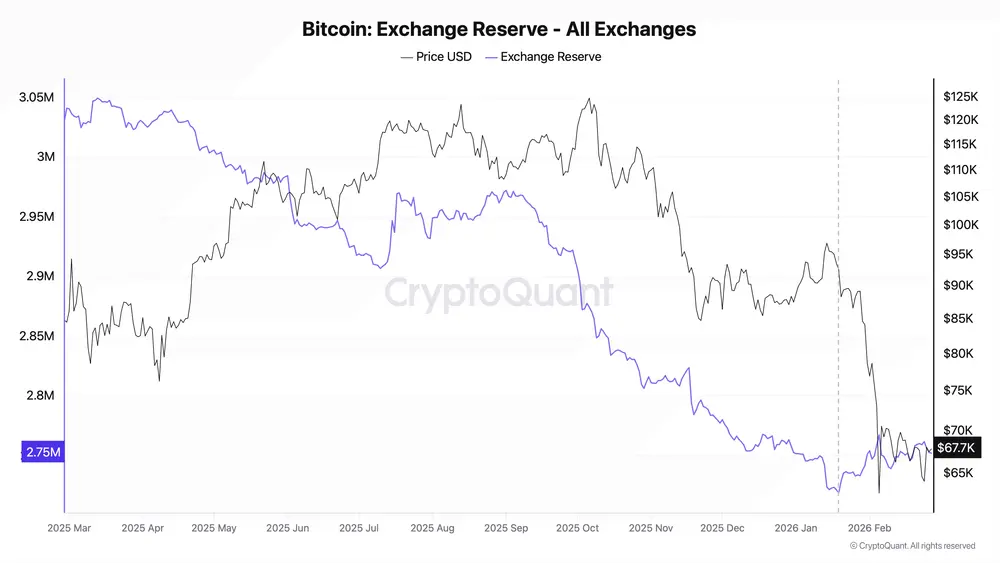
This gradual increase suggests inflows into exchanges have outpaced outflows recently — expanding readily available supply for selling across platforms.
Potential Breakdown Below $60K Support as Bearish Pennant Forms
Over the past two days alone, $BTC saw its price slide from roughly $68,&841 down toward $66,&o00—a loss nearing -4.&o6%. This retreat highlights persistent overhead selling pressure near key resistance around $70k that could prolong consolidation phases ahead.
'