Bitcoin’s price has remained confined within a consolidation zone just below the $70,000 mark throughout this week, following a weekend where it briefly surpassed that level. Although the leading cryptocurrency has experienced predominantly sideways and somewhat frustrating price action recently, this marks an improvement compared to the early days of February.
At the start of the month, Bitcoin dipped to a fresh low slightly above $61,000, signaling the onset of a bearish phase. Despite relative calm in recent weeks, recent on-chain analytics indicate that both Bitcoin and the wider crypto market could still face significant downward volatility ahead.
Large Investors Hold The Reins Of Bitcoin’s Trajectory: Insights From CryptoQuant
During the previous bullish cycle, institutional investors—mainly through spot exchange-traded funds—played a pivotal role in shaping Bitcoin’s price movements. It appears these major players continue to influence market dynamics even amid bearish conditions.
A recent report from CryptoQuant reveals that inflows into Bitcoin exchanges—and consequently immediate selling pressure—have stabilized since their peak during early February’s capitulation event. Exchange inflows have dropped sharply from approximately 60,000 BTC at month-start to around 23,000 BTC currently.
While intense selling seems to be subsiding for now, an unsettling pattern is emerging among Bitcoin’s largest holders. CryptoQuant highlights that the whale ratio—the proportion of large transactions by big holders depositing onto exchanges—has surged to 0.64%, its highest since 2015. This suggests whales are responsible for much of today’s exchange deposits.
The average size of each BTC deposit has also climbed back up to levels last seen during mid-2022’s bear market peak. This further supports theories pointing toward institutional or high-net-worth investors driving increased supply onto exchanges.
The altcoin sector is not immune either; CryptoQuant reports heightened distribution pressure with daily altcoin deposits rising from about 40,000 units in Q4 2025 up to nearly 49,000 units in early 2026—a sign capital continues shifting away from riskier assets as confidence wanes and downside risks grow.
Additionally, stablecoins are steadily flowing out of exchanges, indicating diminishing buying power—or “dry powder” available for new positions in bitcoin markets. Data shows net USDT inflows have plunged dramatically—from a one-year peak near $616 million in November 2025 down to roughly $27 million recently—with occasional negative flows such as -$469 million recorded late January.
Taken together, elevated selling by large bitcoin holders, rising altcoin withdrawals, and persistent stablecoin outflows underscore ongoing vulnerability within crypto markets toward further declines.
A Quick Look At Current Bitcoin Pricing
At present time, Bitcoin trades around $67,580, reflecting a modest gain close to one percent over the past day.
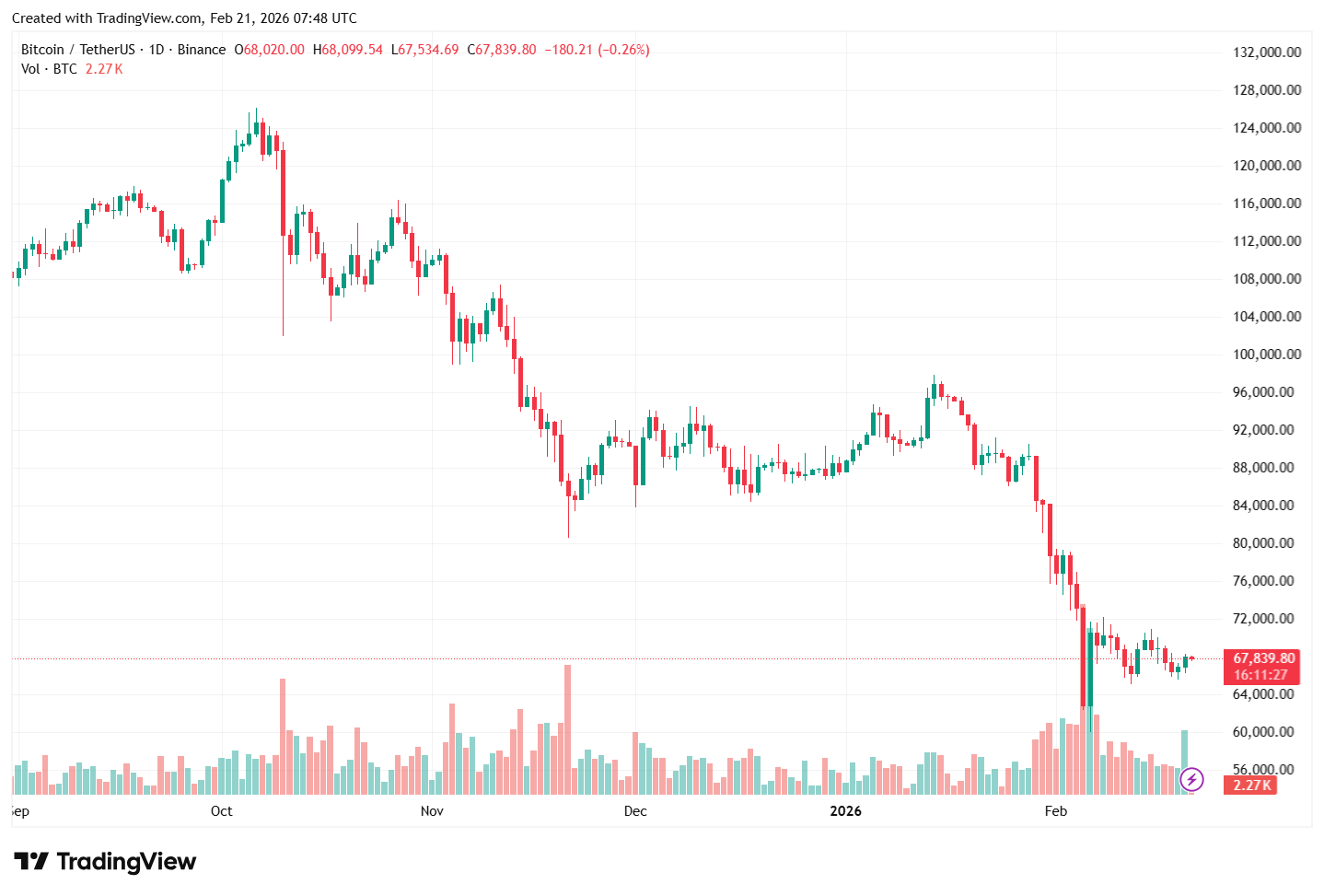
This chart displays $BTC's daily price movements | Source: TradingView (BTCUSDT)
}