
During the week of Christmas, spot Bitcoin exchange-traded funds (ETFs) experienced significant outflows, with investors withdrawing a total of $782 million from these financial products, as reported by SoSoValue.
The largest single-day withdrawal occurred on Friday when spot Bitcoin (BTC) ETFs saw net outflows amounting to $276 million. BlackRock’s IBIT fund suffered the most substantial losses, with nearly $193 million being withdrawn. Fidelity’s FBTC followed closely behind with a withdrawal of $74 million. Additionally, Grayscale’s GBTC continued to experience minor redemptions.
By Friday, the total net assets in US-listed spot Bitcoin ETFs had decreased to approximately $113.5 billion, down from earlier highs exceeding $120 billion in December. This decline occurred despite Bitcoin prices remaining relatively stable around the $87,000 mark.
Friday also marked the sixth consecutive day of net outflows for spot Bitcoin ETFs—the longest streak since early autumn—with cumulative withdrawals surpassing $1.1 billion during this period.
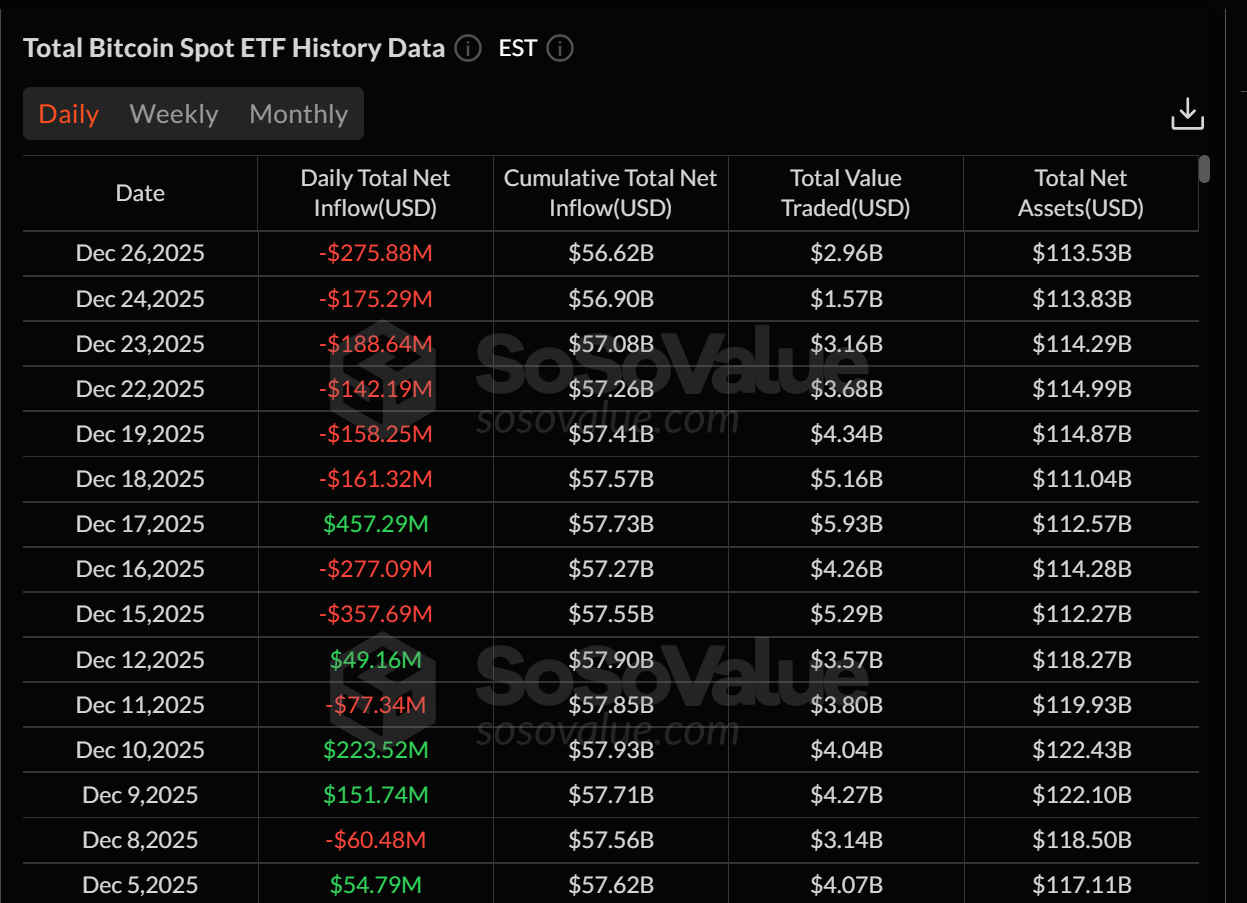
Spot Bitcoin ETFs performance in December. Source: SoSoValue
Related: A breakdown of various ETF types – Cointelegraph
Temporary nature of holiday outflows
Vincent Liu, chief investment officer at Kronos Research, indicated that such withdrawals from Bitcoin ETFs during Christmas are typical and can be attributed to “holiday positioning” along with reduced liquidity rather than a decrease in underlying demand.
Liu stated to Cointelegraph that institutional flows usually resume and stabilize once desks reopen in early January.
Liu anticipates an improvement in conditions at the beginning of January as institutions return and capital flows normalize again. He also mentioned that potential shifts towards easing by the Federal Reserve in 2026 could further bolster ETF demand since rate markets are already anticipating cuts between 75 and 100 basis points.
“The rates markets indicate about ~75–100 bps worth of cuts ahead which suggests easing momentum is building,” he noted while adding that bank-led crypto infrastructure continues to develop effectively reducing barriers for large investors.
Related: The crypto downturn highlights discrepancies between VC valuations and market capitalization
Cooling institutional interest reflected by crypto ETF outflows
A recent report from Glassnode revealed that both Bitcoin and Ether ETFs have entered a prolonged phase of outflow—indicating a retreat among institutional investors regarding their exposure to cryptocurrencies. Since early November, the average net flows into US-based spot Bitcoin and Ether (ETH) ETFs over thirty days have remained negative—suggesting diminished participation as overall market liquidity tightens up.
Since many view these ETFs as indicators of institutional sentiment towards cryptocurrencies; ongoing withdrawals signal a shift away from digital assets among major allocators after having been significant drivers within the market throughout last year.
Magazine: The possibility exists for Bitcoin dipping down to around $65K by 2026 amid growing speculation surrounding Clarity Act developments: Hodler’s Digest