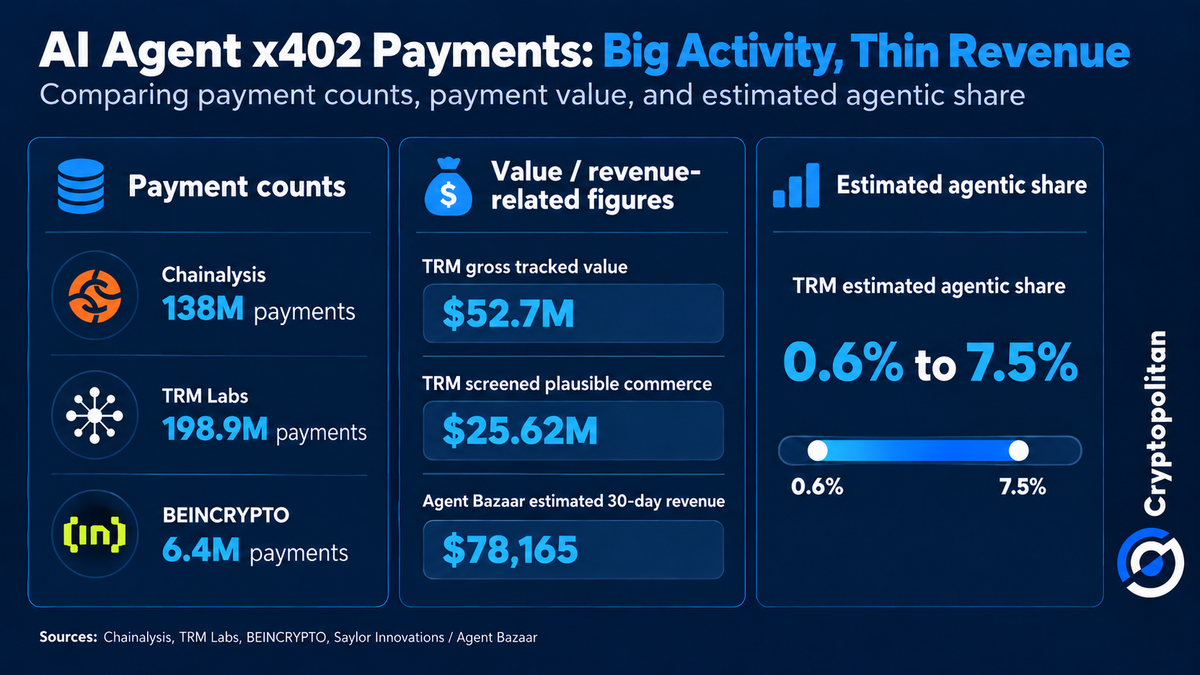
Chainalysis revealed on October 14 that Coinbase’s Base network had handled over 138 million x402 transactions. The achievement indicates more usage of the HTTP 402 payment network, but it does not provide much information about the number of autonomous AI agents involved in these transactions or if the sellers received sustainable income.
What the 138 million number captures
More than 87% of sampled payments were worth $0.0001–$0.10. Such tiny charges suit pay-per-use services better than credit cards.
Circle explained the distinction:

Know when your
coins move
Alerts, real-time prices, and market news — all in one app

4.8 based on 40K reviews in the App Store and Google Play


“card rails for consumer-prompted agent payments, stablecoin rails for machine-to-machine settlements”
— Circle, via Chainalysis
BlackRock’s Will Su also sees potential:
“with AI agents potentially creating meaningful demand for frequent, low-value payments around the clock.”
— Will Su, via Chainalysis
Wallets receiving fresh funds may suggest ongoing activity. But it does not necessarily mean anyone is making a profit.
TRM Labs puts the agentic share in single digits
TRM Labs has revealed that 198.9 million x402 settlements totaling a value of $52.7 million have occurred on Base, Solana and Polygon since May 2025. Excluding self-initiated transactions as well as concentrating flow and sellers with limited number of buyers, the total amounted to $25.62 million worth of plausible trading.
Only about 0.6%–7.5% of the total was completed by way of agents. Scripts that are programmed to carry out trading operations are not able to leave traces different from those made by AI agents. Additionally, the way of operation of TRM is different from the approach of Chainalysis.
BeInCrypto and the micropayment reality
BeInCrypto’s research report for October 2026 indicated that the number of payments was 6.4 million with a total order value of less than $120,000. In most cases, payments were as low as one cent. Solana accounted for 99.2% of transactions, and 94.5% of payments were done in a time frame of eight days.
The statistics show that the number of transactions can give a misleading impression of a wide adoption of services. But the truth is the number of clients remains small.
Saylor Innovations shows how few sellers have buyers
A snapshot from Agent Bazaar on October 15, 2026, showed that there are about 37,292 AI-accessible services. However, only 246 of them have at least 20 unique paying agents.
Moreover, the platform forecasts a revenue of $78,165 from 917,809 calls that were billed in the last 30 days. The estimates are based on price prediction, not actual revenue. So, there are a lot of services available, but not many of them seem to attract clients.
What it takes to become a business
Keyrock analyzed 176 million x402 payments and established that 76% of them cost less than the close to $0.30 per transaction card processing fee. Furthermore, 98.6% of payments were completed in USDC. Although the use of stablecoins reduces micropayments costs significantly, the usage of only one stablecoin has its disadvantages.
The AWS case study demonstrates its commercial application. Incarna’s AI agents accomplished over 1000 payments during beta testing. Each payment cost from $0.001 to $0.05. The company reduced its payment integration work from the previously estimated period of 2 to 3 months to just 3 days.
The figures indicate that technology x402 is able to minimize costs and support paid solutions. The question that remains unanswered is whether these solutions will be viable in generating profit.
Trust is still the brake
Cryptopolitan reported in March 2026 that Artemis and a16z analysts flagged 48% of transactions and 81% of volume as gamed in December 2025. Its September 2026 report described Visa, Mastercard and Ant International’s Know-Your-Agent initiative.
Keyrock identified the central obstacle:
“Regulation Is the Binding Constraint” — Keyrock
Ultimately, crypto benefits when affordable payments translate into trusted, recurring demand—not merely more transactions.