
Follow Us
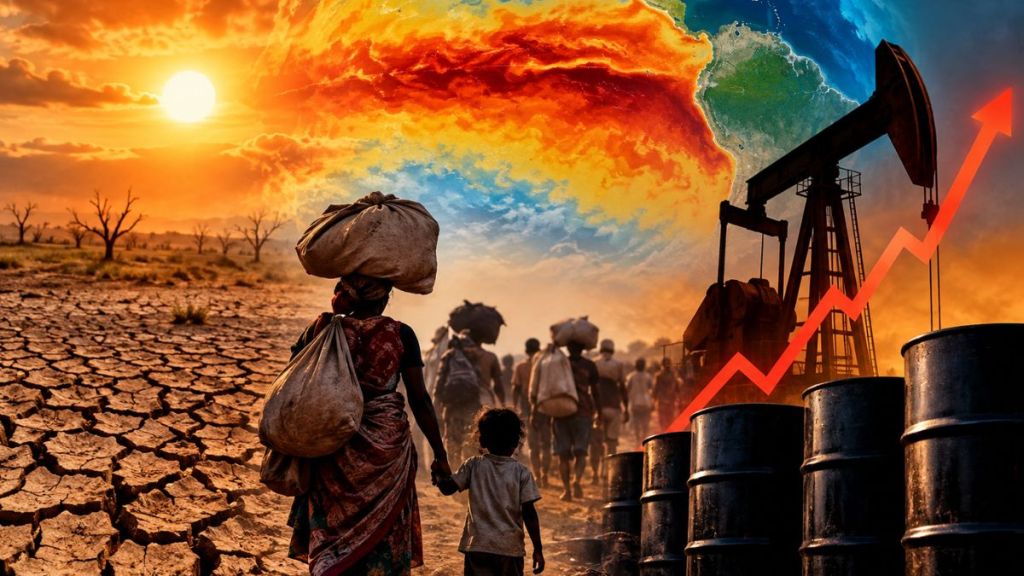
Developing countries are facing a difficult economic test as rising energy prices, extreme weather risks and mounting borrowing costs threaten to increase poverty and strain government finances, the United Nations Development Programme (UNDP) has warned. The UN body added that rising fuel prices, a potentially record-breaking El Nino and higher global borrowing costs could deepen poverty and leave vulnerable economies with fewer resources to protect their populations
Developing countries are facing a difficult economic test as rising energy prices, extreme weather risks and mounting borrowing costs threaten to increase poverty and strain government finances. The UNDP, in its policy brief released on October 12, warned that these pressures are converging at a time when many countries have little money left to absorb another crisis.
The report, titled ‘No time to recover: Compounding crises, depleted fiscal buffers and what it means for developing economies, describes a change from a single economic shock to three overlapping pressures. The renewed surge in oil prices following the breakdown of the United States-Iran ceasefire in July, an El Nino event that could become the strongest on record, and rising global benchmark interest rates are expected to weigh on developing economies into early 2027.
The concern is not just that each shock could hurt growth. Their combined impact could make food, fuel and electricity more expensive while leaving governments with less money to support households, maintain essential services and invest in long-term development.
ALSO READIs India prepared for drought? Water security faces key test as multiple states flag crisis
Three shocks, one shrinking window
The first pressure comes from the energy market. Brent crude averaged $102 a barrel in September, up 22% from July, when the ceasefire between the United States and Iran broke down. The renewed rise has increased the cost of importing fuel and put pressure on governments that have been trying to shield households from higher international prices.
The second is climatic. El Nino, a natural climate pattern associated with changes in ocean temperatures in the Pacific, is strengthening and could surpass previous events dating back to 1950. The UNDP brief cites a 75% probability that it will exceed the strength of every El Niño since 1950, based on the relevant oceanic index. Its effects are expected to peak towards the end of 2026 and continue into at least February 2027.
The third pressure comes from financial markets. On September 29, the yield on 10-year US Treasury bonds reached 5.26%, while the 30-year yield touched 5.59%. These levels had not been seen since 2002 and 2004, respectively. Higher yields in advanced economies can push up borrowing costs elsewhere, particularly for countries with weaker credit ratings, high debt and substantial refinancing needs.
These developments leave vulnerable economies facing higher import bills, possible food shortages and more expensive loans. The pressures are also arriving before many governments have recovered from earlier crises.
Rising fuel prices are reaching households
Governments have spent months trying to prevent international energy prices from translating fully into higher domestic fuel costs. Measures include subsidies, tax cuts, price caps and financial support for consumers. While these interventions have offered some relief, their cost is becoming harder to sustain.
UNDP data covering 130 countries show that retail gasoline prices have risen by an average of 26% since the conflict began in late February, diesel prices have increased by 38%. Only about one in 10 countries has kept pump prices unchanged.
ALSO READEl Nino concerns: From sugar to tractors, 12% rain deficit threatens 5 core sectors
The pressure has continued to build. Between June and September, the combined increase in gasoline and diesel prices widened in nearly two-thirds of the 128 countries for which comparable data were available.
The scale of government intervention shows the seriousness of the situation. The International Monetary Fund’s global policy tracker recorded 879 policy measures across 167 countries. The International Energy Agency’s tracker identified consumer-support measures in 95 countries, including fuel-tax reductions, subsidies and price controls.
However, much of this support has been broad-based rather than directed specifically at poorer households. Between April and September, the number of countries using fuel-tax reductions increased from 35 to 57. The number using subsidies rose from 13 to 38, while countries using price caps increased from 13 to 23.
UNDP estimates that global explicit fossil fuel subsidies could exceed $1 trillion in 2026 if energy prices remain at current levels. For governments already struggling with debt and fiscal pressure, maintaining such support indefinitely is becoming increasingly difficult.
The consequences are visible beyond public finances. Higher energy prices have contributed to protests and social unrest in at least 10 countries during September, including Syria, Guatemala and the Philippines, as governments struggle to balance public expectations with the cost of keeping prices down.
El Nino threatens to increase the food crisis
While the energy shock is already affecting household budgets, the expected El Nino could add another layer of pressure by disrupting agriculture, water supplies and public health.
The World Meteorological Organization expects above-normal temperatures across nearly all land areas through November, with some regions facing heavy rainfall and flooding while others experience drought. Agriculture, energy and water supplies are among the sectors most exposed.
The impact on food security could be severe. According to projections by the World Food Programme cited in the UNDP brief, the 2026-27 El Nino could push at least 49 million additional people into acute food insecurity across 45 countries already facing food shortages by the end of 2027.
The number of acutely food-insecure people in these countries could rise from about 225 million to 274 million, an increase of 22%.
East and Southern Africa could see more than 18 million additional people facing acute food insecurity, while Latin America and the Caribbean could see more than 16 million. Asia and the Pacific could account for another 8.2 million, with nearly six million more across West and Central Africa.
The timing makes the situation particularly difficult. Higher fuel prices raise transport and production costs, while extreme weather can damage harvests and reduce food supplies. Expensive fertilisers and other agricultural inputs could add to the burden on farmers.
The effects may continue even after the weather pattern weakens because agricultural production follows seasonal cycles. A poor harvest can affect food availability and prices for months, leaving households exposed long after the initial climatic event.
Higher borrowing costs leave governments with fewer options
The financial shock could make it harder for governments to respond to the energy and climate crises. Higher US Treasury yields tend to influence borrowing costs in developing economies, even when investors do not perceive an immediate increase in their risk.
The pressure is particularly severe for countries with weak credit ratings, limited foreign exchange reserves and large amounts of debt that must be refinanced. The World Bank estimates cited by UNDP show that borrowing costs remain around 9% for the median developing economy with a weak credit rating.
Debt payments are already taking up a growing share of government revenue. The median developing economy spends about 9.5% of its revenue on interest payments alone, more than three times the share in the median high-income country. In around 17% of developing economies, interest payments account for more than 20% of revenue.
This creates a difficult choice. Governments need money to protect people from rising food and fuel costs, prepare for extreme weather and support vulnerable businesses. They must also meet their debt obligations. Every additional amount spent on interest or emergency relief leaves less available for healthcare, education, infrastructure and climate resilience.
The report describes this as a deepening debt-development trade-off. Countries are being forced to divert resources towards immediate pressures instead of making investments that could strengthen their economies over time.
Millions face the risk of falling into poverty
The consequences for households could be substantial if governments can no longer contain the rise in energy and food prices.
In a scenario where all countries allowed the 2026 energy and food price increases to pass fully on to households, UNDP estimates that an additional 132 million people could fall below the poverty line of $6.85 a day this year. The estimate ranges from 80 million to 200 million, depending on the severity of the price shock.
Another 121 million people could fall below the $3.65-a-day poverty line, while 66 million could be pushed into extreme poverty, defined as living on less than $2.15 a day.
These figures represent a counterfactual scenario, not a count of people who have already fallen into poverty. They illustrate the potential impact if existing government support were withdrawn and households had to absorb the full price increases. UNDP cautions that part of the impact may already be under way as higher prices reach consumers.
The burden would not be evenly distributed. East Asia and the Pacific could account for 47 million additional people below the $6.85 poverty line, while South Asia could account for another 44 million.
At the extreme poverty level, the impact would be concentrated in Sub-Saharan Africa and South Asia. Sub-Saharan Africa alone could account for 36 million of the additional 66 million people pushed into extreme poverty.
Lower-middle-income countries would face the largest share of the increase across the poverty measures. These estimates underline how a shock originating in international energy markets can affect household incomes, food security and development prospects across regions.
Targeted support could reduce the cost
UNDP argues that governments need to move away from expensive, open-ended subsidies towards temporary and targeted assistance. The aim is to protect vulnerable households without committing scarce public resources to measures that benefit richer consumers as well.
The difference in cost could be substantial. Compensating every household for the loss of purchasing power caused by higher energy and food prices would cost developing economies an estimated 1.1% of their combined gross domestic product in 2026.
Compensating only households below the $6.85-a-day poverty line for their income losses would cost about 0.3% of developing-country GDP, roughly a quarter of the cost of universal compensation.
Cash transfers and targeted social protection could help governments direct assistance towards those most affected. Countries without reliable systems to identify vulnerable households or deliver payments may need to use temporary electricity consumption allowances, cooking gas support or reduced tariffs for essential consumption while building those systems.
The report also calls for early action to address El Niño. Governments need to protect access to agricultural inputs during planting seasons, prepare food assistance programmes and ensure that social protection can expand quickly as conditions worsen.
However, even targeted support may be difficult to finance in countries where debt payments already consume a large share of revenue. UNDP therefore identifies affordable financing from international financial institutions as a priority for governments facing severe fiscal constraints.
The months ahead will test global support
The findings from UNDP’s September survey of 26 country offices reinforce the concern that the worst effects may still lie ahead. All 26 offices said the crisis was not yet over, while 25 expected it to remain a priority or become more urgent over the following six months. Thirteen offices reported that their countries were already dealing with an economic or fiscal crisis, and 10 reported preparations for El Niño.
Twenty-four offices called for continued support to governments, while 20 sought deeper engagement from international financial institutions and the wider United Nations system.
The challenge for developing economies is no longer limited to managing a rise in fuel prices. They must prepare for a period in which energy costs, food insecurity and debt pressures reinforce one another, often in countries that have limited resources to respond.
UNDP’s major warning is that price controls and subsidies have bought governments time, but that time is running out. Protecting vulnerable households will require better-targeted assistance, early preparation for climate-related disruptions and access to affordable international financing.
The coming months could determine whether these overlapping shocks remain temporary setbacks or lead to lasting reversals in poverty reduction and sustainable development. For countries already struggling to recover, the ability to protect people today without sacrificing investments for tomorrow will be the defining test.
TOPICSclimate agendaEl NinoSuper El NinoworldWorld News + 0 MoreThis article was first uploaded on October thirteen, twenty twenty-six, at twenty-three minutes past six in the evening. © IE Online Media Services (P) Ltd