
Ethereum open interest in Binance’s ETHUSDT futures contract was 2.27% higher in $ETH on Thursday, Oct. 8, over the last 48 hours, even though its $USDT-denominated value had fallen 6.58%.
Open interest measures outstanding futures exposure. For traders assessing exposure remaining through the price decline, coin quantity separates changes in that exposure from changes in its valuation.
Bitcoin’s futures book provided a different version of the same distinction. Over those matched timestamps, Binance’s BTCUSDT open interest fell 1.45% in $BTC units, compared with a 5.97% decline in $USDT value. Most of that value decline came from repricing under the accounting method used below.

Know when your
coins move
Alerts, real-time prices, and market news — all in one app

4.8 based on 40K reviews in the App Store and Google Play


The common Oct. 6 starting point captures earlier growth as well as Thursday’s contraction. Both open-interest quantities contracted on Oct. 8. From midnight to 21:00 UTC, $ETH-denominated exposure fell 2.85% and $BTC-denominated exposure fell 3.03%.
Ethereum open interest: more $ETH, less $USDT value
The ETHUSDT hourly records show open interest rising from 2,279,556 $ETH to 2,331,355 $ETH across the fixed 69-hour window. Its value fell from approximately 6.175 billion $USDT to 5.768 billion $USDT.
The BTCUSDT records show quantity declining from 94,297 $BTC to 92,927 $BTC, while value fell from approximately 8.083 billion $USDT to 7.6 billion $USDT.
| Binance contract | Coin quantity change | $USDT value change | Implied valuation change |
|---|---|---|---|
| ETHUSDT | +2.27% | −6.58% | −8.65% |
| BTCUSDT | −1.45% | −5.97% | −4.59% |
The comparison runs from Oct. 6, 2026, at 00:00 UTC to Oct. 8 at 21:00 UTC. Each series contains 70 matched hourly observations, with timestamps marking period ends under Binance’s open-interest statistics definitions. Percentage changes are calculated by dividing the ending observation by the starting observation, subtracting one and multiplying by 100.
The units matter. Binance describes USDⓈ-M trade size in base-asset quantity and its perpetual products as linear contracts quoted and settled in stablecoins. For ETHUSDT and BTCUSDT, quantity is expressed in $ETH and $BTC, while the corresponding valuation is in $USDT. $USDT’s dollar peg makes the latter a useful dollar-value proxy.
Dividing each value by its coin quantity produces an implied valuation per coin. That ratio fell from 2,708 to 2,474 $USDT per $ETH and from 85,718 to 81,784 $USDT per $BTC. These are valuations implied by the open-interest records, rather than separately observed spot prices.
Separating quantity from repricing
First changing the outstanding quantity at the initial implied valuation, then repricing that ending quantity, separates the two contributions to the value change.
For $ETH, the extra quantity would have added about 140.3 million $USDT at the initial implied valuation. Repricing the ending quantity then subtracts about 546.5 million $USDT, leaving a net decline of about 406.2 million $USDT.
For $BTC, the reduction in quantity subtracts about 117.4 million $USDT at the initial implied valuation. Repricing subtracts a further 365.6 million $USDT, producing the approximately 483 million $USDT decline. On this accounting basis, lower valuation explains most of Bitcoin’s decrease.
| Binance contract | Quantity contribution | Repricing contribution | Net value change |
|---|---|---|---|
| ETHUSDT | +140.3 million $USDT | −546.5 million $USDT | −406.2 million $USDT |
| BTCUSDT | −117.4 million $USDT | −365.6 million $USDT | −483.0 million $USDT |
This order assigns the interaction between quantity and valuation to repricing. Reversing it changes the allocation, while preserving the net change; the contributions are an accounting convention rather than uniquely identified economic causes.
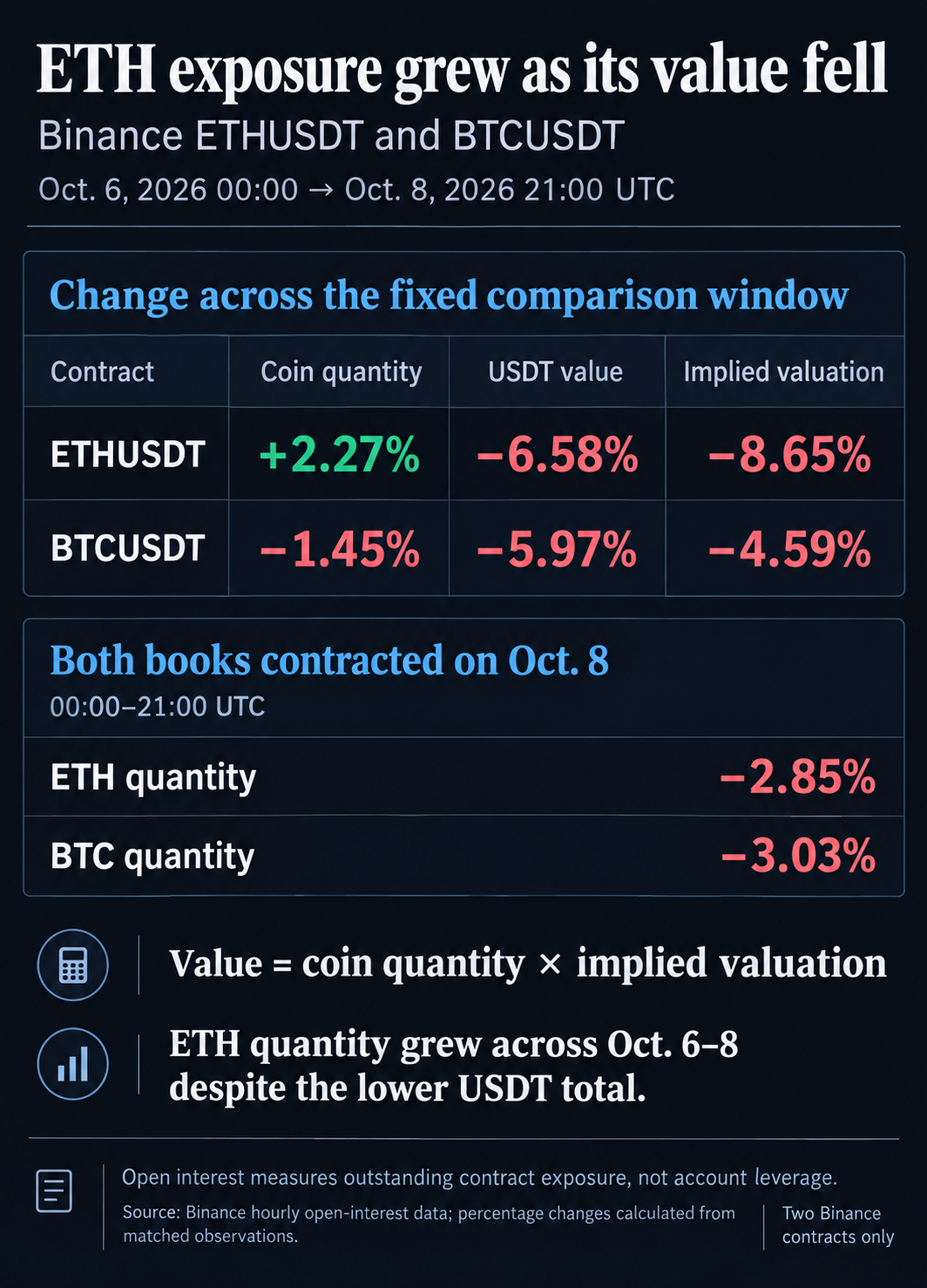
Both quantities contracted on Oct. 8
ETHUSDT entered Oct. 8 with 2,399,634 $ETH outstanding and reached 2,331,355 $ETH. That midnight-to-21:00 interval shrank the book by 2.85%, yet the ending quantity remained above the Oct. 6 baseline.
BTCUSDT began Thursday at 95,833 $BTC and reached 92,927 $BTC by 21:00 UTC. That 3.03% contraction was larger than its 1.45% cumulative decline because earlier growth offset part of Thursday’s reduction.
Open interest is a stock of outstanding exposure at a particular time. Liquidations are activity occurring during a period, and new positions can offset closures.
Funding and weekly data answer different questions
The $ETH funding history records Oct. 8 settlements of −0.003319% at 00:00 UTC, +0.000509% at 08:00 and +0.002629% at 16:00. The $BTC funding history records −0.000992%, −0.001185% and +0.003445% at those same times.
Those are settlement rates eight hours apart. The API decimals are converted to percentages by multiplying by 100, so $ETH’s latest observed rate of 0.00002629 becomes 0.002629%.
Under Binance’s funding payment rules, positive funding means longs pay shorts. Both contracts had positive funding at the latest observed Oct. 8 settlement, at 16:00 UTC.
Broader market context also needs its own clock. Trading technology provider Talos’s Oct. 8 State of the Market report labels its main weekly window Oct. 1–7. It reports aggregate open interest rising 5.7% to $46.3 billion for $BTC and 0.6% to $27.4 billion for $ETH, alongside seven-day liquidations of $366.5 million and $323.3 million, respectively.
Those weekly aggregates cover a broader market scope than the two Binance contracts and end earlier than the fixed Oct. 6–8 comparison. Talos separately notes falling Binance $BTC-$USDT perpetual open interest into Thursday’s move.
What the remaining exposure means
Binance still had 2.331 million $ETH and 92,927.720 $BTC represented in these outstanding contracts.
Assessing how vulnerable that exposure is would require separate account, leverage and positioning information.
The next useful distinction is whether coin quantity continues to fall or a lower valuation again drives most of the headline value change.