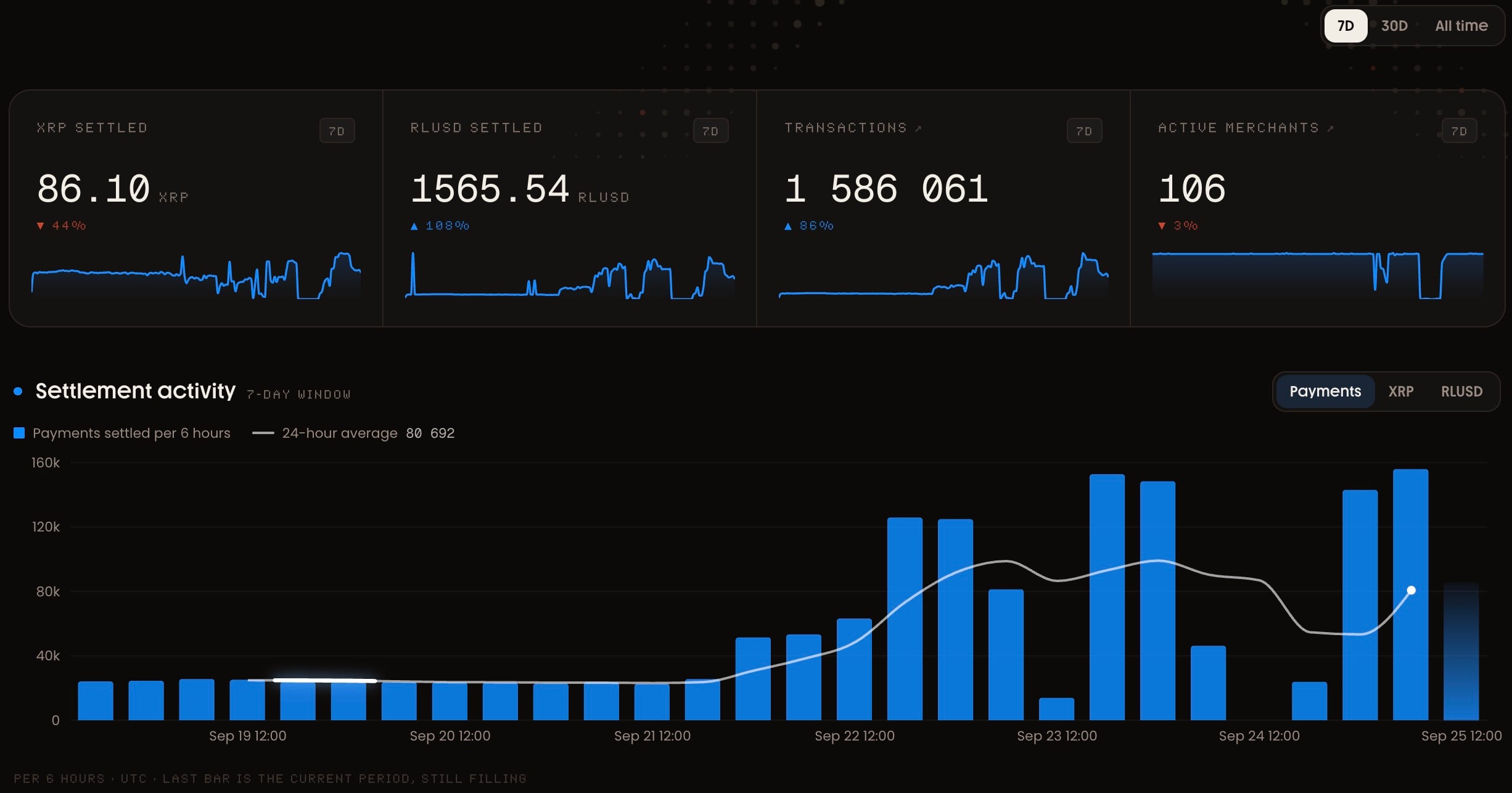
Autonomous AI agents using $XRP Ledger infrastructure for around-the-clock settlements have begun to favor regulated stablecoins over native crypto assets on a large scale, according to XRPL AI Hub data.
According to on-chain payment activity data, an analysis of all-time highs and the 30-day trend in direct clearing settlements shows the sustained dominance of Ripple’s stablecoin, while transaction volumes in the network’s native cryptocurrency, $XRP, have stagnated over the past week.
BlackRock’s new forecast: AI agents will build the economy of the future
This trend highlights the relevance of BlackRock’s research note, “The Machine-Native Economy.” The financial giant points to a tectonic shift: the traditional banking system, tied to human schedules, is technically unable to handle millisecond micropayments made by autonomous software.
According to BlackRock, the global stablecoin market has already surpassed $300 billion, while its annual transaction volume of $11.6 trillion has turned this asset class into a basic unit of account for AI. This circulating liquidity allows machine networks to reliably run high-frequency micropayments without causing friction or systemic blockages.
Robots need to purchase computing power around the clock and pay for API access, making tokenized GPUs a key raw material of the new technological order.
The machines’ pragmatism is explained by the nature of their programming. As Coinbase CEO Brian Armstrong noted, the number of AI agents making transactions will grow exponentially, but they critically need predictable costs. Software’s strict budgeting algorithms rule out volatile assets: even a change of a few percent in $XRP’s price within an hour could undermine an autonomous task’s financial model.
By contrast, Ripple USD, pegged one-to-one to the U.S. dollar, allows algorithms to forecast costs precisely. While $XRP retains its role in interbank clearing, Ripple’s digital dollar is taking the lead in the internal economy of robots on the $XRP Ledger across all time horizons.