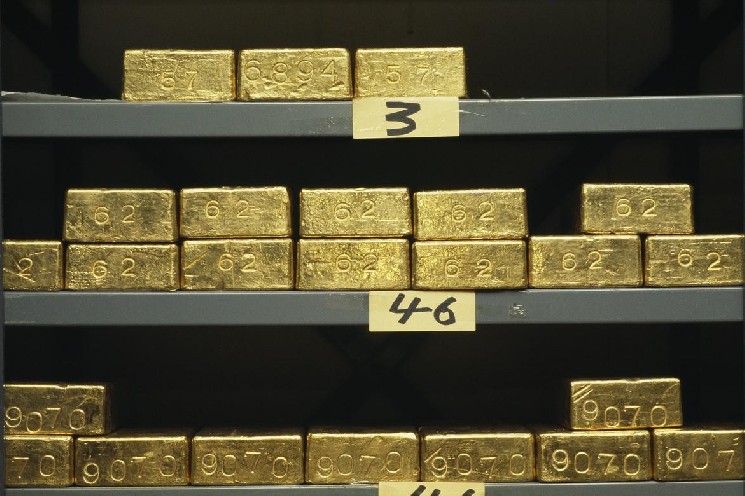
Gold is having its strongest run since 1979. The metal touched a record near $5,600 an ounce in January. And unlike other retail-frenzy driven asset runs, this one is being driven by the most conservative institutions on earth: Central banks.
Central banks added 863 tonnes of gold in 2025 and are on pace for roughly 850 more in 2026, nearly twice their pre-2022 rate. The World Gold Council’s latest survey of 76 reserve managers found that 89% expect official gold holdings worldwide to grow over the next twelve months, and a record 45% plan to add to their own.
Gold has been around for millennia, and there are many ways to invest in the asset. Each investment format comes with certain tradeoffs. Physical gold, like coins or bars, is hard to store, move, buy, and sell. You typically need to store it at a third party custodian, or safeguard it at home. Both of which come with risks. Gold-based Exchange Traded Funds (ETFs), like GLD, are only available to a select few with access to brokerage accounts that can access international markets. They can offer price exposure to gold in a convenient format, but you cannot spend it, move it, transfer it, or redeem it for physical gold– GLD charges annual fees of 0.40%. Recently, technology has brought about a third way to invest in gold: tokenized gold. A digital token representing an ounce of gold, held in a vault in Zurich or London, transferrable globally in seconds, to anyone with a mobile device, and redeemable for a bar of physical gold.
To get a sense of the potential implications, we can analyze a similar setup, and see what happened when we tokenized the U.S. dollar.
What Stablecoins Did For The Dollar
A USD stablecoin is a digital token backed by a U.S. dollar in reserves. It can be transferred digitally through the internet via blockchain networks, and can be used and spent like a U.S. dollar. Anyone, anywhere, can access a digital wallet that sends or receives stablecoins on their mobile phone, and without needing a bank account. You can send it across the world for pennies, it settles in seconds, and works 24/7. And, you can exchange it for U.S. dollars, or local fiat currencies globally, at any time.
Stablecoins exploded after COVID as demand grew for digital dollar rails that work around the clock, settle in minutes, and cost cents. Stablecoin supply grew from roughly $27 billion at the end of 2020 to more than $300 billion today, per DefiLlama data. That’s more than 10X in just over five years. Total transaction volume hit a record $28 trillion in Q1 2026, according to exchange CEX.IO. Much of that has been flagged as automated trading flow, but even a16z’s filtered tracker, which strips out bot activity, recorded $4.5 trillion in the quarter. That pace rivals what major card networks process in a year. And with the GENIUS Act signed into law in July 2025, the United States gave dollar tokens a federal framework requiring one-to-one reserves in cash and short-term Treasuries. Stablecoins have evolved from novel tech to regulated settlement infrastructure.
Stablecoins did not change the dollar itself. They changed how the dollar moves, how to store it, and who can have access to it.
Gold’s Format Problem
Gold’s problem has never been the asset. Gold’s problem has always been the format.
Physical gold is hard to verify, expensive to store and insure, liquidity and saleability can depend on where your gold is located, it is practically indivisible, and nearly impossible to move across a border in size. ETFs solved some of this, but an ETF share is an indirect claim that trades only during market hours. Retail holders can’t redeem shares for metal, can’t self-custody them, and can’t send them to another person. They also can’t easily be pledged as collateral outside the brokerage system. Furthermore, U.S.-listed gold ETFs shed a record $13 billion in March, making it the largest monthly outflow ever recorded. This happened even as physical bar-and-coin gold demand jumped 42% year-over-year, with U.S. retail bar buying rising while U.S. funds sold. Investors clearly want gold. They’re increasingly unsatisfied with the available wrappers.
Enter tokenized gold. A token like Tether Gold ($XAUt) or Pax Gold (PAXG) represents title to specific, allocated physical bars sitting in a professional vault: real gold, verifiable, and redeemable for the physical metal. But unlike the bar itself, the token is divisible to fractions of an ounce, transferable anywhere in minutes, tradable 24 hours a day, and usable as collateral for dollar liquidity without selling.
The Adoption Curve Is Already Bending
If the stablecoin analogy holds, tokenized gold’s usage curve should be bending the way dollar tokens’ did around 2020. And it is.
Tokenized gold traded $90.7 billion in the first quarter of 2026 alone, exceeding the $84.6B traded in all of 2025. Market capitalization crossed $6 billion in February, and the category grew 5.5 times faster than physical gold holdings in Q1 this year, the fastest pace on record, while adding more than 44,500 new holder wallets.
Six billion dollars is still a rounding error next to gold’s roughly $30 trillion market. But that’s the point: stablecoins were a rounding error next to the money supply in 2019, too. Every new format starts small. They win by being better, and the benefits compound over time.
Counter Party Risk
The most common objection to the tokenized version of an asset is counterparty risk: “If I don’t hold it, I don’t own it.” And it’s a valid view. Some people like to have full responsibility over their life savings, and assume the tradeoffs that come with that. However, the overwhelming majority of gold investors already accept intermediaries, through ETFs, vaulting services, or unallocated gold accounts (paper claims where you own an IOU from a bank rather than any specific bars). A well-structured gold token is a claim on specific allocated bars, backed one-to-one, redeemable for physical metal. That’s a strong and transparent claim. The two main issuers of tokenized gold offer quarterly proof of reserves reports, and Tether just completed an audit by KPMG.
Where This Goes
Bitcoin soared because it was the first time we created digital value that can move and settle 24/7 through the internet, without an intermediary, accessible to anyone globally. Stablecoins soared because we put U.S. dollars on the same online rails through an intermediary issuer. Those same intermediaries that tokenized the U.S. dollar are now tokenizing gold, and have a massive distribution network. But more importantly, tokenized gold solves a big access problem for people globally. It’s a more functional format for what many need.
I saw first hand what happened in Venezuela when people found bitcoin, and later stablecoins. It solved a problem for us, and we adopted it. It’s why I’ve dedicated my professional life to this industry. When you find something that works better for you, you just keep using it. It’s a very simple principle.
Technology may not change your desire to hold gold, but it just provided billions of people with a brand new way to hold a 5,000 year old asset.
Disclosure: The author is co-founder and Chief Strategy Officer of Ledn, which offers tokenized gold ($XAUt) trading. This article is for informational purposes and is not investment advice.