Copper has seen a phenomenal run-up recently. The red metal has rallied more than 50% over the last year and is currently trading near its January peaks on the London Metal Exchange (LME). This surge has been closely linked to artificial intelligence and the boom across the data centre ecosystem.
While data centres remain an important driver for copper demand as they are highly power-intensive, they are unlikely to trigger a ‘transformational’ change in the global markets, as red metal’s demand needs to be viewed alongside structural drivers like electric vehicles, renewables grid, and defence, UBS Bank said in a report.
Data centre demand: Only 4% of global copper consumption by 2030
UBS estimates that the data centre and the associated power generation infrastructure accounted for just 3% of the global copper demand in 2025. The bank expects this to inch up to only 4% by 2030. According to S&P Global, data centre copper demand is projected to climb to 2.5 million tonnes by 2040 from 1.1 million tonnes reported in 2025.
“As per street estimates, AI-related demand is expected to be one million tonnes yearly by 2030,” said Netra Deshpande, Research Analyst at Mirae Asset Sharekhan. Deshpande added that, while the new demand pool led by AI and data centre expansion is significant, it remains significantly smaller compared to the global consumption of nearly 28 to 30 million tonnes.
ALSO READAI to create a ‘Double-edge impact’ for IT sector: Axis Securities says AI spending Vs pricing pressure key challenge ahead
According to UBS, of the total 900 kilotonnes of AI-linked copper demand reported in 2025, around 700 kt came from the direct installation of data centre capacity, while the remaining 200 kt was associated with incremental power generation required to meet higher electricity consumption.
The brokerage expects the combined demand to grow at a CAGR of 11% to nearly 1.55 million tonnes by 2030.
Structural drivers: Electrification and supply-side constraints drive the bull case
UBS highlighted that over the last 5 to 10 years, electrification demand, including that from electric vehicles (EVs), renewables, energy storage systems, and grid expansion, has already underscored a bullish case for copper. From 2019 to 2025, electrification-related demand added nearly 5 million tonnes to the copper’s growth story, exceeding the net total demand during that period.
This implies that without the broader electrification boost, overall copper demand would have either declined or grown at a slower pace, with contributions from AI adding little to the demand story.
ALSO READBeyond the launchpad: India’s space sector finds its biggest impact back on Earth
Since 2018, new copper discoveries have remained at marginal levels, compounded by operational challenges caused by water scarcity in the world’s largest producer, Chile. According to a report published by HDFC Securities, monthly Chilean copper production has tightened significantly and is trending around the levels last seen in 2003.
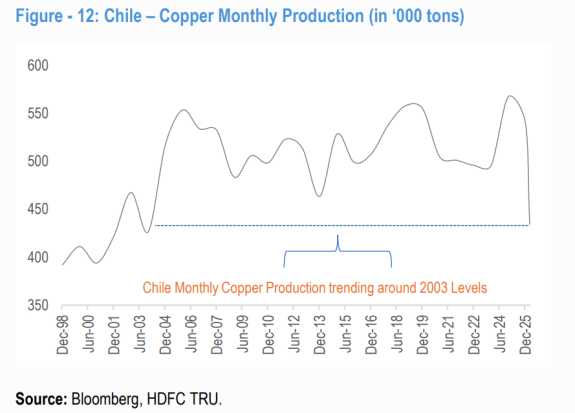
Additionally, sulphuric acid, a critical input for copper extraction, has seen a steep rise in its price driven by the West Asia conflict and China’s restrictions on the export of industrial acid. Supply-side limitations of sulphuric acid, which accounts for nearly 20% of the global copper production, are pushing up the break-even points for miners, especially in Chile and Africa, HDFC Securities added.
“AI is the more exciting headline story, but EVs, renewables, and grid modernisation represent the larger, multi-decade structural demand base,” added Deshpande. In simple words, mines can’t expand fast enough, and the world needs more copper also for reasons beyond the AI basket.
Where AI genuinely earns its keep: America
None of this means that data centres are irrelevant to the copper’s growth story; it’s just that their footprint in the US is much more significant. UBS noted that the US accounts for less than 10% of the global refined copper demand but carries nearly 60% of the world’s data centre installations.
The bank estimates that data centres and associated infrastructure account for nearly 25% of the copper demand in the US, and expects this to rise to 30% by 2030. In comparison, China and Europe’s copper demand for data centres was pegged at 1-2.5% in 2025 and is expected to reach only around 3% by 2030.
ALSO READFrom Rs 38,000 cr to Rs 4.24 lakh crore: How mobile manufacturing is driving India’s export boom
Hyperscale Vs Standard data centre copper usage
UBS assumed hyperscale data centres consume around 30 tonnes of copper per megawatt of capacity, nearly twice the 15 tonnes used by a regular data centre. The difference is mostly explained by the extra copper needed in busbars, transformers, and cooling systems, used to handle higher rack densities.
The bank believes accelerated AI training clusters and hyperscaler build-out, alongside the growth in liquid cooling, may add more to DCs’ consumption of the red metal, but the industrial metal remains concentrated in the internal distribution system.
Downside risks: Forecast surplus, high mine margins and Chinese demand drag
Despite the physical market tightness and constrained mine supply, copper prices remain vulnerable to near-term risk of downside, HDFC Securities flags. It notes that the International Copper Study Group estimates a 96 kt refined copper surplus in 2026 and forecasts a significantly larger 377kt surplus in 2027.
HDFC Securities cited Sprott data, which shows that 99% of global copper mines operate profitably, with a median all-in sustaining cost margin of around 55%, and nine in ten mines have remained profitable ever since 2020, reflecting that mining tightness may not be an immediate concern for the producers.
ALSO READFrom Rs 38,000 cr to Rs 4.24 lakh crore: How mobile manufacturing is driving India’s export boom
While AI and related grid tailwinds remain intact, brokerages noted that a sustained US-Iran conflict and the risk of a US recession could compress demand for red metal. Additionally, uncertainty around US tariffs on refined copper imports may provide headwinds for the base metal.
Experts note that one of the biggest factors at play remains Chinese demand. A slowdown in China’s manufacturing and property sectors would not offset the additional copper demand from the AI-basket, as the country accounts for more than 50% of global copper consumption.
“Any meaningful slowdown in its (China’s) property or manufacturing sectors would dwarf AI’s incremental contribution in the near term,” said Deshpande. The economist added that while AI and data centre demand is structurally supportive, it remains too small in absolute tonnage to serve as a standalone offset.
Outlook over the next 12 months
According to Mirae Asset Sharekhan’s economist, in a bull case, copper may cross the $15,000 per tonne level over the next 12 months, given that supply disruptions worsen and AI-driven grid investment increases faster than projected
However, she kept the base case for the red metal at nearly $12,000-12,500 per tonne, reflecting a sustainable structural deficit, and steady AI/EV demand growth looms.
And the economist noted that the red metal may see the bear case below the $10,500 per tonne mark, given that China’s property/manufacturing slowdown outweighs AI-related demand improvements and the shortfall narrows significantly.
The bigger picture
UBS remained structurally supportive of copper’s outlook and expects underlying demand trends to support prices. However, the bank’s estimates suggest that AI is not a standalone “copper supercycle”. Datacentres may be a part of the story, but electrification is actually the fundamental driver.
TOPICSArtificial IntelligenceChinacopperData CentreData centres in Indiaelectric vehicleElectric vehicleselectrificationRenewable EnergyUBSUSA + 0 MoreThis article was first uploaded on August fifteen, twenty twenty-six, at nineteen minutes past twelve in the night. © IE Online Media Services (P) Ltd