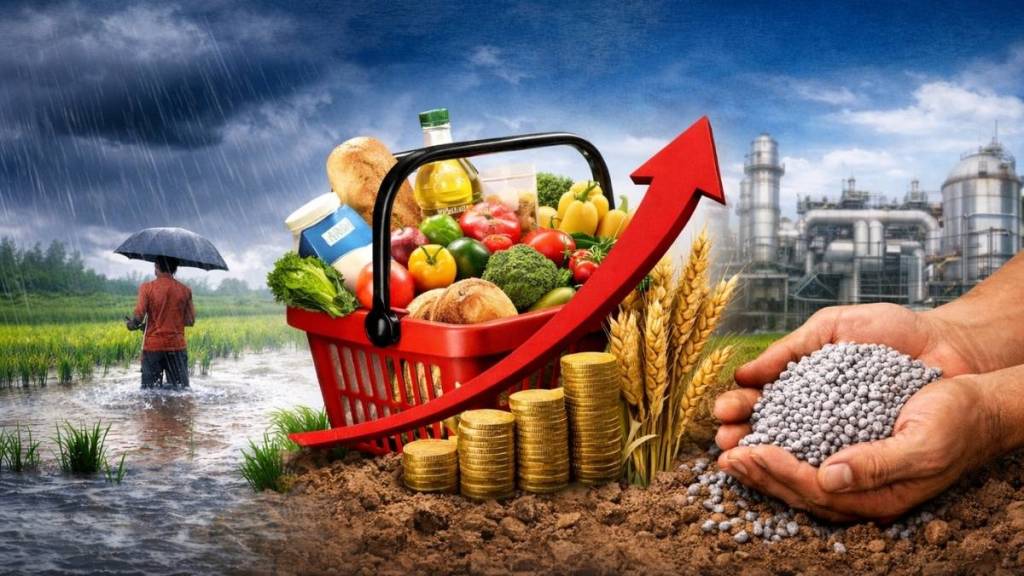
Food inflation, as measured by the recently revised consumer food price index, continued to move upwards to touch 5.52% in July, primarily because ginger, garlic, onion, chicken, eggs and edible oils became costlier.
Sequentially, the all-India Consumer Food Price Index (CFPI) rose by 2.09% last month from the June level. Food inflation was 5.32% in June 2026, and it was in the negative territory for seven months through December 2025.
Food inflation was 2.13% in January 2026 when the new consumer price index (CPI) series with a base year of 2024 was introduced by the Ministry of Statistics and Programme Implementation (MoSPI). Using both the current and previous CPI series (the latter with 2012 as the base year), food inflation in June was the steepest in 18 months.
“While monsoon has recovered substantially in July, there has been news of crop damage due to excess rains. This combined with a longer cropping period and hence, harvest will push up prices of pulses in particular,” Madan Sabnavis, Chief Economist, Bank of Baroda, said. Sabnavis said global prices of edible oils are also high which is being felt in domestic markets.
ALSO READBihar to join crop insurance scheme from next rabi season
Inflation in ginger (83.62%), garlic (35.36%), onion (22.54%), chicken (19.56%) and refined oil (13.35%) reported steep hikes, according to the statistics ministry. The retail prices of refined oils according to MoSPI, rose 13.35% in July year-on-year.
Despite the rise in food inflation, prices of potato (-16.56%), peas (-5.27%), and tomato (-4.59%) declined in July 2026 on a year-on-year basis. There was moderate inflation in wheat (0.26%), rice (3.3%) and chana (0.01%) last month year-on-year.
Aditi Nayar, Chief Economist, ICRA, said while sowing (kharif crops) is now only 1.8% below last year’s level, the volume and dispersion of rainfall in the remainder of the monsoon season will still crucially influence output and prices.
Due to the revival of monsoon since July after a huge rainfall deficit of 36% in June, the overall rainfall deficit on Wednesday was 12%, which had given a boost to kharif crops – paddy, pulses, oilseeds, cotton, sugarcane and coarse cereals -sowing.
After a ‘normal’ rainfall in July, monsoon rains are likely to be ‘below normal’ in August-September, the second half of the southwest monsoon season, the India Meteorological Department stated earlier this month, citing strengthening El Nino conditions.
For the whole of the monsoon season (June-September), the met department stuck to the May forecast of below-normal rainfall at 90% of the benchmark – Long Period Average (LPA). Rainfall in the range of 94-90% of LPA is considered “below normal.”
The ministry had stated that from the beginning of 2026, the base year for measuring CPI has been revised from 2012 to 2024 using the Household Consumption Expenditure Survey 2023-24. The weightage of CFPI in CPI has declined to about 36.73% from 45.86% in the new series.
TOPICSECONOMYfood inflationThis article was first uploaded on August twelve, twenty twenty-six, at forty-three minutes past eight in the night. © The Indian Express (P) Ltd