
In the midst of the CALRITY Act’s approval, Zach Pandl, Head of Research at Grayscale, contends that the US crypto industry can still expand even if the Act is not passed into law in 2026.
He bases this on the idea that significant portions of the crypto ecosystem are already operating without extensive market-structure legislation.
In practice, CLARITY’s failure ‘won’t have an immediate impact’ on the crypto market. This is because stablecoins would still have the ability to be used as payment methods, and Bitcoin would continue to function as a store of value.
He said,
The legislation would have provided a more comprehensive rulebook for digital assets in the US, but the industry has moved forward for almost 17 years without it.
Does Pandl believe that the CLARITY Act is unnecessary?
The greater worry, though, is about upcoming innovation and investment in the US. Needless to say, the CLARITY Act was created to give digital assets a clear regulatory framework.
But, without that framework, investors and businesses might be left in the dark about what securities laws apply, how tokenized assets can be issued, and what regulations crypto companies need to abide by.
On this note, Pandl thinks the SEC and other regulatory rulemaking can help close this gap. Especially since the current administration has already made strides in areas like institutional crypto custody, banking access, staking, and crypto exchange-traded products.
He added,
Crypto will move forward without CLARITY, supported by expected rulemaking by the SEC and other regulators. However, without comprehensive market structure rules, a greater share of new investment may occur overseas, in our view.
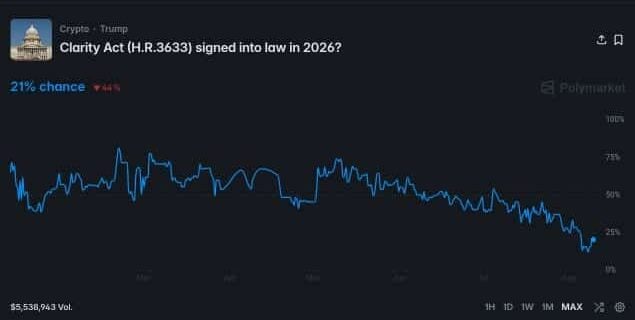
This comes as the Polymarket odds of CLARITY Act approval in 2026 stand low at 21%—a drop of 44%.
New deadline and Senators push
But according to Patrick Witt, Executive Director of the President’s Council of Advisors for Digital Assets, Congress had more than enough time to come to an agreement on the CLARITY Act.
Hence, he argues that further delays are turning this into a political issue rather than a drafting one.
The latest blow was when pro-crypto Democrats, including Senate Minority Leader Chuck Schumer, pushed for more time to negotiate rather than proceed with a procedural vote before the August recess.
Patrick reiterates that lawmakers should go past political differences and take action before the legislative window closes.
At last, he put it best when he said,
If they can’t get there by September 15, they never will.
Final Summary
Zach Pandl believes that the CLARITY Act is not that important for the U.S. crypto market.Senators are waiting for the 15th September deadline as the Polymarket odds drop to 21%.