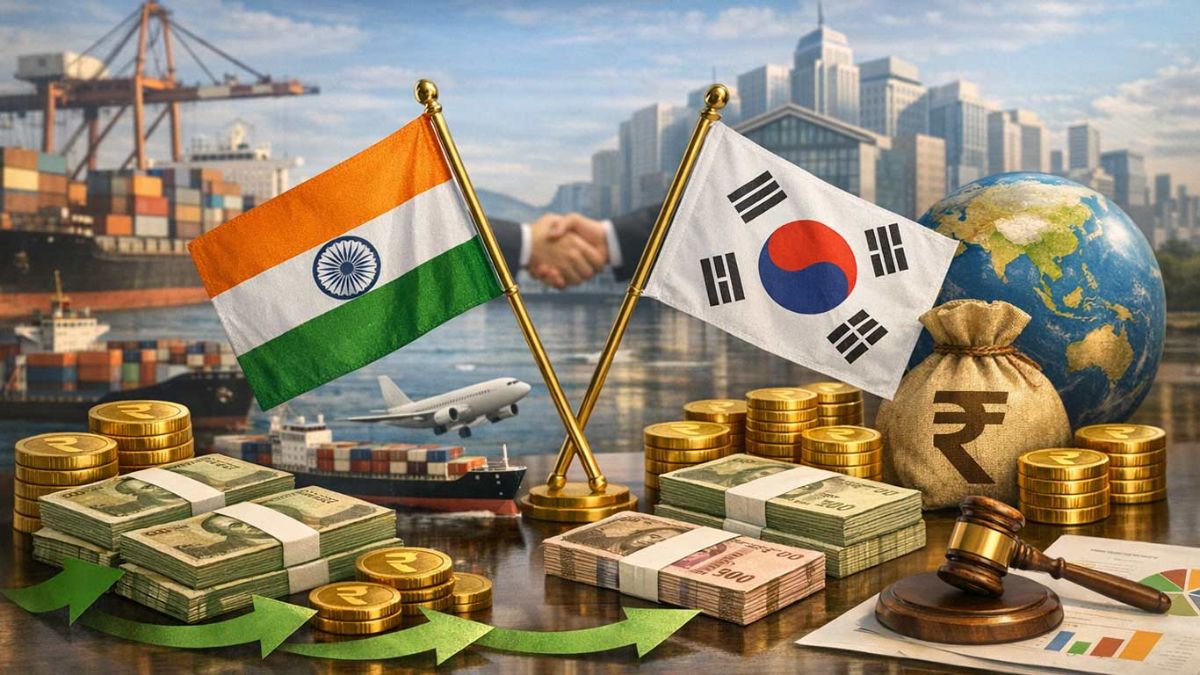
India and Korea started negotiations on Monday to upgrade their existing Comprehensive Economic Partnership Agreement (CEPA). They might also agree to negotiate a fresh trade agreement superseding the existing one.
The talks will continue until May 27. India and Korea signed the CEPA in 2009, and it came into force in 2010. Since the agreement favored Korea, a review was agreed upon in 2016. 11 rounds of talks have been held since then without reaching a conclusion.
The decision to expedite the discussions for upgrading the CEPA and conclude it in a year was taken during the state visit of Korean President Lee Jae Myung to India from April 19–21, 2026.
Through the upgrade both sides aim to double bilateral trade to $54 billion by 2030 from the current $27 billion.
India is inclined to negotiate an entirely new agreement with Korea to make it more contemporary but this depends on how the initial rounds of talks progress. Since the CEPA, India’s exports to Korea have increased from $3.7 billion in 2010-11 to $5.8 billion in 2024-25. During this period imports from Korea increased from $10.4 billion in 2010-11 to $21.3 billion in 2025-26.
The Asean India Trade in Goods Agreement (AITIGA) is another similar agreement that India is negotiating to review because it feels the agreement has benefited the other side more. The 13th round meeting of the Joint Committee (JC) leading the effort will be held from 6th July. The 12th meeting of the Committee was held on March 30-31.
The review of AITIGA was agreed upon in 2020 but the process actually began with the formation of the Joint Committee in 2022. The demand for the review was made even earlier as India’s exports to Asean remained stagnant despite the trade agreement while its imports from the 10-nation bloc soared.
To balance trade, India’s aim in the AITIGA talks is greater liberalisation and bringing 80% of the tariff lines under its umbrella. It is also seeking product-specific Rules of Origin in the review of AITIGA. Currently, AITIGA has a provision for a uniform 35% local value addition requirement across all product categories to qualify for trade on preferential duties.
AITIGA came into effect in January 2010. In 2009–10, India’s exports to Asean stood at $18.11 billion and imports at $25.79 billion. By 2025-26, exports grew to $38.4 billion, but imports ballooned to $ 89.9 billion.
TOPICSSouth KoreaThis article was first uploaded on May twenty-five, twenty twenty-six, at thirty-eight minutes past seven in the evening.