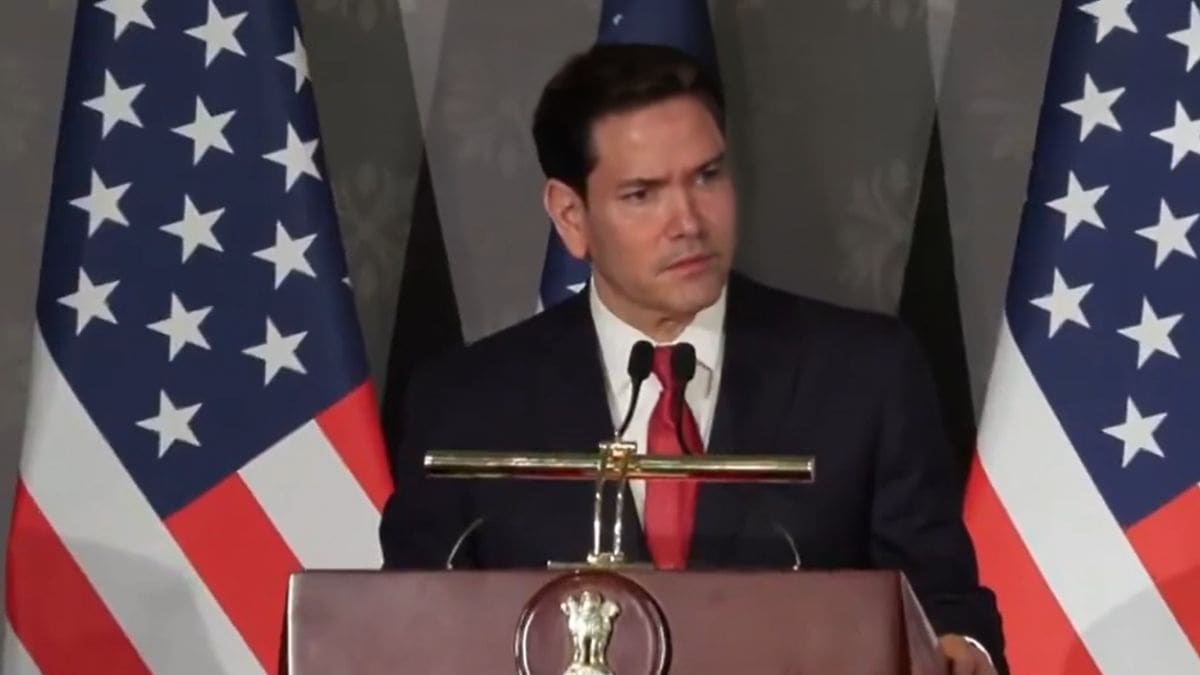
The US is on the verge of finalising a trade agreement with India after “tremendous progress” in negotiations, US Secretary of State Marco Rubio said on Sunday.
“We are hopeful that our trade representative (USTR Jamieson Greer) can visit here (New Delhi) very soon. We are going to wind up with a trade agreement between the US and India that is going to be enduring and beneficial to both sides,” he said at a press conference after holding a meeting with External Affairs Minister S Jaishankar.
Trade ties figured prominently in the discussions between the two sides.
“We spoke about the value of concluding at an early date the final text of the interim agreement. It will be an important step towards a comprehensive Bilateral Trade Agreement which was envisaged during Prime Minister Modi’s visit to the US in February 2025,” Jaishankar said.
Rubio clarified that trade friction with India and other partners was not intentional but an outcome of the effort by the US to address the huge trade imbalance that was making it vulnerable. The US is working on agreements that are good for itself and its partners.
Navigating Judicial Shifts
Both sides have already laid down parameters of the interim trade agreement through a joint statement on February 8. Since the US Supreme Court decision on February 20 invalidating the reciprocal duties, the discussions are around how can India get preference over the competitors in the American market when country-specific tariffs no longer exist.
ALSO READIndia eyes cheaper, diversified energy supplies; calls US key ‘reliable’ partner
Rubio is on a visit to India from May 23 to May 26. Apart from meeting the External Affairs Minister he will also be participating in the meeting of the foreign ministers of Quad that also include Australia and Japan on Tuesday. On Saturday, he met Prime Minister Narendra Modi where he briefed him on progress in bilateral cooperation in sectors such as defence, strategic technologies, trade and investment, energy security, connectivity, education and people-to-people ties.
Responding to concerns over tighter US visa rules and steep fee hikes affecting Indian professionals and students, Rubio said the measures were part of a broader overhaul of America’s immigration system and were not targeted at India.
“It is not a system that is targeted in India. It is one that’s being applied globally. We are modernizing the US immigration system for the 21st century. Once we are complete we will have a system that’s more efficient and beneficial than the previous system was to people from India that seek to enter the United States to work and innovate,” Rubio said.
SHANTI Act Advantage
The two sides also discussed expanding cooperation in energy, including nuclear power, critical minerals and frontier technologies.
ALSO READCropyields seen hit as heatwaves persist, farm-sector growth may slow
“We spent some time today discussing energy issues. We welcomed the expansion of energy trade (between India and the US). We devoted some time to nuclear energy cooperation as well. The passage of the SHANTI Act has opened up new possibilities of cooperation,” Jaishankar said.
The Sustainable Harnessing and Advancement of Nuclear Energy for Transforming India (SHANTI) Act enables private participation and foreign direct investment in India’s nuclear energy sector.
TOPICSIndia-US trade dealThis article was first uploaded on May twenty-five, twenty twenty-six, at forty-nine minutes past twelve in the am.