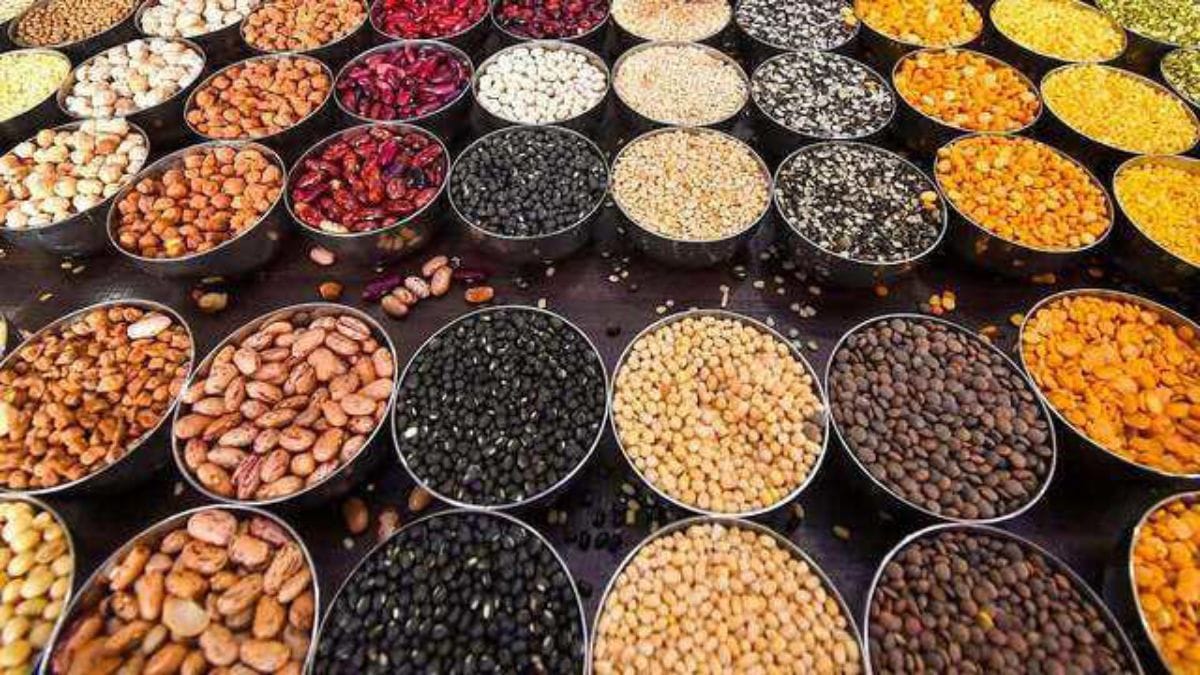
India’s pulse imports dropped sharply 34% to $ $3.63 billion in FY26 on year, which trade sources attribute to sluggish demand and robust domestic crop. Imports were a record $ $ 5.54 billion in FY25. In terms of volume, imports, according to the department of commerce, have declined by 12% to 6 million tonne (MT) last fiscal against 7.34 MT imports in FY 25.
The sources said while pulses import in the current fiscal has not been impacted due conflict in the Gulf, the demand in the current fiscal would depend on domestic production likely to be impacted due to prospects of below normal monsoon rains.
Collapsing Global Prices
Cost of imports have declined by around 30% to 40% last fiscal because of higher global output and low imports thus pulling down prices. Global prices of yellow peas, mostly sourced from Canada and Australia, have been ruling around $300/tonne against $400/tonne a year ago. Similarly, Bengal gram prices have declined to $530/tonne from $650-$670/tonne last year.
ALSO READExplainer: What the curbs on exports say about the sugar economy
“In the FY27, pulses imports are not impacted by conflict in Gulf, yet the actual quantum of imports would be based on domestic production prospects as there is sufficient stocks with the government as a buffer,” Satish Upadhyay, secretary, India Pulses and Grains Association, told FE.
In terms of varieties, yellow peas and masur (lentil) imports during FY26 declined by 47% and 6% to 1.11 and 1.14 MT, respectively, compared to the same period in FY25. However there has been a 25% and 18% rise in imports of urad and arhar (pigeon pea) to one MT and 1.48 MT, respectively, last fiscal.
Strategic Trade Alliances
With a share of 25% , tur have the largest share in the total pulse import of 6 million tonne (MT) in FY26, followed by lentils (19%), yellow peas (18%) and urad (16%). India imports about 18%-20% of its annual consumption of pulses – tur, urad, masoor (lentils), yellow peas and Bengal gram – from Canada, Russia, Brazil, Myanmar and Africa. India has a memorandum of understanding to import tur and urad from Myanmar, Malawi and Mozambique.
To boost domestic supplies, the government extended the duty-free import policy for key pulses — pigeon pea (tur) and black matpe (urad)—until March 31, 2027. The 30% import duty on yellow peas would continue until the end of FY27, while lentils has a 10% duty.
ALSO READBrent may hit $200/bbl if Hormuz closure extends through 2026: Report
Against the target buffer of 2.8 million tonnes (MT) of pulses aimed at managing price volatility and ensuring supplies, government agencies – the farmers’ cooperative Nafed and NCCF – at the start of May had 2.69 MT of pulses, including gram (1.1 MT), tur (0.75 MT), masur (0.36 MT), moong (0.4 MT) and urad (33,402 tonnes). These buffers are built through procurement under the price support scheme and imports. Pulse production in the 2025-26 crop year was estimated at 23.86MT. In terms of share in total production, chana (45%), moong (15%), tur (14%) and urad (8%) have major share.
TOPICSpulsesThis article was first uploaded on May twenty-one, twenty twenty-six, at fifty-six minutes past ten in the night.