Major US banks and financial market intermediaries expect the transition to a digitized financial system to start slowly, then hit a tipping point at which it accelerates, according to credit rating agency Moody’s Ratings.
In a report Tuesday, the agency said that, during conversations with US banks and other financial market intermediaries, most viewed the shift as inevitable and agreed it would start “slow, then fast,” with tokenization volume increasing and extending to more market participants, assets and use cases.
“Across our conversations, industry leaders generally believed that broad asset tokenization will happen; the main uncertainties center around how quickly and in what sequence,” Moody’s said.
“In the near term, progress is expected to remain gradual and focused on those simpler segments, such as funds and short-term instruments, running alongside traditional processes. But beyond that, many believe a tipping point will eventually be reached where broader adoption accelerates rapidly.”
Tokenization has been one of the drivers of institutional interest in blockchain and crypto and is expected to experience massive growth over the next few years. Cathie Wood’s ARK Invest predicts digital assets could grow into a $28 trillion market by 2030, with Bitcoin, decentralized finance, stablecoins and tokenized RWAs as key drivers.
TradFi is laying the groundwork
Current tokenization activity is low, according to Moody’s, with the main uses coming through cryptocurrency trading, cross-border retail payments and some institutional use cases. But traditional financial institutions are actively preparing for a surge in adoption.
The size of the tokenized real-world asset market has increased by more than 420% since the start of 2025 and is worth $31.6 billion as of Thursday, according to analytics platform RWA.xyz.
“Almost all large banks and major financial market intermediaries have established dedicated digital-asset teams or innovation units and are participating in industry pilots to test new infrastructure,” Moody’s said.
“These efforts are strategic: firms want to be ready to serve clients with digital asset and digital money capabilities if adoption takes off, so they are not caught flat-footed by a sudden shift in market demand.”
In January, Morgan Stanley tapped veteran executive Amy Oldenburg to lead the investment bank’s new crypto unit weeks after announcing plans to launch three crypto exchange-traded funds and a crypto wallet.
Three possible outcomes for financial system
Moody’s said in a separate report on Monday that there are three possible outcomes for the financial system, depending on the pace of tokenization.
In the “steady growth” base case, which the agency said is the most likely, the financial system will largely stay the same; tokenization would scale in select assets such as stablecoins and tokenized deposits, but incumbent asset managers, banks and infrastructure providers retain central roles.
However, in a low-growth scenario, in which regulatory friction, unresolved legal questions and low demand from end users have stifled adoption, asset tokenization and digital money would stay confined to narrow use cases with modest changes to the financial system.
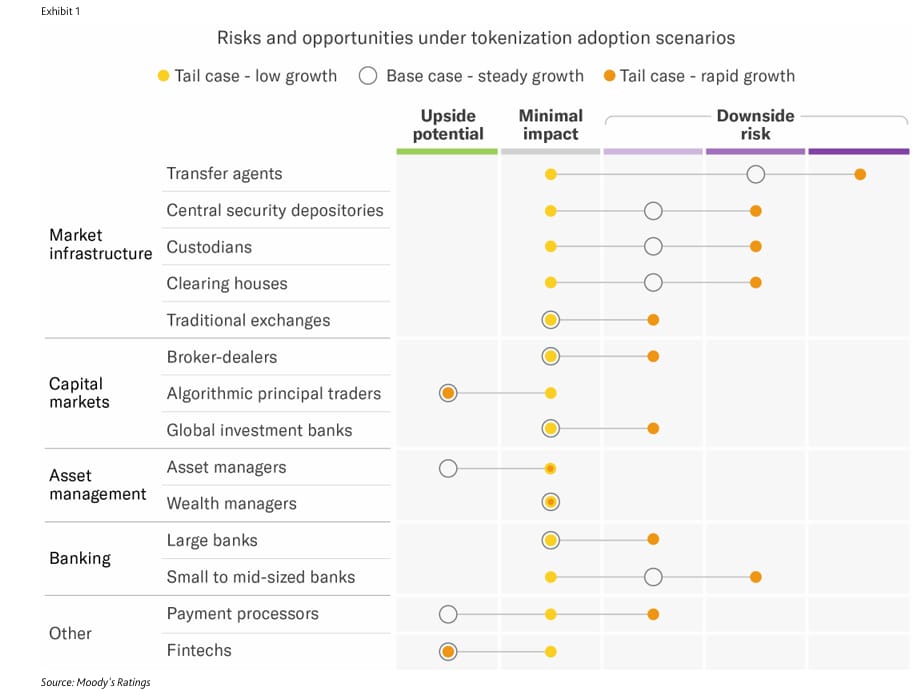
Moody’s predicts there are three possible outcomes for the financial system depending on the pace of tokenization. Source: Moody’s
The most disruptive would be if tokenization undergoes rapid growth and assets such as stablecoins become widely embraced as an onchain settlement option.
“Some incumbents would face greater pressure. For example, payment processors and parts of the legacy market plumbing, such as correspondent banks may lose revenue associated with settlement delay and siloed infrastructure, and for small to mid-sized banks, deposit balances could decline,” Moody’s said.
Macro investor and former hedge fund manager Jordi Visser said on Saturday the “tokenization reality” will start this year, with tokenized assets powering agentic AI payments.
Meanwhile, international financial institution, the International Monetary Fund, said in April tokenization has the potential to remove friction and boost transparency in finance but also warned it has the potential to create challenges around financial stability.