
The landscape of cryptocurrency regulation in the United States is evolving into a more organized framework, as legislators aim to address significant legislative gaps and move away from years of fragmented oversight characterized by enforcement actions.
Recent reports from Punchbowl News indicate that Senate negotiators have come to an agreement regarding stablecoin yield language within the proposed CLARITY Act, which addresses one of the most contentious issues hindering progress.
Understanding the CLARITY Act
The proposed CLARITY Act, which has already received approval from the House, seeks to tackle one of the industry’s major challenges: distinguishing whether a digital asset qualifies as a security or a commodity.
This framework stipulates that decentralized tokens lacking central control will fall under the jurisdiction of the Commodity Futures Trading Commission (CFTC), while assets associated with investment expectations or centralized development will remain under the Securities and Exchange Commission (SEC).
This differentiation aims to eliminate regulatory overlap and provide businesses with clearer compliance pathways.
Resolution on Stablecoin Yield Debate
The compromise spearheaded by Senators Thom Tillis and Angela Alsobrooks introduces limitations on rewards linked to stablecoins.
According to this new language:
- Rewards resembling interest on bank deposits are prohibited;
- Incentives related to legitimate platform activities are still permitted;
- Regulators will establish disclosure standards and approved reward structures.
This clarification builds upon the $GENIUS Act, which banned interest payments by issuers but left uncertainties regarding secondary market practices.
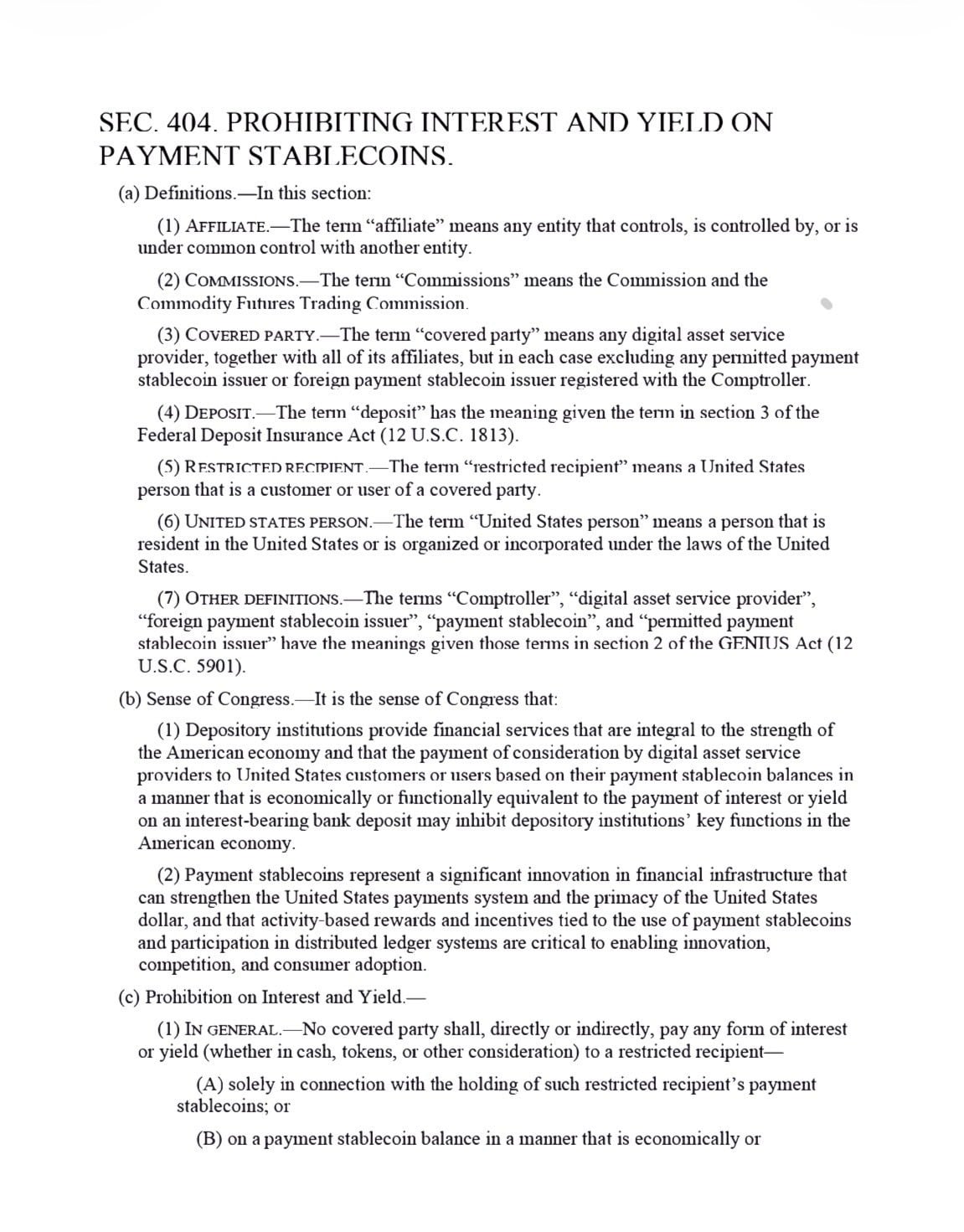
The agreement eliminates a significant barrier that had stalled broader legislative advancements. Senate Banking Committee Chairman Tim Scott is now aiming for potential markup discussions concerning the CLARITY Act in May.
If passed, this bill would:
- Categorize digital assets as either securities or commodities;
- Clarify oversight responsibilities between SEC and CFTC;
- Create clearer compliance pathways for cryptocurrency firms.
The industry has long contended that these definitions are crucial for replacing “regulation by enforcement” with predictable legal standards. The latest developments reflect an overarching shift in U.S. policy. With both $GENIUS Act already enacted and progress being made on CLARITY Act, lawmakers are constructing an integrated framework addressing stablecoins, market structure, and investor protections simultaneously.
Diverse discussions continue surrounding other aspects of crypto policy including safeguards for decentralized finance (DeFi) and restrictions pertaining to potential central bank digital currencies (CBDCs).
“The Clarity Act cleared a major hurdle: stablecoin yield.
A compromise text was released overnight & while it bans passive yield; it still allows room for ‘activity-based’ rewards.
The Senate Banking Committee can now schedule its first markup hearing.”
– Nic (@nicrypto) May 2, 2026
Your Takeaway
The compromise over stablecoin yields indicates increasing alignment between policymakers’ perspectives and industry concerns. By addressing one of existing legislation’s most debated loopholes, it brings America closer toward establishing a comprehensive regulatory system surrounding cryptocurrencies.
Ahead lies further negotiation over key provisions; however direction appears increasingly evident—digital assets are gradually being assimilated into formal financial regulations where defined rules replace ambiguity.
An overall trend suggests that United States is advancing towards creating coordinated regulatory systems defining responsibilities across federal agencies while allowing room for innovation.
FAQ Section:
- What does “CLARITY” stand for?
- Why is there confusion around cryptocurrencies?
Confusion arises due primarily because various entities classify them differently leading often conflicting interpretations about their legal status affecting how they’re regulated accordingly.- What implications does this have on investors?
Clearer guidelines may help protect investors through improved transparency fostering trust within marketplace thus potentially enhancing participation rates overall among consumers seeking invest opportunities here!- Are there any risks involved despite these changes?
Yes! While regulation helps mitigate certain risks others persist such volatility inherent within crypto markets remains challenging factor influencing investments decisions made therein! - What implications does this have on investors?
CLARITY refers specifically not just about clarity in regulations but also aims at providing distinct definitions between different types of digital assets like securities versus commodities.