
The adoption of digital assets in Latin America is undergoing significant changes, with an increasing number of users opting to convert their funds into stablecoins rather than Bitcoin. This trend highlights the growing influence of local economic conditions on user preferences.
According to Bitso’s 2025 report on cryptocurrency adoption in Latin America, a notable 40% of crypto purchases were made using US dollar-linked stablecoins like Tether’s USDt (USDT) and Circle’s USD Coin ($USDC), while Bitcoin ($BTC) accounted for only 18%. This marks a pivotal moment as it is the first instance where stablecoin transactions have outpaced those involving Bitcoin in this region.
The insights presented are derived from data collected from Bitso’s nearly 10 million retail users utilizing its exchange platform.
This shift towards stablecoins reflects what the Latin American crypto exchange refers to as “digital dollarization.” In nations grappling with ongoing inflation, currency devaluation, and restricted access to conventional banking services, stablecoins provide a relatively straightforward means for individuals to preserve value and conduct transactions using US dollar equivalents.
Although the US dollar itself can be affected by inflation, it generally depreciates at a slower rate compared to many local currencies. It remains the predominant global medium of exchange, making it an appealing option for users seeking financial stability.
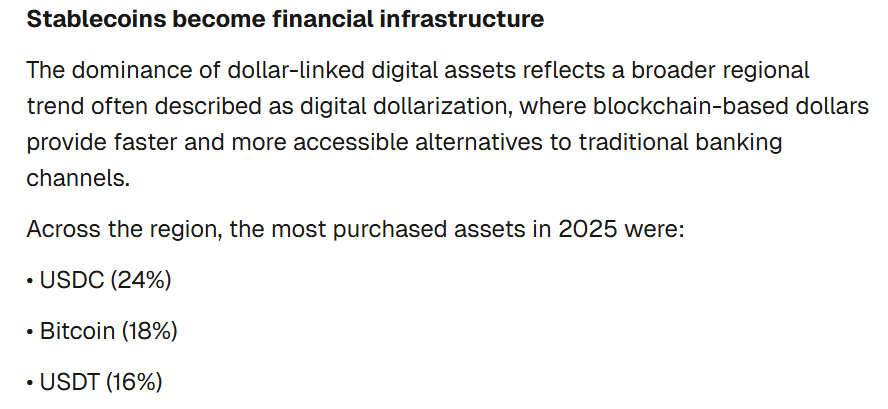
The most purchased assets in 2025 across Latin America. Source: Bitso
The global market for stablecoins has surged to approximately $320 billion, with their usage expanding across both developed and emerging markets. In Latin America specifically, these digital currencies are particularly useful; users depend on them not only for saving but also for making payments and sending remittances across borders.
Local initiatives are also enhancing the use of home-grown stablecoins. For instance, Brazilian retail giant Mercado Libre recently introduced a cross-border remittance service utilizing its Meli dollar stablecoin aimed at customers in Brazil, Mexico, and Chile. This development follows Mercado Libre’s decision earlier this year to cease issuing its own previous version known as Mercado Coin.
Bitcoin Continues Its Role as a Store of Value
Despite seeing a decrease in purchase volume relative to total activity levels among cryptocurrencies reported by Bitso, Bitcoin still retains its significance as a long-term savings asset within Latin America.
“Bitcoin continues serving as the primary long-term digital store of value throughout Latin America,” states the report which notes that this cryptocurrency appears within 52% of regional crypto portfolios in 2025—a slight drop from last year’s figure at 53%.”
Historically viewed primarily through its lens as an investment vehicle or store-of-value asset despite periods marked by volatility—Bitcoin reached above $126K last October before experiencing substantial declines leading prices back down into low $60K territory later on.
A recent study conducted by index provider MarketVector broadens our understanding regarding stores-of-value beyond mere price fluctuations alone; they argue that both Bitcoin & gold share fundamental characteristics such scarcity along decentralization coupled resistance against supply expansion underpinning their enduring worth over time frames stretching far ahead into future horizons!
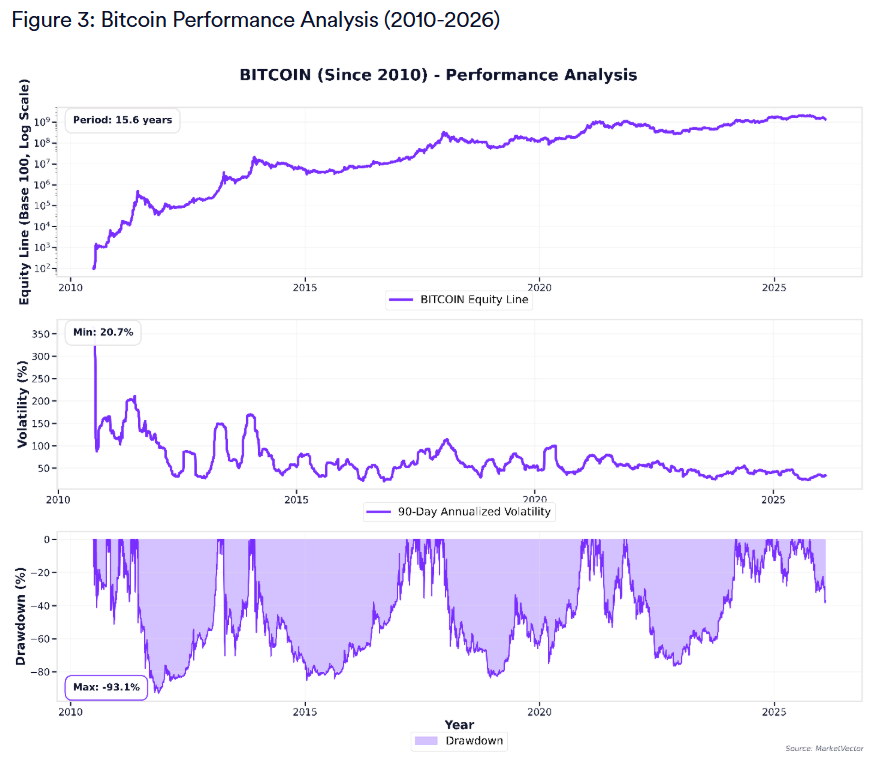
A comparison between performance metrics including volatility/drawdowns since inception observed via respective indices created by MarketVector Indexes
Related: Certain queries arise concerning whether or not BTC has indeed bottomed out against gold? If historical patterns repeat themselves could we anticipate reaching prices upwards towards $167K come year-end twenty twenty-seven?
FAQ
- What factors contribute to increased adoption rates for digital assets like cryptocurrencies?
- The growing need among individuals facing economic instability drives them toward more reliable forms such as Stable Coins which offer better preservation capabilities amidst fluctuating local economies!
- If Stable Coins have overtaken BTC purchases does that mean they’re becoming more popular overall?
- This trend suggests heightened interest surrounding stability offered through these alternatives however traditional investments remain important alongside emerging options!
- Certainly people may wonder about future prospects related specifically around BTC itself given recent price fluctuations seen lately right?
- A continued emphasis placed upon underlying fundamentals coupled alongside broader macroeconomic trends will likely shape investor sentiment moving forward here too!
<![CDATA[
]]