The announcement from Iran on Friday regarding the reopening of the Strait of Hormuz during the ongoing ceasefire led to one of the most significant reversals in oil prices this year.
Brent crude plummeted by 12.95% to $86.52, while WTI saw a drop of 14.26% to $81.19, marking their lowest points since March 11 and representing their largest single-day declines since April 8. In response, US stocks rallied, bond yields fell, the dollar weakened, and Bitcoin reached an intraday peak of $78,336.
Traders removed the war premium that had been gradually added to crude prices over recent weeks as risk assets adjusted accordingly.
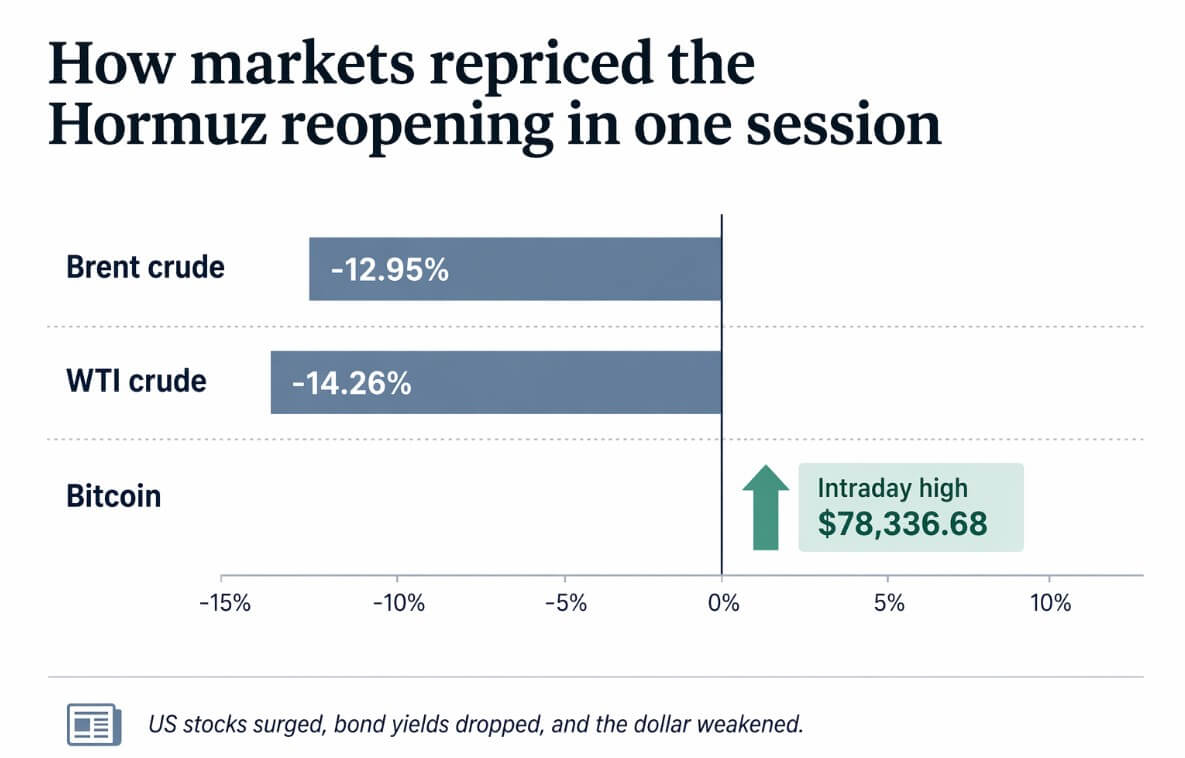
As per yesterday’s developments, vessels were allowed passage through the Strait under Iranian conditions; however, they needed authorization from Iran’s Ports and Maritime Organization as well as from IRGC and were required to navigate through designated safe lanes established by Iran itself. The US blockade on Iranian shipping remains fully enforced until a broader diplomatic resolution is achieved.
This opportunity has already diminished; on April 18th Iran announced it had closed off access again after maintaining its blockade against US interests—leading markets back into a countdown towards the ceasefire deadline set for April 22nd.
Only eight oil and gas tankers managed to transit during this brief reopening period—a clear indication that normal traffic levels are still far from being restored.
During this limited window for passage through Hormuz, there was no confirmation from IMO that these arrangements adhered to freedom-of-navigation standards.
Shipping companies awaited legal clarity regarding safety before resuming regular operations while concerns about mine threats in parts of Hormuz remained unresolved according to statements made by the US Navy.
A Pakistani-flagged tanker carrying approximately 440k barrels of UAE crude successfully exited Gulf waters on April 17th—providing tangible evidence that navigation was feasible under current conditions.
This short-lived test did not lead toward normalization; reports indicated only eight oil and gas tankers moved during this fleeting opening before restrictions were reinstated—leaving Bitcoin with just four days left until it could determine if any real recovery in shipping would occur prior to April’s deadline.
Bitcoin now finds itself caught between rapidly priced-in expectations for reopening versus a Strait once again closed as per developments noted on April18 ahead of upcoming deadlines related directly tied with ceasefire negotiations set for later dates within month’s end timeframe.
The Mathematics Behind Fear
EIA data estimates indicate average daily oil flow via strait will reach around twenty million barrels throughout next year (2024)—which represents roughly twenty percent (20%) global petroleum liquids consumption—with eighty-four percent (84%) comprising both condensate/crude exports directed primarily towards Asian markets .
This figure establishes concrete parameters surrounding market countdown: unless traffic rebounds prior reaching stipulated date mentioned earlier , route responsible transporting approximately one-fifth total worldwide liquid fuels remains effectively impaired .
Since conflict erupted , war has eliminated over five hundred million barrels worth crude/condensate supply available globally translating into losses nearing fifty billion dollars ($50B) due lost output alone ; whereas domestic inventories have dropped nearly forty-five million barrels just within month preceding today’s discussions .
As recently observed back early-April EIA projected Brent averaging around one hundred fifteen dollars ($115) second quarter while Morgan Stanley anticipated figures holding steady near similar thresholds across ensuing quarters modeling gradual export recoveries extending all way October timeframe .
Presently at eighty-six dollars fifty-two cents ($86), Brent sits significantly below every major benchmark published less than two weeks ago demonstrating how quickly market can front-run paths leading toward normalization neither accounted previously either Wall Street nor EIA analysts foresaw happening anytime soon given current circumstances unfolding across regionally sensitive areas impacted heavily following escalations occurring lately between parties involved here too!
Such asymmetry creates financial premiums which dissipate much faster than anticipated overall trends suggest indicating IEA chief recently commented Middle Eastern energy output may take up two years recover levels seen pre-war times !
The Fragility Of Reopening Efforts
Iranian operational messaging released following events occurring last week closely mirrors remarks made earlier deputy foreign minister stated ships could traverse waters only when coordinated properly yet actual volumes reported remained below ten percent normalcy observed historically thus translating roughly seven vessels moving daily compared usual count exceeding hundred forty mark typically seen regularly!
Diplomatic probabilities shifted even though passage rules largely stayed unchanged ; ten-day ceasefire agreement coupled revived U.S.-Iranian diplomacy prompted investors re-evaluate same fundamental operational framework interpreting situation now more aligned towards de-escalation efforts underway currently !