The hashrate in Iran has significantly decreased over the last quarter, coinciding with ongoing tensions involving the US and Israel. However, this regional conflict has not adversely affected the global hashrate, as highlighted in a recent report by Hashrate Index.
According to Ian Philpot, marketing director at Luxor Technology, Iran’s hashrate experienced a drop of approximately 7 exahashes per second (EH/s) compared to the previous quarter. Currently, it stands at around 2 EH/s based on data from the Hashrate Index heatmap.
Philpot pointed out that while this local conflict had a clear impact on Iran’s mining operations, it could have potentially influenced neighboring nations like the United Arab Emirates and Oman. Nevertheless, both countries have remained unaffected thus far.
“The repercussions were limited to Iran; neighboring UAE and Oman have shown stability. The global hashrate remains around ~1,000 EH/s because no single region possesses enough capacity to jeopardize network stability. Instead of destroying it outright, regional disruptions tend to redistribute hashrate,” he explained.
The escalation of hostilities in the Middle East began in February when US and Israeli forces launched attacks against Iranian targets which prompted retaliatory actions from both sides. A temporary ceasefire agreement between the US and Iran was established on Tuesday. It is estimated that there are about 427,000 active Bitcoin (BTC) mining rigs operating within Iran.
Miners play an essential role in maintaining Bitcoin’s network integrity by validating transactions and adding them into new blocks. An increase in miner participation leads to a higher overall hashrate which enhances network security.
A Decline in Global Hashrate Linked to Falling Bitcoin Prices
The average global network hashrate over a 30-day period saw a decrease from 1,066 EH/s during Q1 down to approximately 1,004 EH/s for Q2—a decline of 5.8% quarter-over-quarter attributed by Philpot primarily due to falling Bitcoin prices.
Miners receive Bitcoin rewards for each block they successfully mine; however with current price levels being low these rewards often do not cover operational costs associated with running their equipment.
Bitcoin’s value plummeted more than 45% from its peak price of $126k recorded last October leading hash prices into unprecedented lows. Philpot noted that mining profitability—not energy expenses or regulatory policies—is currently driving geographic shifts within the industry regarding where operations are located.
“At these price points older generation machines—those operating at over 25 J/TH efficiency—are facing negative gross margins which compel operators towards shutdowns,” he added estimating that about 252 EH/s worth of marginal capacity is currently offline due largely due legacy hardware being retired already.”
“This trend follows cyclical patterns; profitability influences machine deployment or retirement more so than energy pricing or regulations do.” Geographic shifts observed throughout Q1 & Q2 reflect operators exploring regions capable sustaining their operations once market conditions stabilize again.”
The Top Three Nations Commanding Over Two-Thirds Of The Global Hashrate
The United States dominates with more than 37% share of total global hash rate followed closely by Russia holding around 17%, while China accounts for roughly 12%, accordingto data presented viaHashrateIndexheatmap .
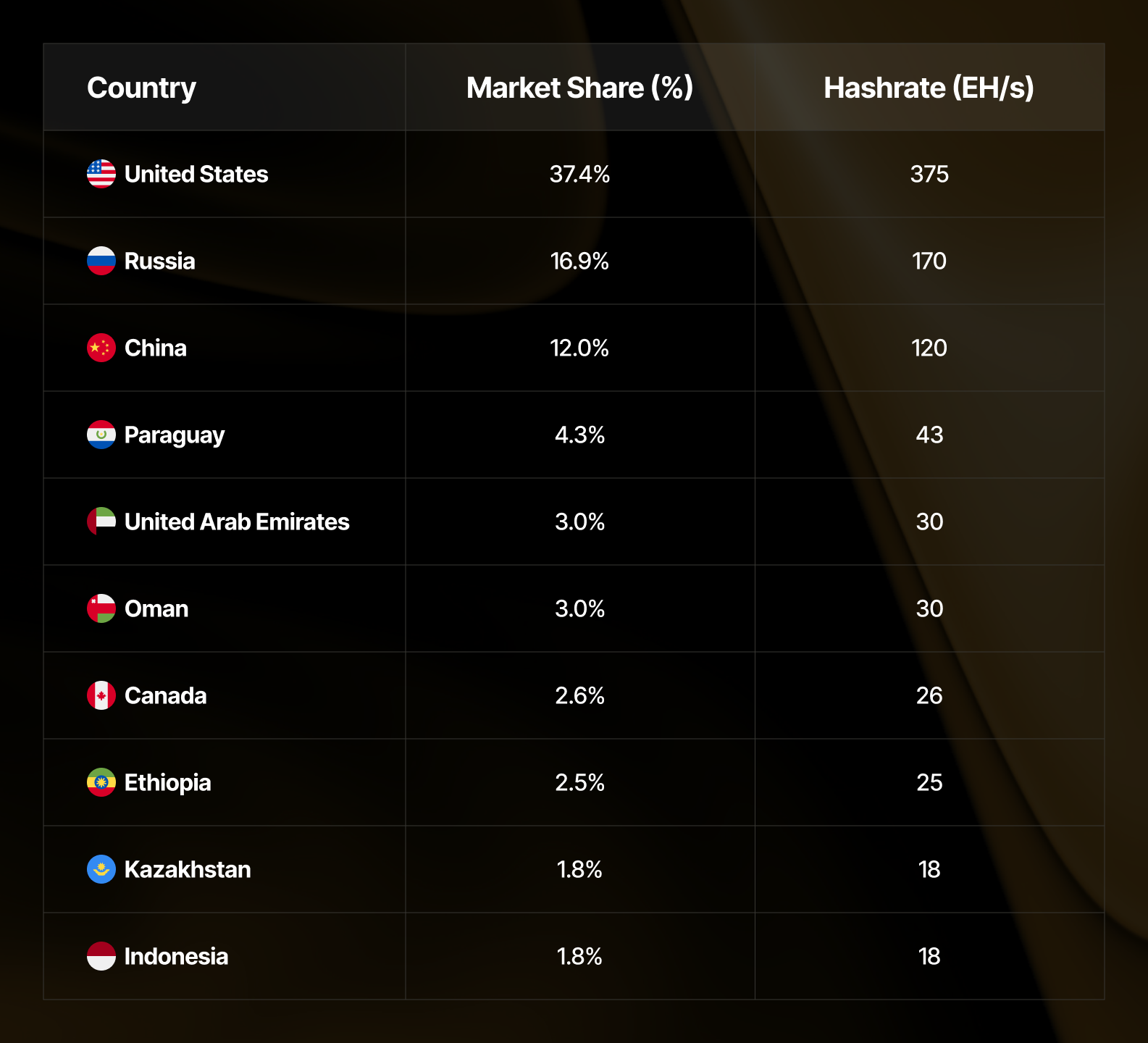
Philpot indicated althoughhasratesthe largest players remain relatively stable ,the compositionis shiftingasolder equipmentgets phased outwhilemodernhardwareis deployed selectivelyin profitable regionsfor long-term sustainability .
“Growth trends involve deploying modern machinery alongside retiring outdated models.Cana da exhibits similar behavior: slightquarter-over-quarterretractionbut positive year-on-yeargrowthindicating optimizationratherthanexodus,”headded .