Bitcoin [$BTC] continues to exhibit a blend of conflicting signals, as bullish traders strive to reclaim dominance. As of the latest update, $BTC is approaching the $70,000 mark after remaining below this threshold for nearly eleven days.
Even with this attempt at recovery, the fundamental demand landscape appears precarious. Both retail investors and long-term holders seem to be scaling back their positions, casting doubt on the viability of this upward movement.
Evident Demand Reveals Structural Vulnerabilities
The metric known as Bitcoin Apparent Demand serves as a crucial indicator for evaluating whether newly minted supply is being absorbed effectively. It highlights that April has commenced on shaky ground. This metric calculates the gap between Bitcoin issuance and coins that have remained dormant for over a year.
Recent statistics indicate that apparent demand has plummeted to negative 86,000 $BTC, translating to roughly $5.95 billion at present. This decline suggests insufficient absorption of newly supplied Bitcoin, pointing towards weak market demand rather than strength.
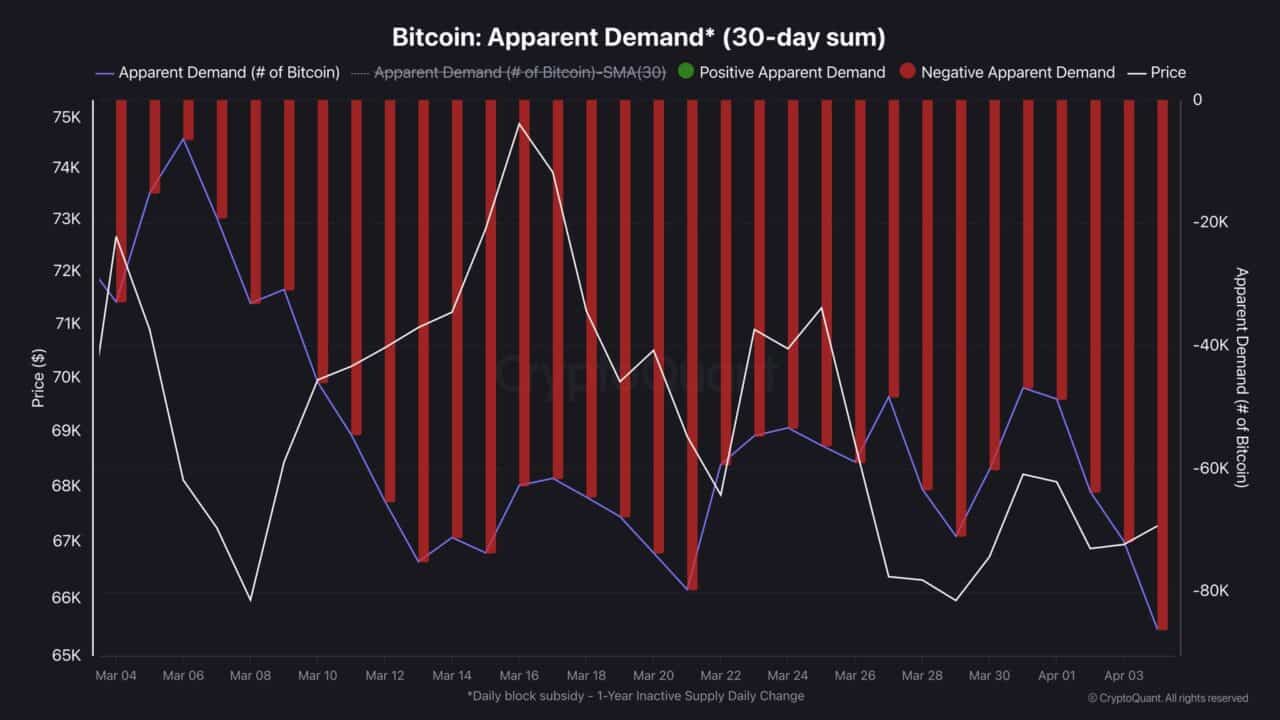
A clear correlation exists between apparent demand and price movements in the market.
A prolonged negative trend in demand generally corresponds with downward pressure on prices. Notably, this represents the lowest reading observed in over a month, amplifying concerns regarding market stability.
Long-Term Holders Shift Towards Distribution
This weakness can also be attributed to long-term holders who are now showing signs of distribution instead of accumulation—a behavior typically associated with minimal selling activity historically.
Data from CryptoQuant reveals that Binary Coin Days Destroyed (CDD) has reached 1; when this figure hits 1 it indicates older coins are being transferred—an event often linked with selling by long-term holders.
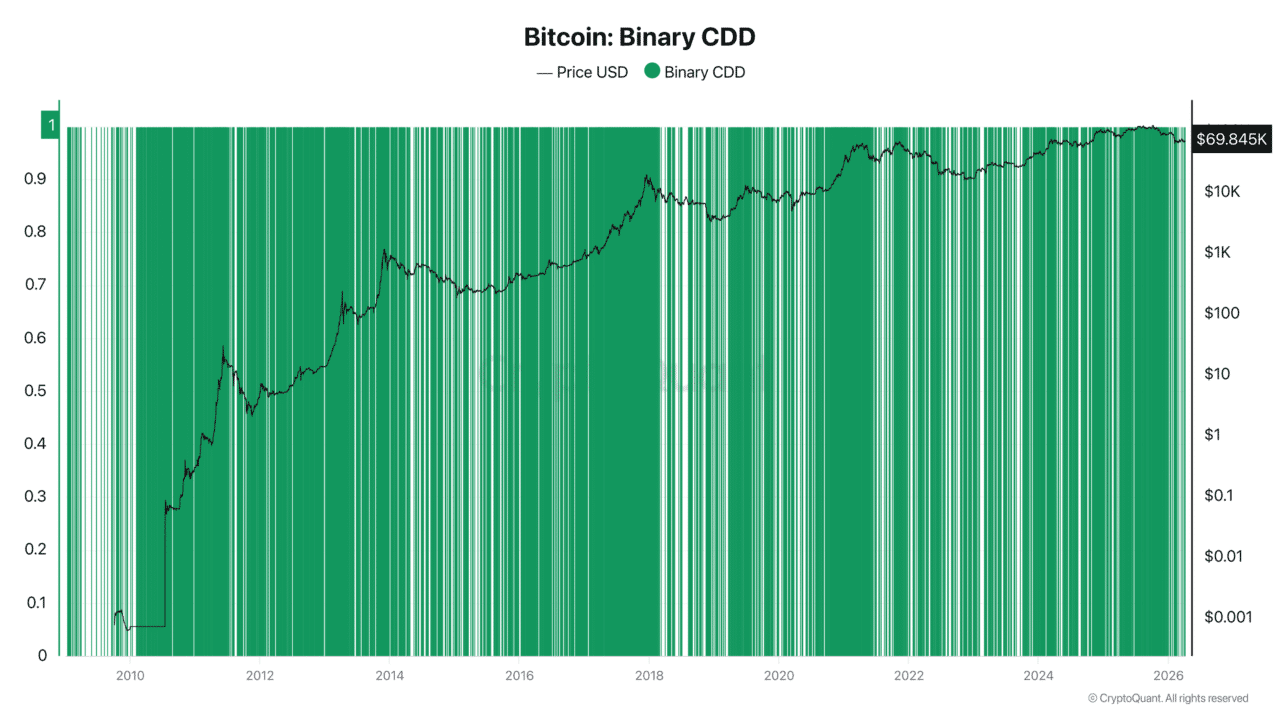
If this trend persists, it could further exert downward pressure on Bitcoin’s price trajectory. Conversely, whales appear to be taking an opposing approach; large stakeholders have increased their activity in response to Bitcoin’s recovery efforts.
The data concerning average spot order sizes indicates that whales—especially larger entities—have been dominating trading activities across major exchanges recently. Their transactions represent a substantial portion of total volume and play a critical role in driving short-term momentum within the market.
This recent rebound suggests that whales may have adopted a tactically bullish stance over at least the past two days regarding $BTC.
The Sustainability of Whale Activity Remains Uncertain
However, depending solely on whale accumulation as an indicator carries inherent risks since whale behavior tends to react swiftly based on changing market conditions. The apparent demand for Bitcoin has declined sharply reaching negative 86K $ BTC , valued around $5 .95 billion indicating poor supply absorption capabilities! Long term investors show signs leaning toward distributions whereas Whales continue accumulating thus creating divergence within marketplace behaviors!
AMBCrypto previously noted significant losses among Bitcoin investors holding between 100 and 10K $BTC , totaling $30.9 billion during Q1 alone—with whales experiencing an average daily loss exceeding $337 million.This context illustrates how even large holders are not immune from losses; periods characterized by accumulation do not always lead directly into sustained upward trends.With long-term holders engaging in distribution while apparent demand signals weak supply absorption—the current momentum driven by whale activity may lack sufficient foundational support necessary for enduring rallies.
A Final Overview