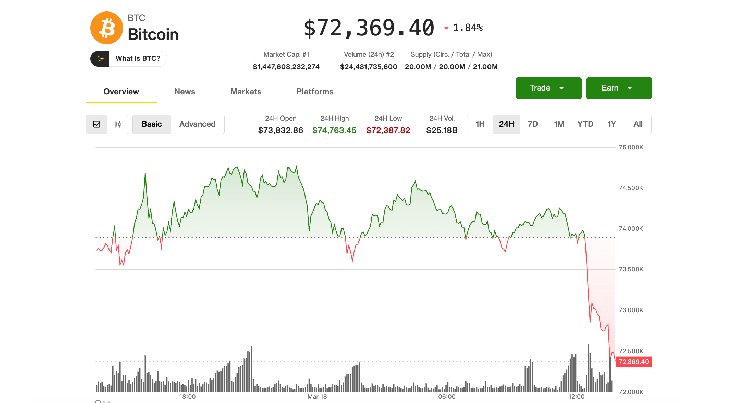
The previously stable price of bitcoin, hovering around BTC$74,191.24, experienced a significant disruption on Wednesday morning due to escalating military tensions in Iran and unexpectedly high inflation figures for February.
The downturn began when U.S. President Donald Trump adopted a more confrontational stance regarding Iran, labeling it the “NUMBER ONE STATE SPONSOR OF TERROR” in a series of posts on Truth Social.
In tandem with this, Iranian state television reported an attack on part of the South Pars gas field.
This incident followed news that Israel had eliminated Iran’s Intelligence Minister Esmail Khatib and that the U.S. had deployed 5,000-pound bunker-buster bombs aimed at missile installations near the Strait of Hormuz—a crucial passage for global oil transportation.
<pThese developments contributed to a sharp increase in WTI crude oil prices, which surged from approximately $92 per barrel overnight to nearly $96.
Shortly thereafter, data revealed that the U.S. Producer Price Index (PPI) for February rose by 0.7%, significantly exceeding expectations of just 0.3%, and up from January’s figure of 0.5%. The core PPI also increased by 0.5%, surpassing expectations but down from January’s rate of 0.8%. Notably, this concerning inflation data was collected prior to the recent attacks against Iran and subsequent spike in oil prices.
This information complicates predictions regarding potential interest rate cuts as elevated oil prices continue to impact market sentiment negatively ahead of the opening bell for U.S. stock markets.
Bitcoin has now dipped to $72,300—a decline of about 2% over the last day—while ether (ETH), solana (SOL), and $XRP have seen drops closer to 3%. Futures tied to major U.S. stock indices shifted dramatically from solid gains into losses nearing about 0.4% across all sectors.
The selloff has also affected precious metals; gold quickly fell by approximately 2.5%, settling at $4,885 per ounce.
The Fed’s Meeting Ahead
Later today, it is anticipated that the U.S Federal Reserve will maintain current interest rates while attention turns towards Chair Jerome Powell’s comments regarding how policymakers view recent economic growth challenges alongside inflationary pressures.
Trump reiterated his calls for lower rates in a post earlier Wednesday adding a political layer to today’s discussions during this meeting.