The Federal Reserve might be preparing for a rather uneventful decision regarding interest rates, but bitcoin is making waves of its own — experiencing an impressive eight-day surge that has many speculating whether it’s finally breaking free from broader economic influences.
Powell Faces Scrutiny: Fed Likely to Maintain Rates Amid Trump’s Critique
The Federal Open Market Committee (FOMC) is set to conclude its meeting on March 17-18 with a widely anticipated announcement: the federal funds rate will remain unchanged at 3.50% to 3.75%. Predictable? Certainly. Irrelevant? Far from it.
While the Fed remains cautious, bitcoin has been on an upward trajectory — enjoying an eight-day winning streak and inching closer to the $75,000 mark, prompting traders to wonder if crypto is beginning to operate independently of traditional market forces. However, let’s not get ahead of ourselves.
Analysts at Bitfinex have poured cold water on the idea of a decoupling between bitcoin and macroeconomic trends. In a note shared with Bitcoin.com News, they highlighted that while bitcoin’s recent performance is impressive, it does not signify a complete departure from prevailing financial conditions.
“The recent rise above $75,000 indicates relative strength; however, labeling this as true ‘decoupling’ would be premature,” Bitfinex analysts conveyed in their report. “What we are witnessing is unique strength within an overarching macroeconomic framework.”
In simpler terms: while bitcoin appears robust — it’s still very much influenced by the same economic factors affecting other assets. According to analysts, this current rally can be attributed to various factors including stabilizing inflows into exchange-traded funds (ETFs), new demand generated by structured products like STRC, reduced leverage following February’s market adjustments, and tightening supply within blockchain networks.
This means that although this rally seems promising — it’s still grounded in macroeconomic realities which are evolving rapidly. Inflation had shown signs of easing slightly; February’s consumer price index data revealed a 2.4% annual increase with core inflation sitting at 2.5%. Not exactly celebratory numbers but sufficient enough for hopes regarding potential rate cuts extending into 2026.
However, rising oil prices changed the narrative dramatically as geopolitical tensions involving Iran pushed crude oil prices towards $100 per barrel—introducing fresh uncertainty around inflation forecasts and compelling markets to reconsider how swiftly the Fed might adjust its policies moving forward—a factor more critical for bitcoin than proponents of “decoupling” may want to acknowledge.
“$BTC may indeed be outperforming other risk assets; yet it hasn’t fully escaped liquidity constraints,” Bitfinex analysts remarked further. “Historically speaking,’decoupling’ often refers merely to temporary divergences during periods when positions are being reset rather than indicating any structural break in correlation.”
This suggests that while bitcoin may appear confident in its movements—it continues responding harmoniously with larger economic indicators such as interest rates and liquidity levels—and currently those signals have intensified considerably.
The inflation risks tied directly back into oil prices—with Brent crude remaining above $100—have already shifted expectations surrounding potential rate cuts further down the line—with some projections now looking toward late-2026 or even reducing anticipated cut counts altogether Higher yields coupled with stronger dollar values do not create precisely favorable conditions for what one could call “crypto independence.”
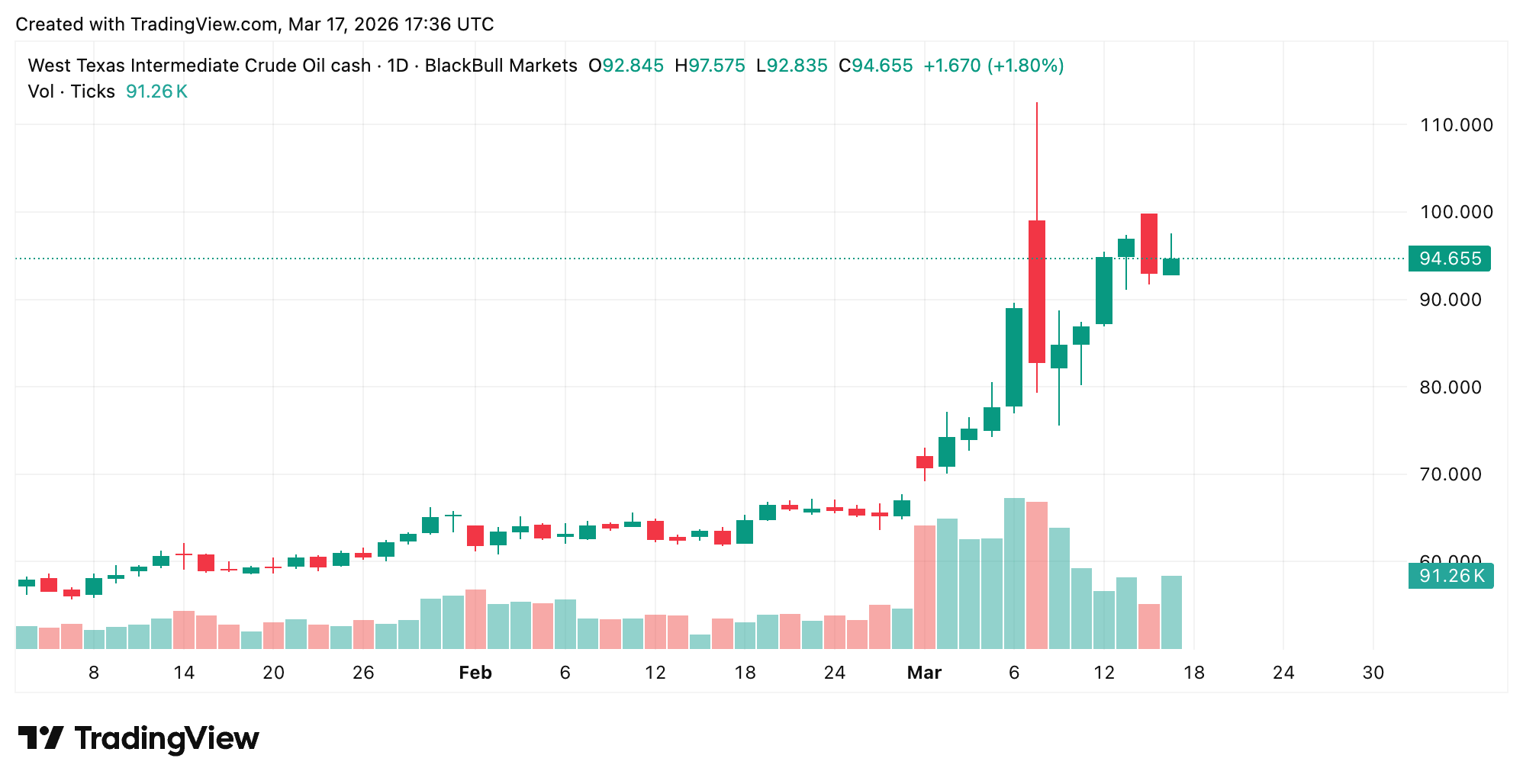
West Texas Intermediate Crude Oil via Blackbull Markets and tradingview.com.
If bitcoin genuinely wishes to detach itself completely from these influences—it must continue ascending despite tightening financial circumstances—a challenge it hasn’t convincingly met thus far.”For genuine decoupling status,” said analysts,”bitcoin needs sustained rallies regardless of constricting fiscal environments … which we haven’t observed definitively yet.” Nevertheless there exists one significant caveat here—
“That being said,” noted Bitfinex experts,”relative strength holds importance.” If $BTC manages consistently staying within the acceptance range between $75k-$78k whilst other risk assets lag behind—that would indicate strong demand driven by spot transactions along with effective supply absorption typically preceding sustained breakout scenarios.”
Phrased differently: maintain these price levels—and things could become intriguing! Fall below them—and suddenly we’re just observing another typical rally amid macro-driven environments putting all eyes firmly focused onto upcoming weeks—not solely dependent upon statements made by The Fed—but also how markets react accordingly!
The press conference led by Powell will likely revisit familiar themes revolving around patience,data dependence,and caution against emerging inflation threats.Traders won’t simply analyze his remarks—they’ll keenly observe real-time reactions exhibited through movements displayed via Bitcoin itself!
If Bitcoin continues climbing amidst high-interest rates alongside tighter liquidity—the notion surrounding possible decouplings deserves renewed scrutiny! Conversely should none materialize well then welcome back once again—to traditional macros where verdicts remain pending!
FAQ 🔎
Is Bitcoin separating itself from conventional markets come year-end?No evidence yet suggests responsiveness towards interest rates,lending dynamics,and overall macro-environment persists actively influencing behavior patterns observed among cryptocurrencies today!
Why does Bitcoin experience growth despite uncertainties stemming directly related back towards The Federal Reserve?A combination consisting mainly outflows seen across ETFs,new sources generating demands plus lowered leverage contribute significantly supporting current upward momentum observed recently!
Which specific pricing level carries utmost significance presently concerning BTC?Sustaining positions between approximately$75000-$78000 proves crucial signaling ongoing resilience amidst fluctuating external pressures encountered daily throughout broader marketplace context!
How do actions taken By Feds influence fluctuations experienced relating specifically pertaining towards cryptocurrency valuations? Evidently elevated lending standards coupled tighter monetary conditions typically exert downward pressure impacting riskier asset classes—including cryptos like BTC specifically over time too !