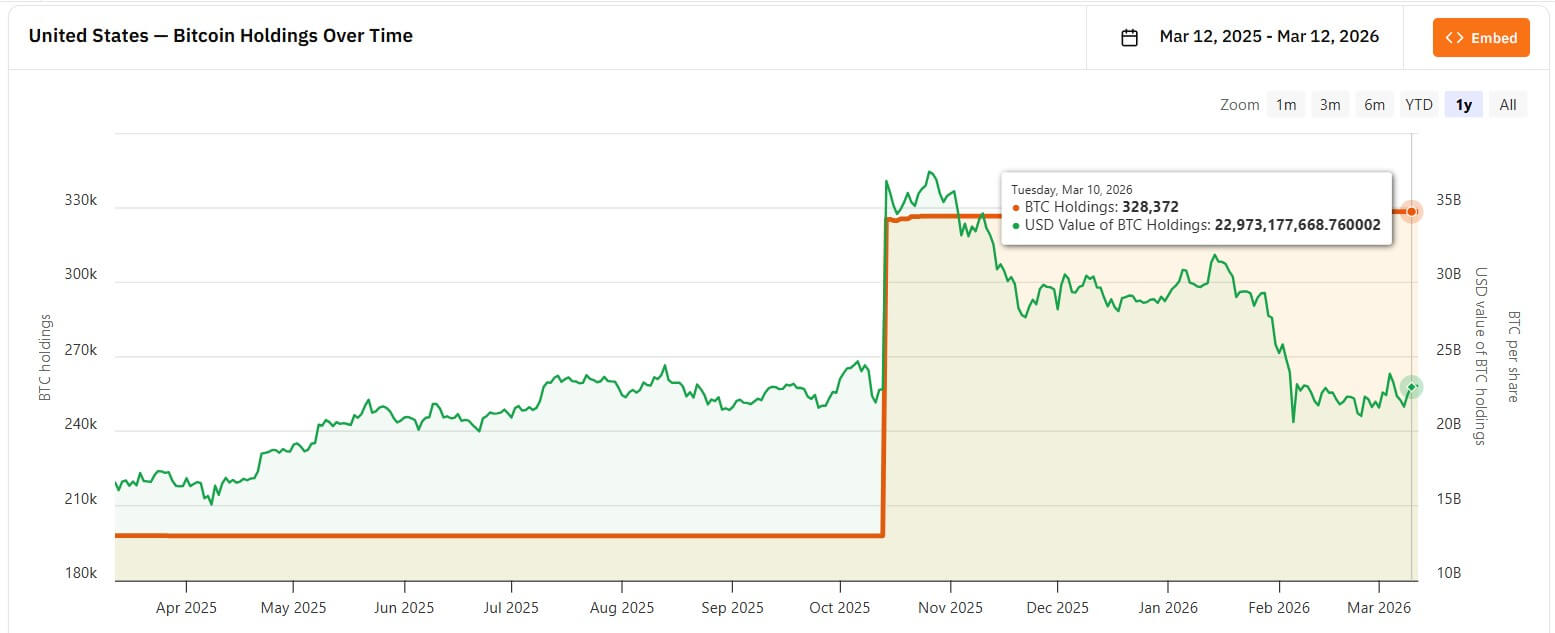
In the initial six days of its conflict with Iran, the United States incurred expenses amounting to nearly half of the current market value of Bitcoin owned by the federal government.
This week, officials informed lawmakers that expenditures related to the war reached at least $11.3 billion during those first six days, as reported by Reuters on March 11.
The $11.3 billion figure was derived from a private briefing for senators held on Tuesday and does not encompass all costs associated with the ongoing conflict.
Additionally, U.S. representatives revealed that approximately $5.6 billion worth of munitions were utilized within just two days of military operations. Several members of Congress indicated they anticipate a request for further funding from the White House.
Assessing U.S. Spending in Relation to Bitcoin
According to data from BitcoinTreasuries—which monitors sovereign and corporate Bitcoin holdings—the U.S. government possesses 328,372 Bitcoins valued at around $70,430 each, totaling approximately $23.13 billion.
This means that spending over six days represents about 48.9% of this federal holding’s current market value; equivalently, this expenditure translates into roughly 160,443 Bitcoins based on an $11.3 billion cost.
The calculations also reveal insights into spending patterns: averaging out to about $1.88 billion per day over those six days suggests that utilizing all 328,372 Bitcoins would fund military activities for approximately 12.3 days at this rate.
A potential supplemental funding request estimated at $50 billion—according to congressional aides speaking with Reuters—would represent about 2.16 times more than what is currently valued in government-held Bitcoins.
It’s important to note that these figures illustrate only a portion of how much money is being spent by the U.S., without detailing how such expenditures are financed during wartime operations.
The White House directive establishing a Strategic Bitcoin Reserve stipulates that any Bitcoin deposited must “not be sold” and should remain as an asset reserve for the United States.
This order also restricts agencies from selling or disposing digital assets except under specific circumstances such as court orders or law enforcement needs—keeping federal Bitcoin holdings separate from typical wartime financial processes.
The Intersection Between War Spending and Inflation: The Role of Bitcoin
Arthur Hayes—the co-founder of BitMEX—has long posited that escalating war expenditures in America could bolster support for Bitcoin in terms of increasing borrowing levels and inflationary pressures while driving demand towards alternative assets outside conventional finance systems.
This year saw Hayes link his views regarding Washington’s unwavering backing for Israel’s conflict against Hamas alongside military spending related to Ukraine; he contended these fiscal obligations would likely continue expanding significantly over time.
“When combined with Ukraine’s costs,” he stated,”the American defense budget is poised for substantial growth.” This escalation will necessitate increased future borrowing which can lead capital waste through prolonged warfare.”
“The only way out…assuming no capital controls are imposed…is purchasing a store-of-value like bitcoin outside traditional systems.”
“If long-term US Treasury bonds provide no safety net…investors will seek alternatives; gold—and most importantly bitcoin—will rise amid genuine fears surrounding global wartime inflation.”
Hayes reiterated similar sentiments one year later indicating persistent increases in military budgets could place additional burdens upon domestic savers.
His argument centers around how modern governments manage financing large-scale prolonged campaigns effectively.
He asserts authorities may guide banks toward lending priorities or encourage them towards acquiring government bonds below-market rates while inflation steadily diminishes real savings values.
Typically funded through debt mechanisms war expenses can elevate dollar circulation within financial ecosystems leading gradually diminishing purchasing power impacting existing currencies thereby enhancing interest toward scarce resources like bitcoin itself!
Within this context,Bitcoin occupies an exceptional position since it isn’t state-issued nor does its supply expand due fiscal strains thus preserving its unique appeal among investors seeking stability amidst volatility!
Citing CryptoSlate’s findings:BItcoin has surged nearly four percent following early February strikes against Iran highlighting why many investors might consider entering emerging markets today!