
According to Rony Szuster, the Head of Research at Mercado Bitcoin, Brazil’s largest cryptocurrency exchange, Bitcoin may be approaching a market bottom as early as next month. This assessment is based on the price of Bitcoin when measured against gold.
The latest peak for Bitcoin in U.S. dollars was recorded in October 2025, reaching approximately $126,000. If this current cycle mirrors previous trends, it could see a downturn lasting until late 2026, as detailed in Szuster’s report shared with CoinDesk.
However, when considering its value relative to gold, the timeline appears different. The highest point for Bitcoin against gold occurred in January 2025. Following a similar pattern of 12 to 13 months would suggest that a potential low could emerge around February 2026 and that recovery might start by March.
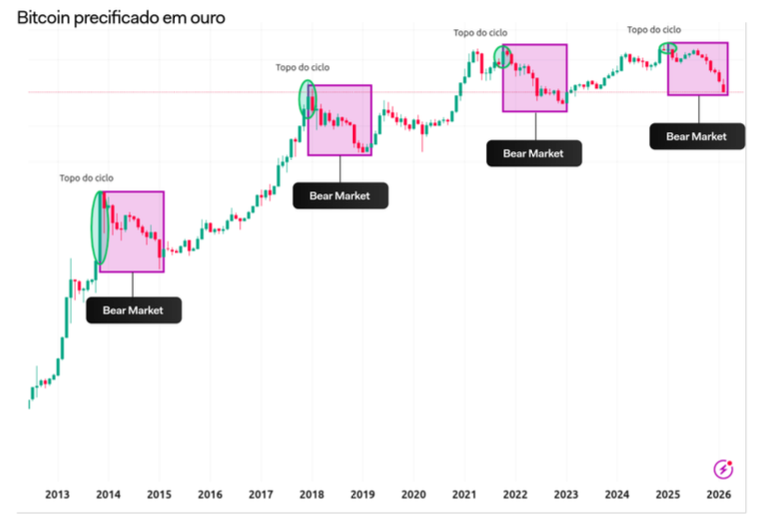
This divergence highlights broader macroeconomic influences at play.
Since Donald Trump began his new term, markets have been impacted by aggressive trade tariffs and domestic institutional conflicts within the U.S., alongside escalating tensions with China and Iran—tensions that have led to ongoing military confrontations.
The World Uncertainty Index indicates that global uncertainty has surged due to these factors. Gold has thrived amid this climate; its price increased over 80% within the past year to reach $5,280. As investors shifted their capital towards bullion assets like gold, Bitcoin started losing ground against it sooner than it did versus the dollar according to analysts from Mercado Bitcoin.
Additionally, exchange-traded funds (ETFs) have exerted further pressure on prices. Since November alone saw approximately $7.8 billion exit spot bitcoin ETFs—around 12% of their total value which stands at $61.6 billion.
This sell-off driven by fear only tells part of the story.
While reactive investors are moving away from Bitcoin during this downturn phase known as an accumulation zone for larger players or “whales,” significant investment firms such as Mubadala Investment Company and Al Warda Investments from Abu Dhabi are increasing their exposure through spot bitcoin ETFs since mid-February according to reports.
In light of these developments, Szuster advises investors to strategically build their positions using dollar-cost averaging techniques so they can capitalize on prevailing market fears while avoiding timing pitfalls associated with investments.
“Historically speaking,” he noted,” purchasing during times of fear tends to yield better results than buying during periods of euphoria.” He added that while it’s uncertain if we’ve hit rock bottom yet—it does indicate we’re statistically entering an area where optimal average prices are typically established.”