
According to network economist Timothy Peterson, Bitcoin may reach $122,000 within the next ten months. His prediction is grounded in historical monthly performance data that extends back to 2011.
Peterson shared his insights on the social media platform X, highlighting that Bitcoin has experienced positive closures in 12 out of the last 24 months. Historically, this pattern has been associated with an impressive 88% likelihood that Bitcoin’s price will increase over a ten-month period. Using this statistical analysis as a basis, he anticipates an average return of approximately 82% from current levels, suggesting a potential price around $122,000 per coin.
Understanding the Data
This model evaluates how often positive months occur rather than focusing on the extent of gains made during those periods. This distinction is crucial; even if Bitcoin experiences minimal growth or remains stagnant in value, it could still maintain favorable statistical conditions.
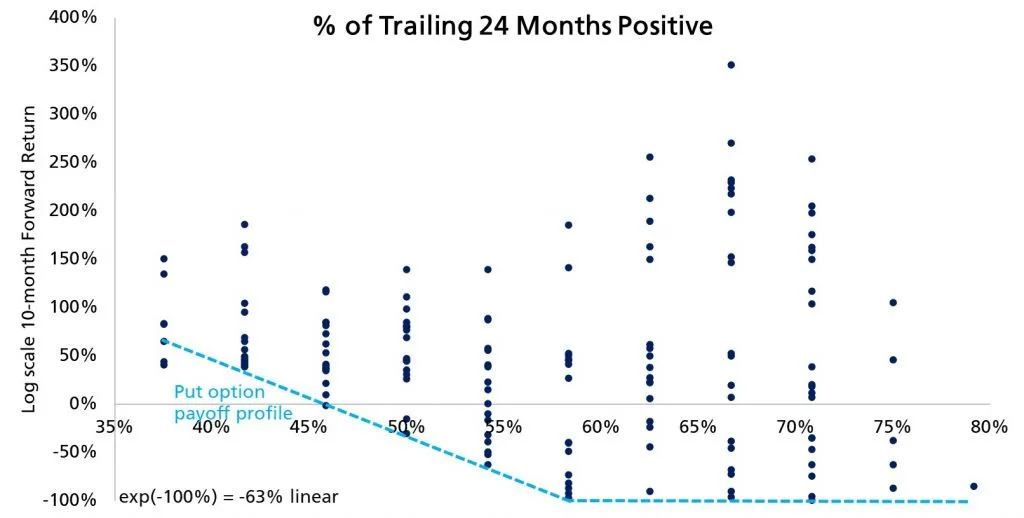
Peterson characterizes his analytical tool as an “informal” reversal indicator instead of a precise forecasting tool. It indicates when probabilities shift towards higher prices but does not specify how quickly or significantly these changes might occur.
At present, broader sentiment surveys indicate a predominantly cautious atmosphere among market participants. This contrast between statistical probabilities and trader sentiments frequently arises during transitional phases within cryptocurrency cycles.
Bullish Sentiment Persists Amid Doubts
Despite recent market consolidation trends, several prominent institutions continue to express optimism about future prospects for Bitcoin. Analysts at Bernstein have previously characterized the current downturn as one of the milder bearish phases seen throughout Bitcoin’s history and have set a target price of $150,000 for 2026.
Additonally, analysts from Wells Fargo foresee significant capital inflows into both Bitcoin and equities shortly due to seasonal liquidity factors and evolving risk appetites among investors.
The Model’s Simplicity vs Today’s Market Complexity
Skeptics contend that since its inception in 2011, Bitcoin’s landscape has undergone substantial transformation. Earlier cycles were primarily driven by retail investors; however today institutional investments along with spot ETFs and macroeconomic shifts play more critical roles in determining prices.
Pursuing this probabilistic approach resembles coin-tossing logic: if an event historically occurs half the time during single trials then over multiple periods there is considerably increased probability for at least one successful outcome occurring. While mathematically valid—financial markets are constantly evolving—this framework must adapt accordingly.
The liquidity environment surrounding Bitcoin in 2025 differs greatly from what it was ten years ago; whether or not historical signals like Peterson’s remain impactful amid institutional influences presents key challenges for contemporary investors moving forward.
Currently available data suggests favorable odds leaning upwards toward potential growth ahead; however achieving that anticipated milestone near $122k will rely less solely upon past trends but rather on real-time responses observed within today’s capital flows over forthcoming months.