Bitcoin has begun 2026 in an unprecedented manner. For the very first time, the cryptocurrency recorded losses in both January and February within a single calendar year. Data from CoinGlass reveals that Bitcoin dropped by 10.17% in January, followed by an additional decline of 12.12% throughout February.
This consecutive downturn is notable when compared to over ten years of monthly performance data. Historically, early-year results often set the trajectory for longer market cycles; however, this year deviates from that trend as Bitcoin’s price falls below $70,000 amid growing institutional withdrawal.
Price Trends and ETF Withdrawal Patterns
January has traditionally been a mixed month for Bitcoin—sometimes positive but frequently negative—with average returns being relatively mild at around +2.81%, while median returns hover near zero.
Even during years when January ended negatively, February typically brought recovery gains averaging +11.31%, with a median close to +11.68%. Exceptional months include gains like 61.77% in 2013 and more recently 43.55% in early 2024.
However, some Februaries such as those in 2014, 2020, and now again recently have seen declines—but never paired with such significant losses starting from January as observed this year.
The unique combination of back-to-back negative months at the start of 2026 lacks any historical precedent according to seasonal heatmaps which usually show improving momentum heading into spring months like March (+12.21%) and April (+13.06%). Later parts of the year—particularly October and November—often yield strong returns too; September remains an outlier with average drops around -3.08%, making this early-year slump even more striking.
Current Market Behavior & Institutional ETF Impact
At present trading levels near $68,278—a roughly three percent drop on the day—and daily volume contracting to approximately $37.58 billion—the price is positioned below key short- (7-day average: $68,677) and medium-term (30-day average: $78,588) moving averages indicating waning upward momentum rather than strength building up.
A further source of pressure comes from U.S.-based spot Bitcoin ETFs experiencing substantial net outflows totaling over $410 million on February 12 alone according to SoSoValue analytics data—highlighting increased risk aversion among institutional investors who previously helped fuel rallies through inflows but are now withdrawing support during this fragile phase.
The Altcoin Season Index tracked by CoinMarketCap has also plunged sharply down to a reading near thirty-four after recent declines suggesting traders are retreating towards liquidity preservation instead of chasing speculative altcoin opportunities currently favored less amidst uncertainty about capital allocation strategies going forward.
Reemergence Of Long-Term Technical Signals
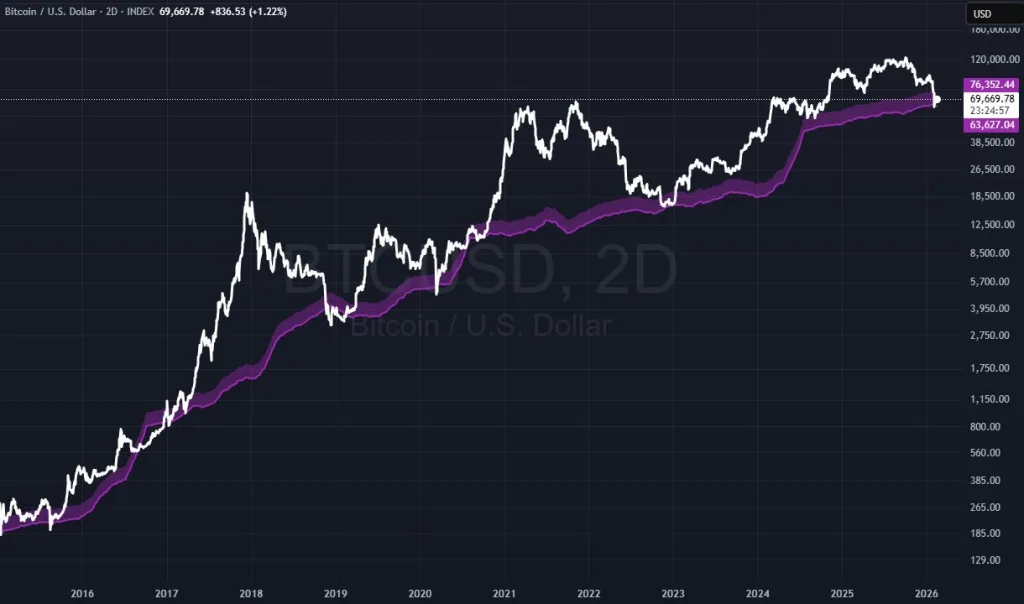
Cycling analysts point toward revisiting long-term trend indicators historically linked with major market inflection points—for example Master Of Crypto notes how Bitcoin spent nearly two hundred seventy days beneath its critical two-hundred-week moving average before reclaiming it again:
Bitcoin spent ~270 days below the 200W MA before reclaiming it.
Then another ~220 days sideways chop before breakout.
Almost half a thousand days testing one key level.
Now price pulls back toward 200W MA once more.
If history repeats itself, this zone isn’t final—it’s…pic.twitter.com/xEsqu9v4tU.
This prolonged interaction spanning close to five hundred days between consolidation phases may be repeating itself now as prices approach that same multi-year moving average again signaling potential pivotal moments ahead for market directionality.
Additionally noted is how current spot prices approach estimated miner production costs—a metric highlighted by analyst Michael Van De Poppe—which tend historically align closely with cycle bottoms seen during previous bear markets such as those occurring around years like 2015, 2018, and 2022.
Together these signals suggest possible foundational support zones forming despite recent weakness implying potential groundwork for future recovery once broader conditions improve sufficiently across macroeconomic or crypto-specific catalysts alike.
Atypical Start To The Year Amidst Historical Baselines Returning
<strong>Source: X